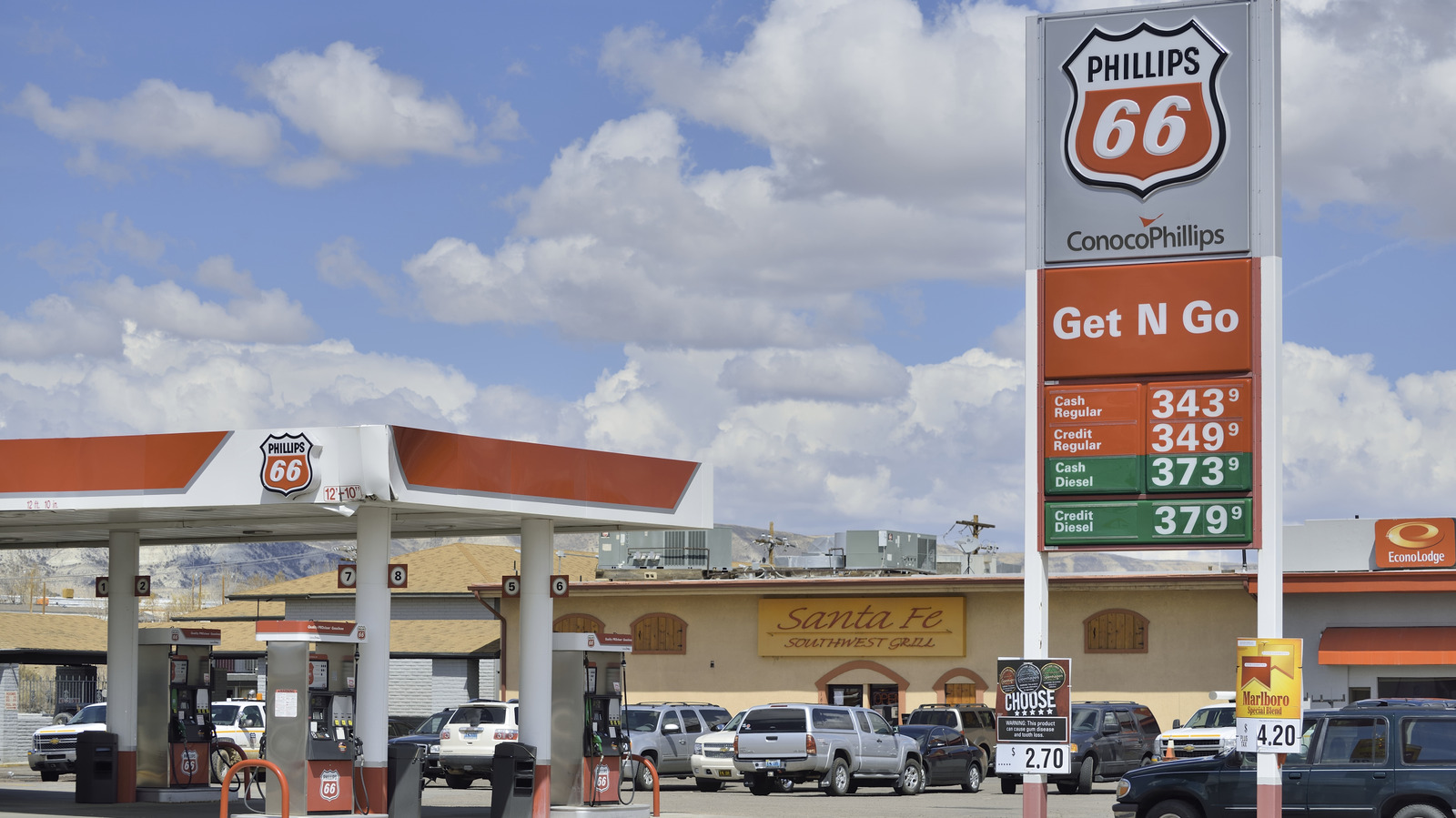
Today, Phillips 66 is headquartered in Houston, Texas, with 11 refineries, 200 terminals, and 7,000 branded sites globally. Among its portfolio of brands is Conoco, another major U.S. brand that originally expanded throughout the Rocky Mountain region, including Utah and Colorado. It also owns 76 (formerly Union 76), known for its orange ball logo and West Coast dominance (founded in Southern California). Internationally, it has JET, a brand operating in European markets like the U.K., Germany, and Austria; meanwhile, the Coop brand operates in Germany, France, and Italy.
Phillips’ history, however, started far more humbly and reaches back well over a century. In 1917, brothers Frank and L. E. Phillips founded the Phillips Petroleum Company in Bartlesville, Oklahoma. What started out as an oil exploration company quickly expanded into refining in the 1920’s. In 1927, they opened the first Phillips 66 station in Wichita, Kansas. This brand mushroomed across the Midwest, perhaps due in no small part to a monumental American project happening at the same time.
In 1926, the Bureau of Public Roads started building the nation’s very first Federal highway system. Part of that system was U.S. Route 66, which wound 2,448 miles across eight states, basically connecting Chicago to Los Angeles. As legend has it, the name of their first station was inspired by a series of oddly coincidental occurrences: An automobile was driven on a stretch of Route 66 near Tulsa, Oklahoma, hitting 66 miles per hour in the process. It was allegedly testing a new version of Phillips gasoline, one with a specific gravity around 66 — all while on Route 66 — and voilà, instant name recognition.
66 was a lucky number
The larger umbrella company that now owns all of these brands is ConocoPhillips, a unified enterprise involved in every aspect of the petroleum business, from exploration and drilling to refining and marketing its products. In 2012, it split in two, making ConocoPhillips the “upstream” company, one that’s focused primarily on exploration and production of crude oil and natural gas deposits. Meanwhile, Phillips 66 became the “downstream” company that refines and markets its products under all of its other brands. Any “middlestream” operations — like the processing and transportation of natural gas — are divided up between the two.
In May of 2024, ConocoPhillips acquired Marathon Oil in a deal valued at $22.5 billion. Upon completion of the acquisition in November of that same year, Marathon became a wholly owned subsidiary of ConocoPhillips and was no longer publicly traded on the stock market. Each share of Marathon Oil’s common stock was converted into 0.255 shares of ConocoPhillips common stock, and cash was paid out for smaller, fractional shares. This practice of competitor mergers and acquisitions isn’t uncommon, as Chevron owns a few different brands as well.
The iconic Phillips 66 “shield” sign also has an interesting origin story. Unveiled in 1930, the burgeoning company ingeniously “borrowed” the same shape as the U.S. highway route markers, something else that was just becoming recognizable in its own right. And just like that, it had instant sign recognition — one that left an indelible mark on both car and pop culture.