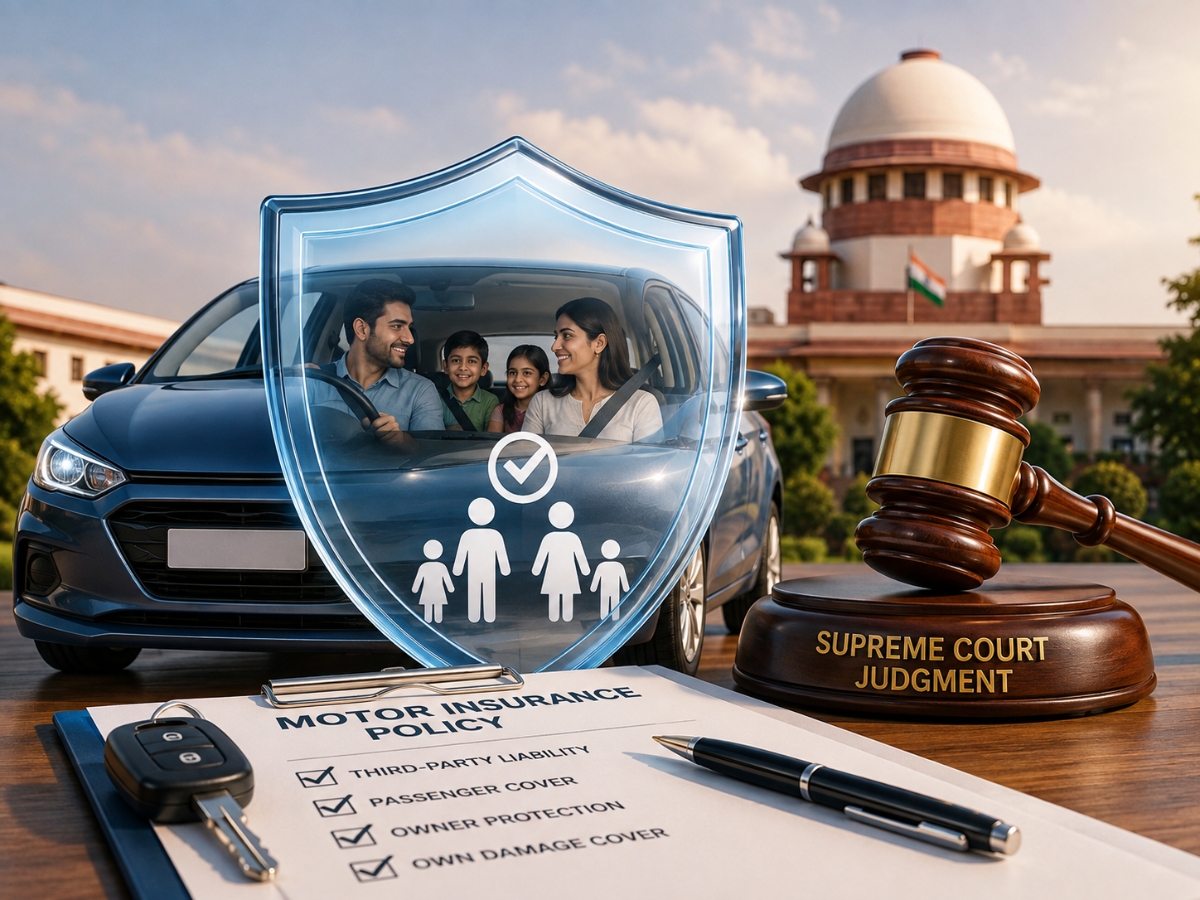
Are you thinking of renewing or buying car insurance? One important question to ask yourself before you hit “Buy Now”: Does your policy actually cover the people travelling with you?
In a landmark judgement, the Supreme Court has made it clear that a comprehensive (or package) motor insurance policy is quite different from a basic third-party insurance policy. Third-party insurance is compulsory by law, but it does not automatically provide the same level of protection as comprehensive cover, particularly for the vehicle owner, passengers, or damage to your own car.
The verdict came while hearing an appeal filed by National Insurance Company against a Telangana High Court order and is the first in the country in a conspiracy case.
Why The Matter Went To The Supreme Court
This is a case of T. Ramu, who died in 1996 when his Maruti 800 was allegedly hit from behind by an unidentified lorry when he was returning from Tirupati. As the police could not trace the offending vehicle, his family claimed compensation under the comprehensive insurance policy on his own car.
The Motor Accident Claims Tribunal dismissed the claim, holding that no separate premium was paid for the personal risk of the owner. However, the Telangana High Court reversed the decision, awarding the family Rs 1,000,500 along with 7.5% annual interest, observing that the comprehensive policy covered the owner travelling in the vehicle.
The Supreme Court has confirmed the High Court ruling. It is well settled that the courts should not be hyper-technical in matters of motor accident claims. As rightly submitted by the claimant-respondents, as per the circular of IRDA dated 16.11.2009, the insurance companies are liable to pay the compensation for any occupant in the vehicle under the comprehensive/package policy. We therefore see no reason to disagree with the reasoning adopted by the High Court.
Third-party Or Comprehensive – What’s The Difference?
The judgement also merely explains the various types of motor insurance.
Section 146 of the Motor Vehicles Act provides for third-party insurance as the minimum level of insurance. It protects you from liability if your car injures, kills or damages someone else’s property. But it doesn’t cover damage to your own vehicle and it doesn’t automatically cover any occupants travelling with you.
A comprehensive or package policy, however, offers wider protection. Besides third-party liability, it can cover the owner, the passengers or the occupants of the vehicle depending on the terms of the policy. The Supreme Court has directed the insurers to clearly display these benefits on their websites in a simple-to-understand format.
Optional Own Damage Cover is also available to pay for repairs or replacement of your own vehicle if it is damaged in an accident, fire, theft or other covered event.
Commercial vehicle insurance policies typically include coverage for the vehicle, goods carried and eligible occupants, as well as third-party liability.
A Simpler Insurance System Could Soon Be Introduced
The Court also referred to the Insurance Regulatory and Development Authority of India’s (IRDAI) move to introduce a more explicit four-layer insurance structure for private vehicles.
The proposed framework would first offer the mandatory third-party-only policy to every buyer. They could also choose additional covers such as legal liability cover for passengers or pillion riders, personal accident cover for the owner and occupants and an own-damage cover for the vehicle.
Additionally, as an aid to clarity, the Court recommended that insurers provide every customer, buying online or offline, with a simple customer option form. The form would outline the required policy, optional coverages, their benefits and their premiums. Buyers could then choose extra protection using simple checkboxes rather than hidden policy terms.
What It Means For Car Owners
This ruling provides a timely reminder that motor insurance policies are not all the same. While buying only the minimum third-party insurance required by law may be within the law, it may not be sufficient to protect you, your passengers or your own vehicle after an accident. Knowing the difference between basic and comprehensive cover when you purchase a policy could save you unexpected financial loss when you most need insurance.
Also Read: Why Are Zepto, IndiGo, Physics Wallah And Others Fined by Regulator? Their Online Shopping Tricks Revealed
Priyanka Roshan
Priyanka Roshan is a business writer and assistant editor at the NewsX website who tracks everything from stock market swings and corporate earnings to personal finance trends and policy shifts. Known for turning fast-moving business developments into sharp, reader-friendly stories, she combines speed, accuracy, and a data-driven approach to break down complex financial news for everyday audiences.
With over 9.5 years of newsroom experience, Priyanka has worked with leading media organisations, including Bussiness, Times Now, and Ping Digital, covering diverse beats such as business, politics, technology, auto, travel, sports, and the world. From live breaking news desks to SEO-led digital storytelling, she specialises in creating engaging content that keeps readers informed without overwhelming them.
The post Third-Party Or Comprehensive Insurance Policies? Supreme Court Explains Which Motor Insurance Actually Covers Passengers appeared first on NewsX.