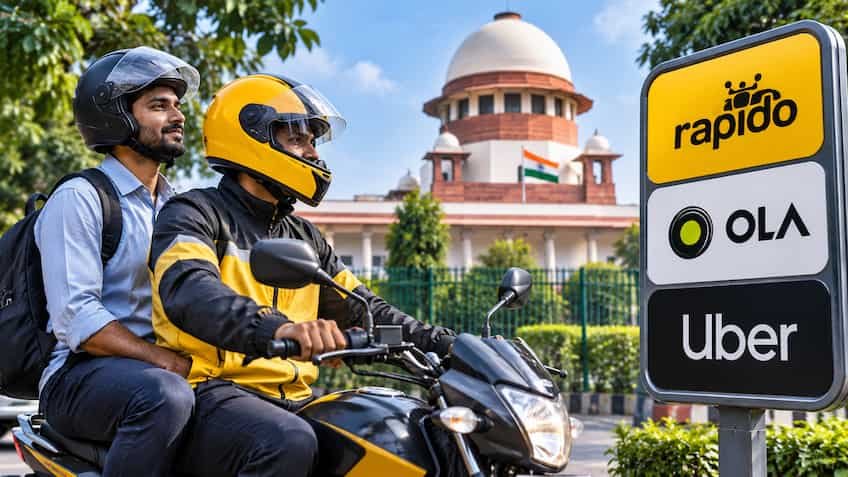
New Delhi / Bengaluru: The country's largest court i.e. the Supreme Court has given a historic and big relief to the app-based bike taxi services companies Ola, Uber and Rapido as well as millions of passengers traveling daily. The Supreme Court has completely rejected the Karnataka government's Special Leave Petition (SLP) which sought to re-impose a ban on bike taxi services within the state. After this decision of the Supreme Court, now the operation of bike taxis will continue without any interruption on the roads of entire Karnataka including Bengaluru. The bench of Justice Satish Chandra Sharma and Justice N Kotishwar Singh, while hearing this case, made very important observations and made it clear that instead of completely shutting down a service, making appropriate rules for it i.e. regulating it is a much better option. What is the whole matter and why was there an uproar? The legal and administrative battle over bike taxi services in Karnataka was going on for several years. Following intense pressure from the state's auto rickshaw and cab unions, the Karnataka government had taken a tough stance on the commercial use of two-wheelers with private number plates or white-boards. The government's argument was that motorcycles cannot be registered as passenger transport vehicles under the Motor Vehicles Act and this also increases the problem of traffic jams. On this basis, operation of bike taxis was banned in the state. However, aggregator companies like Ola, Uber and Rapido had approached the Karnataka High Court against this decision. On January 23, 2026, the division bench of the Karnataka High Court, while ruling in favor of the companies, had lifted the ban on bike taxis and directed the transport department to consider the permit applications. The Karnataka government and five auto-taxi driver associations had challenged this order of the High Court in the Supreme Court. Justice Satish Chandra Sharma's big comment: "Bike taxi is safe for young girls"
During the hearing, the Supreme Court bench not only looked into the legal aspects but also kept in mind the everyday challenges and economic condition of the common man. While delivering the verdict, Justice Satish Chandra Sharma mentioned a conversation he had with young women working in his own office, which has now become a topic of discussion. Justice Sharma, while addressing the lawyers present in the court, said that he had asked the young girls of his office how they come to office every day. In response, the girls said that they use bike taxis because they do not have enough money to book a cab. When Justice Sharma asked them why they did not come by auto rickshaw, the girls told that the fare for an auto was five times more than that of a bike taxi. Justice Sharma emphasized that the bike taxi is equipped with a GPS tracking system, due to which it is quite safe for young girls and working women to travel. The service is running in 25 states of the country, so why is it stopped in Karnataka? The Supreme Court rejected the arguments of the Karnataka government that bike taxis increase traffic jams on the roads. Taking a practical approach, the bench questioned that a motorcycle occupies much less space on the road compared to a car, so how can it increase traffic jams. Further, the Court also underlined that bike taxi services are already running successfully in 25 states of India and the guidelines of the Ministry of Road Transport and Highways (MoRTH) of the Central Government also allow motorcycles to be used as contract carriage. The Supreme Court bluntly said that new modes of transport are emerging with technology and time, therefore the state government should give up its insistence on banning them and should make a transparent regulatory policy to protect the interests of passengers and drivers. Victory for lakhs of commuters and gig workers of Bengaluru. This decision of the Supreme Court will have a direct impact on lakhs of people living in IT hubs like Bengaluru and other cities of Karnataka. According to the data presented in the court by the aggregator companies, about 4.5 lakh passengers in Karnataka use bike taxis every day to reach their destination and for last-mile connectivity. Students, IT professionals and middle-class families are completely dependent on these services to save time and avoid expensive auto-cab fares in Bengaluru's severe traffic jams. Along with this, this decision has also proved to be a lifeline for thousands of bike taxi captains i.e. gig workers, whose livelihood depends on this platform. Shock to auto unions, what will happen next? On the other hand, this decision of the Supreme Court has dealt a big blow to the Karnataka State Private Transport Federation and local auto unions. Expressing disappointment over this decision, the unions have demanded the state government to bring a special ordinance to stop bike taxis. At the same time, senior officials of the state transport department say that they will study the copy of the detailed order of the Supreme Court and only then the further strategy will be decided. Legal experts believe that after the Supreme Court upheld the High Court order, the Karnataka government is now left with no other option but to give legal recognition to bike taxis and set licensing and safety standards for them.