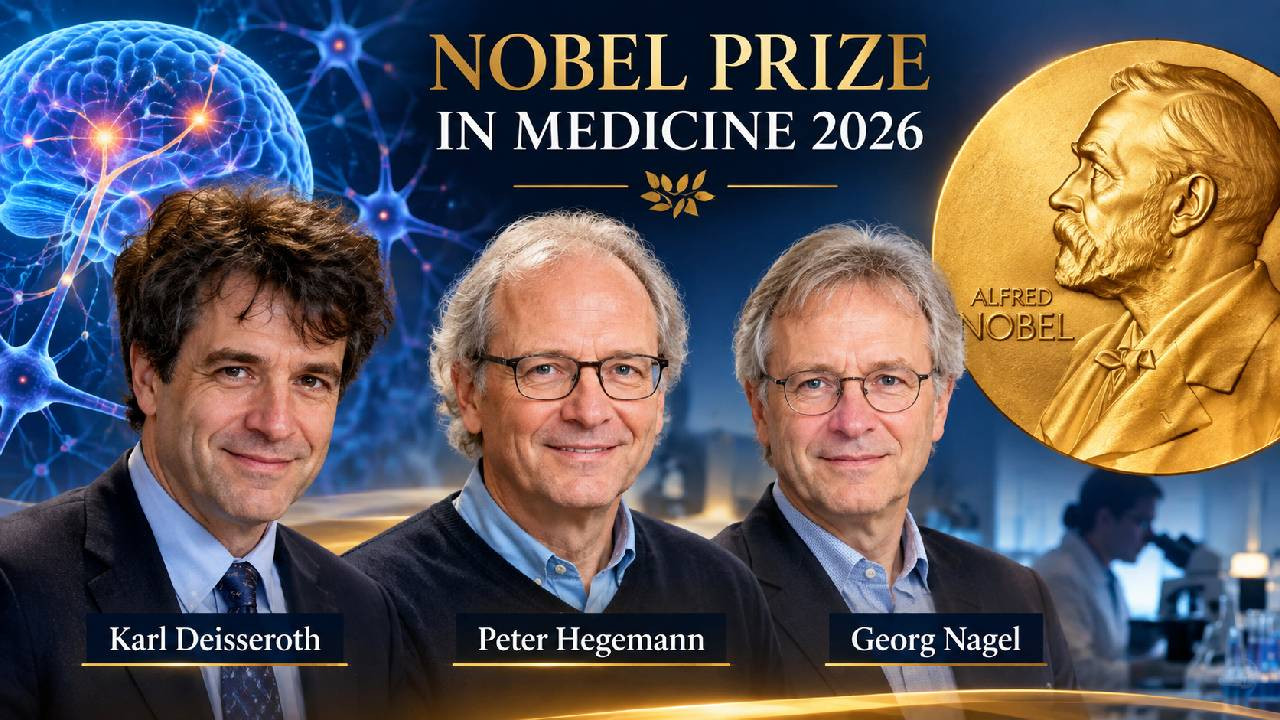
The Nobel Prize in Physiology or Medicine was announced on Monday at the Karolinska Institute in Stockholm, Sweden. With this announcement, this year’s Nobel Prizes formally began. American scientist Carl Deisseroth and German scientists Peter Hagemann and Georg Nagel were chosen for scientific achievements that reshaped modern ways of understanding the functioning of the brain and nervous system.
His research gave scientists the ability to observe and control when individual nerve cells activate and when their activity can be stopped. This is why his discovery is considered a very impressive achievement in the field of neuroscience.
After all, for which discovery did you get such a big honor?
All three scientists have been honored for their scientific discoveries related to light-gated ion channels and optogenetics. The specialty of this research is that the activity of some nerve cells can be controlled with the help of light. Normally, the billions of neurons in the brain constantly communicate with each other through electrical and chemical signals. Understanding the role of a particular cell remained a very difficult task for a long time. In this direction, optogenetics has given scientists an experimental method through which the work of specific neurons can be studied by activating or deactivating them in a more precise manner.
How did optogenetics change neuroscience?
The development of this technology created a significant change in brain research. Scientists are no longer limited to simply recording that activity is occurring in a neuron, but can also understand its effects by changing its activity in a controlled manner. Through this, it has become possible to study the neural circuits related to behavior, memory, movement and other brain functions in a more precise manner. This same scientific basis may prove useful in future efforts to understand many complex diseases related to the nervous system.
What was the contribution of the three scientists?
Peter Hagemann played an important role in the discovery and understanding of light-sensitive proteins and their function. His research with George Nagel laid the foundation for later techniques for controlling neurons with light. Carl Deisseroth was instrumental in developing this scientific concept into a widely used optogenetics technique in neuroscience. This joint scientific journey opened the way to examine the extremely complex activities of the brain at different levels in the laboratory.
What is the prize money this year?
The total prize money for the 2026 Physiology or Medicine Nobel Prize is reported to be 12 million Swedish kronor. This amount will be shared among the three winners as per the rules of the prize. With the announcement of the Nobel Prize, the world will now keep an eye on the remaining prestigious awards of this year.
Who got the Nobel Prize in Medicine last year?
The 2025 Nobel Prize in Physiology or Medicine was awarded to Mary E. Brunko, Fred Ramsdell and Shimon Sakaguchi. The three scientists were honored for their discoveries related to a mechanism in the body’s immune system that plays an important role in preventing the immune system from unnecessarily attacking its own tissues. This year’s award focuses on scientific achievements in neuroscience and understanding the activities of nerve cells.
Now the turn of which Nobel Prizes?
After the announcement of the medicine prize, Nobel week will see announcements of prizes in other categories including Physics, Chemistry, Literature, Peace and Economics. Every year, through these awards, people or institutions who have made extraordinary contributions in the fields of science, literature, peace and economy are honored at the global level.