
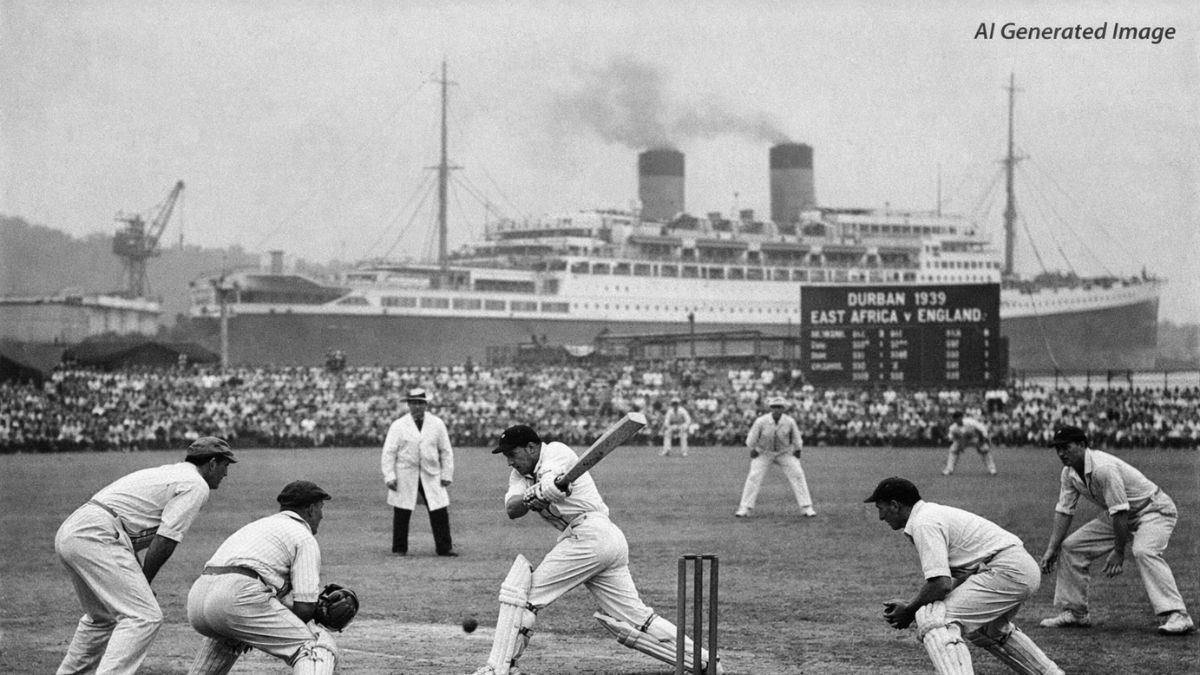
When England left the match midway to catch the ship, the match against South Africa lasted for 12 days; Story of Timeless Test

Timeless Test 1939 East Africa vs England: Cricket is called a game of uncertainties. Many times this game writes such a story that it becomes very difficult for common people to believe. Sometimes the winning team loses, and sometimes the team standing on the verge of defeat turns the match. This thrill makes cricket the most interesting game in the world.
Today we will tell you about that moment in cricket history. test match We are going to tell about this game, which changed the definition of the game. A contest which lasted not for 5 days… not for 7 days… but for 12 days, and the surprising thing is that even after this there was no result.
Which format is considered real cricket?
Three formats are played in international cricket – Test, ODI and T-20. Test cricket lasts for 5 days, ODI for 50 overs and T-20 for 20 overs. test cricket Has always been considered real cricket. This is the biggest test of a player’s technique, patience and mental strength, but even though today Test matches end in 5 days, there was a time when matches were played without any time limit… and during this period, the longest match in the history of cricket was played – Timeless Test.
How many days did the historic match last?
This historic match was played in 1939 between England and East Africa (now called South Africa). At that time there was no fixed time limit for the match – that is, the game continued until the result was declared. The competition between the two teams started and the game went on… one day… five days… eight days, 8… 10 days… and then the 12th day also came… but what happened after that was even more shocking.
Why did the match have to be stopped on the 12th day?
Despite the match continuing for 12 days, there was no result. Ultimately the match had to be stopped because the England team had to catch a plane to return to their country. Yes… if the team had missed the ship, they would have had to wait several more days. For this reason, this match which lasted for 12 days had to be declared a draw.
Match recorded in Guinness World Record
This match became the longest test match in cricket history and was also recorded in the Guinness World Records. It is impossible to play such a match in today’s times. However, even now a reserve day is kept in big matches, like in the final of the ICC World Test Championship… but this record of a Test match lasting 12 days still remains intact.
There is hardly any story more strange and exciting than this in the 150 year history of cricket… and that is why it is known as ‘The Abandoned Timeless Test’. This match was played between 3 March and 14 March 1939 in Durban, South Africa.
1. What was meant by ‘Timeless Test’?
In that era, no time limit was set for some test matches (like today it is 5 days). The rule was that the match would continue until one team wins. Its purpose was to eliminate the possibility of a draw.
2. What happened in the match? (10 days game)
- Batting in the first innings, South Africa scored 530 runs in 202.6 overs, in response to which England’s first innings was reduced to 316 runs in 117.6 overs.
- South Africa scored 481 runs in 142.1 overs in the second innings and gave England a huge target of 696 runs to win.
- England batted brilliantly while chasing this impossible target. By the 10th day of the game, England had scored 654 runs at the loss of 5 wickets in 218.2 overs. They needed only 42 runs to win and their 5 wickets were safe.
- For South Africa, Peter van der Bijl (125) and Dudley Nourse (103) played brilliant century innings in the first innings. Whereas, for England, Les Ames scored 84 runs and Eddie Painter scored 62 runs.
- In the second innings, Allan Melville scored 103 runs and Peter van der Bijl scored 97 runs for South Africa, while for England, Eddie Edrich scored 219 runs and Wally Hammond scored 140 runs.
3. Why did the match have to be stopped?
Heavy rain started in the evening on 14 March, the 10th day of the match. The England team had to catch a ship named ‘RMS Athlone Castle’ from Cape Town, which was going to take them back to England. If he had not caught the train that evening, he would have missed his plane. The next ship was available several weeks later. With the mutual consent of the captain and the officials, the match was declared a ‘draw’, because the England team had to leave the field and run to catch the ship.
4. Some unique statistics of the match
The match lasted for a total of 12 days, in which there were 2 days of rest and 10 days of play. However, one day it got washed away due to rain. During this period a record 1,981 runs were scored. A total of 5,447 balls were bowled in the entire match. England’s William Edrich scored 219 runs in the second innings, which was the highest individual score in an innings for both the teams.
5. What was the impact on cricket?
Considering the fatigue of this match and its inconclusive ending, the ICC decided that a fixed time limit (5 days) would be fixed for future Test matches. After this the concept of ‘Timeless Test’ ended forever.
Which ship stopped the timeless test?
- That historic ‘Timeless Test’ of 1939 not only changed the rules of cricket, but the story of that ‘ship’ still thrills cricket lovers. The name of the ship by which the England team had to return was RMS Athlone Castle. It was a British passenger liner, built in 1935 in Belfast, Northern Ireland.
- This ship was 220 meters long. It had accommodation for about 780 passengers. Its speed was about 20 notes.
- On 14 March 1939, the 10th day of the match, England had to take a train from Durban at 8:05 pm to catch the plane. If he had left that train, he would have missed his plane, which was scheduled to depart from Cape Town.
- After this visit in 1939, the ship was used as a troop ship during World War II.
What changes were made in the rules after the Timeless Test?
After the Timeless Test, major changes were made in many rules of cricket, so that such a situation does not arise in future. These rules include;
- Time Limit: After this match of 1939, ‘Timeless Tests’ (matches without time limit) were stopped forever and the 5-day Test format became mandatory.
- Length of over: In old times, the number of balls in an over was not fixed. There were 4 ball overs till 1889, then 5 balls till 1900 and sometimes even 8 ball overs in Australia. Now at the international level it is played with only 6 balls.
- Bowling Style: In the initial phase only ‘underarm’ bowling was allowed. For the first time in 1864, ‘overarm’ bowling (throwing the ball by taking the arm above the shoulder) was recognized.
- Declaration: Before 1889, no captain could declare his innings. The team had to play until everyone was out.

Comments are closed.