0
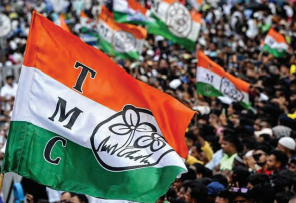
With every passing day, troubles appear to be mounting for the Mamata Banerjee-led Trinamool Congress (TMC) ahead of the upcoming civic polls in West Bengal.
The party is not only struggling to find candidates in several wards, with veteran leaders reportedly reluctant to contest, but is also facing the prospect of incumbent councillors switching sides and contesting on BJP tickets. A growing sense of uncertainty within the TMC has prompted several local leaders to explore the possibility of joining the BJP, fearing that contesting under the Trinamool banner could jeopardise their electoral prospects.
Political observers believe that the Calcutta High Court’s decision to put the civic election process on hold could prove to be a blessing in disguise for TMC leaders contemplating a switch to the BJP, as it provides them with additional time to negotiate their political future and join the ruling party.
Sunil Sharma, a senior journalist based in Kolkata, told Read that a political shift resembling a tsunami was beginning to take shape, with several leaders looking to move from the Trinamool Congress to the BJP. He said there was a growing sense of insecurity among TMC leaders, who fear they may not be able to retain their seats if they contest under the party’s symbol. “As the saying goes, everyone wants to be in power and remain there. These leaders are therefore waiting for an opportunity to join the BJP,” he said. Sharma added that the challenge for the BJP was whether to accommodate disgruntled TMC leaders to strengthen its ward-level presence or contest with a smaller pool of candidates to preserve its ideological identity.
Notably, the political uncertainty has been compounded by the Calcutta High Court’s decision to halt the civic poll process and direct the State Election Commission to first resolve the controversy surrounding ward delimitation before issuing the election notification. Chief Minister Suvendu Adhikari has indicated that the state government will approach the Supreme Court against the verdict, while maintaining that the delimitation exercise will continue in the interest of the people.
Adhikari has argued that prolonged delays in holding civic elections could affect the delivery of essential municipal services. He has also said that if elections are not held by November 30, the government will appoint BJP-backed coordinators to oversee civic administration, citing a lack of confidence in the existing opposition representatives.
The controversy centres on the delimitation exercise undertaken under recent legislative changes to the Kolkata Municipal Corporation Act. The proposed restructuring has increased the number of municipal wards from 144 to 209, significantly altering the city’s electoral map. The BJP government has defended the move, arguing that Kolkata’s population has increased over the years and that a larger number of wards would improve administrative efficiency and ensure better delivery of civic amenities.
However, the exercise has drawn criticism from opposition leaders. Former CPM councillor Dipu Das has alleged that the delimitation process is part of a BJP strategy to increase the number of seats and improve the party’s electoral prospects in the city.
Meanwhile, the bulldozer action outside the Kalighat residence of TMC MP Abhishek Banerjee has added another dimension to the political confrontation. The Kolkata Municipal Corporation recently used a bulldozer to remove a makeshift bamboo structure and alleged footpath encroachments outside Banerjee’s residence. The TMC MP condemned the action, describing it as politically motivated intimidation, while party leaders staged protests against what they termed an emerging “bulldozer culture” in the state.
“No number of bulldozers can silence my voice or break my resolve. I will continue my fight against the Bangla Birodhis. I will neither retreat nor budge an inch until my last breath,” Banerjee said.
Adding to the political churn, Babun Banerjee, brother of Chief Minister Mamata Banerjee, has publicly praised Suvendu Adhikari and the state government. His remarks have fuelled further speculation amid the changing political equations in Bengal, with the BJP leadership seeking to consolidate its position ahead of the civic elections.
However, the possible influx of TMC leaders has also exposed differences within the BJP and the RSS. While Adhikari appears open to accommodating leaders from the Trinamool Congress to address the party’s shortage of local candidates, BJP state president Samik Bhattacharya and senior leader Dilip Ghosh have reportedly expressed reservations about indiscriminate inductions. Their concern is that an excessive influx of TMC leaders could dilute the BJP’s organisational identity and accelerate what party insiders describe as the “TMC-isation” of the BJP.
A political analyst told Read that the changing political circumstances had made several TMC leaders increasingly keen to switch sides. The High Court’s decision, the analyst said, had effectively given the BJP additional time to manage potential defections while resolving differences within its own organisation.
The immediate challenge for the BJP will be to strike a balance between electoral expansion and organisational discipline. This is likely to require ward-wise consultations between Bhattacharya and Adhikari, followed by discussions with the party’s central leadership, before the BJP finalises its strategy for the civic polls