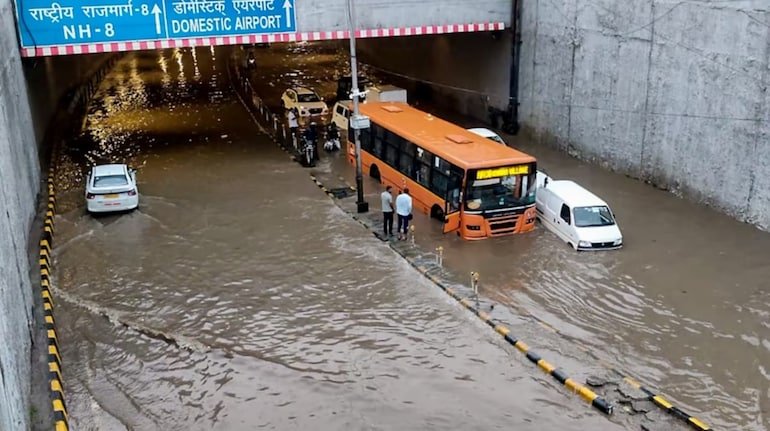
On Friday, the monsoon showed such a severe form in the national capital Delhi and the entire adjoining National Capital Region (NCR) that the pace of the city came to a complete halt. The stormy rains that started in the afternoon exposed Delhi's infrastructure and drainage system within a few hours. The situation at Terminal 3 of Indira Gandhi International Airport (IGIA), considered to be the most modern and busiest in the country, became unexpected when heavy rain water reached inside the huge forecourt, arrival gate and the main passenger movement complex outside the terminal. There was panic among the passengers coming from India and abroad due to knee-deep water accumulation in many parts of Terminal 3. Passengers coming out of the plane were forced to wade through the waterlogging, carrying their heavy luggage and trolley bags on their heads and shoulders. With many internal halls of the terminal complex flooded, the airport ground staff was struggling to get the water out with the help of wipers, vacuum machines and portable pumping sets. Many senior employees working at the airport said that for the first time in their service, they have seen accumulation of water on this scale inside Terminal 3. Emergency barricades and sandbags were installed to prevent water seepage into the Airport Express metro line and underground tunnel passing beneath the terminal. More than 400 flights were affected, 9 flights were diverted to Jaipur, Lucknow and Ahmedabad. Air traffic at Delhi Airport came to a complete halt due to poor visibility, strong flow of water on the runway and gale speed of 50 to 60 kilometers per hour. According to flight tracking website 'Flightradar24' and aviation sources, more than 400 domestic and international flights to and from Delhi were delayed by hours. The weather conditions at the airport became so adverse that at least 9 flights landing in Delhi between 3:30 pm and 4:30 pm had to be diverted to nearby alternate airports. Of the diverted planes, four were sent to Jaipur in Rajasthan, four to Lucknow in Uttar Pradesh and one to Ahmedabad in Gujarat. Major aircraft sent to Jaipur included IndiGo's flight from Bengaluru to Delhi (6E-869), flight from Purnia to Delhi (6E-6560) and Air India's Srinagar-Delhi flight (AI-1818). After circling in the air for hours, due to lack of fuel and bad weather, Air Traffic Control (ATC) instructed these planes to land in nearby cities. Due to sudden flight cancellations and excessive delays, huge crowd of passengers gathered inside the terminal, leading to long queues at check-in counters and baggage belts. Major roads became ponds: Vehicles submerged in Dhaula Kuan, Subroto Park and Aerocity underpass. Apart from the airport, the most dreadful effect of torrential rains was on the major roads and underpasses which are called the lifeline of Delhi. The Aerocity underpass and Terminal-3 approach road connecting Delhi Airport was completely submerged, where many vehicles, taxis and private cars were seen floating midway due to heavy water pressure. Due to waterlogging on the busiest corridors of South and West Delhi i.e. Dhaula Kuan, Subroto Park, Mahipalpur Bypass, Moti Bagh and Ring Road, the queues of vehicles became several kilometers long. Due to 2 to 3 feet waterlogging on the main road near Subroto Park, two-wheeler drivers were seen falling into the water and many buses broke down in the middle of the road. Apart from this, there was a huge traffic jam due to blocked drainage at Pragati Maidan Tunnel, Minto Bridge Underpass, Moolchand, lower part of Ashram Flyover, ITO, Sarai Kale Khan and Kalindi Kunj Border. Lakhs of people returning home from offices in the evening remained stuck in their vehicles for hours. Delhi Traffic Police issued several traffic alerts one after the other on social media, instructing drivers to avoid submerged roads and adopt alternative routes. IMD's Orange Alert: Warning of storm with speed of 60 km/hr and 100 mm rain. India Meteorological Department (IMD) has upgraded its forecast for the National Capital Region and issued 'Orange Alert' with immediate effect. According to the regional forecasting center of the weather department, a huge cluster of dense clouds is active in Delhi, Noida, Greater Noida, Ghaziabad, Gurugram and Faridabad due to the pressure of the monsoon trough and powerful cyclonic winds over northwest India. Meteorologists have warned that extremely heavy rainfall of 50 to 100 mm may be recorded in many areas of NCR during the next 24 to 48 hours. With this weather system, there is a strong possibility of sustained winds of 40 to 50 kilometers per hour and strong storm gusts of up to 60 kilometers per hour. The Meteorological Department has also expressed serious risk of lightning and lightning. IMD has instructed disaster management agencies, municipal corporations and common citizens to remain alert and say that they should stay away from weak structures, old trees and electric poles, as there is a strong possibility of them falling due to strong winds. Advisory of Indigo, Air India: Appeal to passengers to reach the airport on time. After the flights were affected on a large scale, the country's major airlines Indigo and Air India have issued an immediate travel advisory for their passengers. In an official statement, IndiGo said that extremely adverse weather conditions over Delhi have severely impacted flight operations. The airline has requested passengers to check the live status of their respective flight on the company's official website or mobile app before leaving for the airport. Along with this, keeping in mind the extra travel time taken due to heavy waterlogging and traffic jams on the roads, passengers have been advised to leave home 2 to 3 hours earlier than usual. Air India and SpiceJet also issued information on social media platforms saying that due to bad weather, the timings of flights are being changed and the affected passengers are being provided the facility of rescheduling or refund without any extra charges. Airport operator DIAL has also instructed ground handling teams to be deployed in sensitive areas with additional pumps and backup generators. Serious questions on the drainage system of the world class airport, the infrastructure exposed. This incident has once again raised sharp questions regarding the drainage system and disaster preparedness of the national capital. Delhi's Indira Gandhi International Airport has won many prestigious awards at the international level and is considered the most modern aviation hub in the country. Despite this, the submergence of the forecourt of Terminal 3 in just two hours of torrential rain and the water reaching the main lounge of the terminal raises a big question mark on the hydraulic drainage design of the airport. Citizens and experts say that every year before the monsoon, huge budgets are claimed to be spent on cleaning drains and underpasses, but the ground reality is that they get washed away in the first heavy rain. Choking of the low lying areas of the airport and the outlets connected to the Najafgarh drain leads to backflow, due to which the water starts returning towards the terminal complex instead of flowing out. Environmentalists and urban planning experts have warned that in the era of climate change, when incidents of extreme rainfall (Cloudburst-like intensity) are increasing in a short period of time, it has become mandatory to reorganize Delhi's old and inadequate drainage network to modern standards, otherwise every monsoon rain will continue to bring Delhi to a standstill.