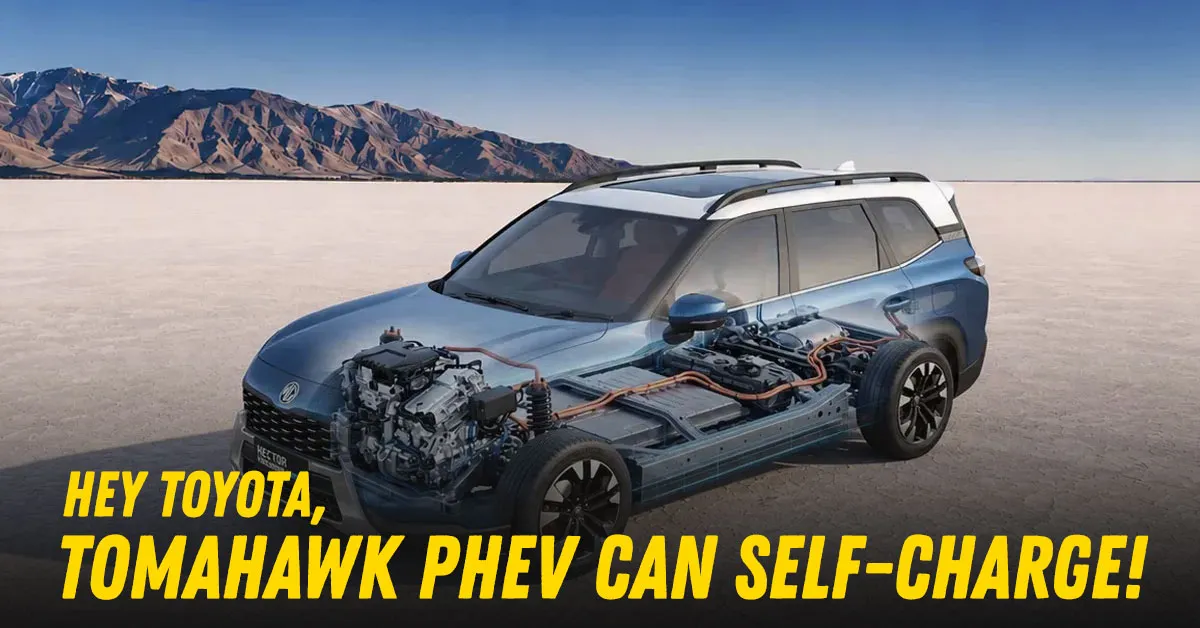
The launch of the MG Hector Tomahawk PHEV (plug-in hybrid EV) has been creating a lot of headlines. The vehicle got so much attention online, prompting Toyota, India’s hybrid king, to come up with a response video. In it, the company asserts its own dominance in the hybrid space by projecting the self-charging nature of its products. The video is now getting a lot of traction online. But there is something wrong about it. Unlike what this video seems to suggest, the Tomahawk’s plug-in hybrid powertrain is capable of self-charging as well.
The MG Hector Tomahawk PHEV has a large 20.5kWh battery, which can be charged externally by plugging the vehicle in. Owners can use a 3.3kW AC home charger for this. It can also be charged at DC chargers.
However, plugging in is not the only way the battery can receive energy. The Tomahawk PHEV also has regenerative braking. Whenever the SUV slows down or brakes, the system can recuperate some of the car’s kinetic energy and send it back to the battery. This energy would otherwise be lost during deceleration. From what we know, the vehicle lets the driver adjust the regeneration levels. Higher/ more aggressive regeneration means more energy recovered during deceleration.
More importantly, the petrol engine can also generate electricity while the vehicle is moving- engine generation. The SUV can recharge its battery when it is running.
The Tomahawk PHEV uses a 1.5-litre dedicated hybrid petrol engine. There is a ‘Series Hybrid’ mode on offer, kicks in automatically when required. When the vehicle is instructed by the system to maintain or build battery charge, the engine works accordingly and generates electrical energy.
In series hybrid mode, the engine works as a generator and produces electricity to charge the battery pack. The battery will then power the electric motor which will further drive the wheels. This is particularly useful if the battery runs low on large in the city.
In short, any suggestive remarks that the MG Hector Tomahawk’s PHEV powertrain cannot self-charge are factually wrong. The self-charging criticism thus needs to be viewed carefully. The Tomahawk may not be the conventional self-charging hybrid that we are familiar with, but it definitely can recharge the battery on its own. The extent and nature of the same are different from something like a Toyota strong hybrid.
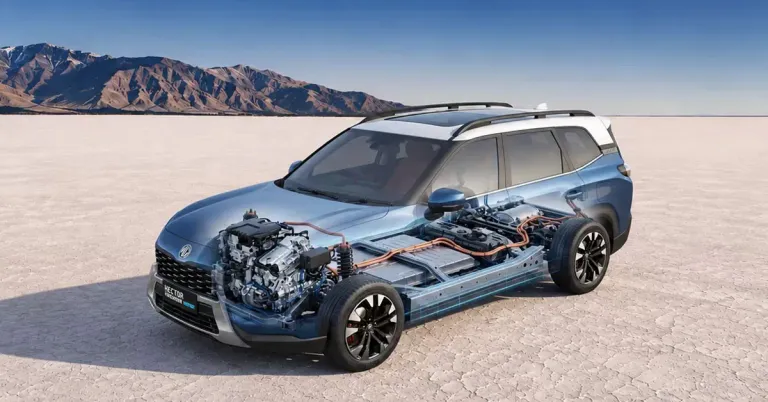
Toyota’s strong-hybrid technology and MG’s plug-in-hybrid system are entirely different in the way they are engineered and in how they function. A conventional strong hybrid has a relatively small battery and relies on regenerative braking and the engine to keep that battery charged. The vehicle cannot normally be plugged into an external charger.
A PHEV, on the other hand, has a much larger battery and can be plugged into an external power source. The Tomahawk takes this a step further by also allowing its engine and regenerative braking system to replenish battery energy while driving.
So, saying that the Tomahawk is a PHEV is correct. Saying that it cannot self-charge simply because it is a PHEV is not.
From what we know, the Tomahawk’s powertrain is designed to continuously monitor engine operation and battery charge levels, and act accordingly. The system decides how the electric motor, engine and battery should work together. It can switch between powertrain operating setups in 0.1 seconds, depending on factors like vehicle speed, battery charge and throttle input.
When the battery’s charge level falls, the switch happens automatically. We will be able to comment more authoritatively on the real-life experience of this when we drive the PHEV in the coming weeks. For now, we will have to base this article on pure theory and available technical information.
All these said, Toyota’s troll video has not openly stated that the MG PHEV cannot self-charge. However, the underlying connotation points to something of that sort. That is why this explanation was necessary. Any claim that the PHEV stops being a hybrid once its externally charged battery runs down, does not hold up.