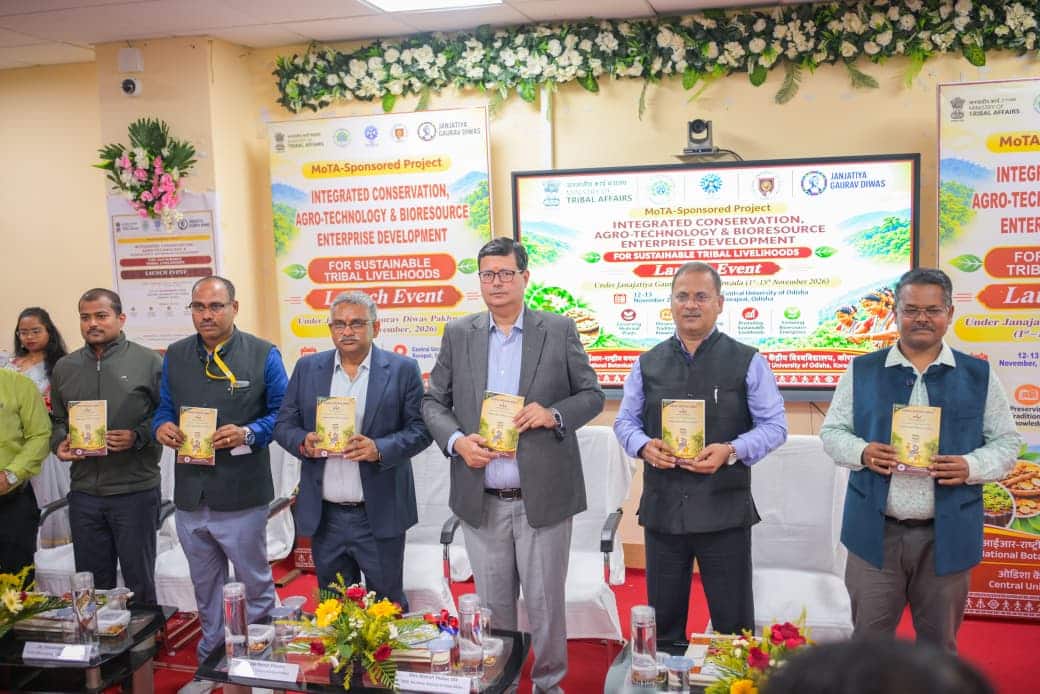
In a major step toward protecting India’s rich biodiversity and empowering its indigenous populations, the Ministry of Tribal Affairs (MoTA) has officially rolled out a sweeping national initiative aimed at the conservation of medicinal plants and the promotion of sustainable livelihoods.
Launched on November 12, 2026, at the Central University of Odisha in Koraput, the project is a collaborative effort with the CSIR–National Botanical Research Institute (CSIR-NBRI). Officially titled “Integrated Conservation, Agro-Technology and Bioresource Enterprise Development for Sustainable Tribal Livelihoods in Tribal Hotspots of India,” the three-year initiative aims to seamlessly blend traditional knowledge with modern scientific enterprise.
A Nationwide Footprint
The project is set to make a massive impact, targeting 16 highly biodiverse tribal hotspots across 13 States and Union Territories. The selected regions stretch from Kargil (Ladakh) in the north to Wayanad (Kerala) in the south, and include Alluri Seetharama Raju (Andhra Pradesh), Kokrajhar (Assam), Narayanpur (Chhattisgarh), Navsari (Gujarat), East Singhbhum (Jharkhand), Kodagu (Karnataka), Anuppur (Madhya Pradesh), Gadchiroli and Nashik (Maharashtra), Kandhamal, Balangir, and Koraput (Odisha), Sonbhadra (Uttar Pradesh). and Dharchula (Uttarakhand).
Interventions and Goals
Over the next three years, the MoTA and CSIR-NBRI plan to execute several key interventions to protect rare flora and boost local economies:
- Thorough Documentation: Cataloguing 200–300 medicinal plant species utilised by tribal communities.
- Scientific Propagation: Saving 30–40 rare, endangered, and threatened (RET) plant species from the brink of extinction.
- Infrastructure Building: Establishing 16 community nurseries and 16 local seed banks.
- Planting Materials: Distributing up to 50,000 quality planting materials to encourage sustainable cultivation.
Early Success in Uttar Pradesh
The initiative is already hitting the ground running. In October 2026, the CSIR-NBRI field team successfully concluded operations in the Sonbhadra district of Uttar Pradesh. Engaging with 146 tribal knowledge holders across 12 villages, researchers documented invaluable traditional medical practices. The team successfully collected roughly 200 samples of economically important medicinal plants, alongside 25 live orchid samples slated for germplasm multiplication at the CSIR-NBRI Botanical Garden in Lucknow.
From Knowledge to Enterprise
During the launch event, stakeholders participated in a special technical session titled “From Tribal Knowledge to Enterprise.” The discussions focused on creating strong institutional linkages between scientific bodies, Krishi Vigyan Kendras (KVKs), Van Dhan Vikas Kendras (VDVKs), and state forest departments.
By prioritising the inclusion of traditional healers, women, and rural youth, the Ministry aims to create a replicable model of bioresource-based enterprises. The initiative recognises tribal communities not just as beneficiaries, but as the primary custodians of India’s ecological and traditional heritage.