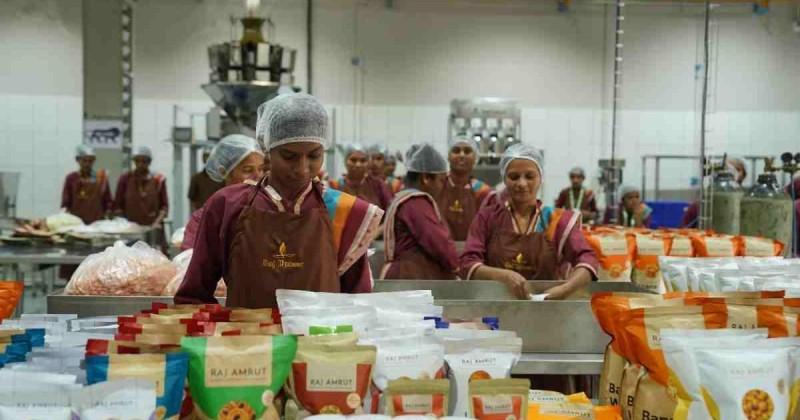
On International Day of Rural Women, a look at what happens when training, a proper workplace and a village network come together. At a campus in South Gujarat’s tribal belt, women who once had no regular income now make products that sell through more than 750 stores
A candle with a long journey
Somewhere in a corporate gift hamper this Diwali season, there may be a candle that began its life in a village near Dharampur, in Gujarat’s Valsad district. It was poured by a woman from one of South Gujarat’s tribal communities, packed by her colleagues, and shipped out under a label that most buyers would never connect to a village at all: Raj Uphaar.
According to Shrimad Rajchandra Mission Dharampur (SRMD), such candles are made with 90 per cent local materials, and Raj Uphaar products are now picked as corporate gifts by leading Indian business houses. The range has reached 26 countries through more than 750 stores.
That is a long way from where many of these women started.
Why the day matters
October 15 is observed by the United Nations as the International Day of Rural Women, a reminder that the women who grow food, carry water and hold rural households together are often the last to be paid for their work. In India’s tribal belts, the problem is sharper. Work is seasonal, mostly informal, and rarely comes with skills that travel.
Shrimad Rajchandra Love and Care (SRLC), the humanitarian arm of SRMD, set out to change that equation around Dharampur. Its answer was not a one-off training camp, but three things that work together: skills, a real workplace, and a network that reaches into the villages.
Step one: a workplace built for women
The heart of the effort is the Shrimad Rajchandra Sarvamangal Centre of Excellence for Women, an 11-acre campus with more than two lakh square feet of space, close to the Mission’s ashram in Dharampur.
It is not a small craft shed. The campus has modern production lines, a vertical warehouse and digital training rooms. It also has a crèche, so that mothers can bring their young children to work instead of choosing between a job and their family. Prime Minister Narendra Modi took part in its foundation-stone ceremony virtually in August 2022. Defence Minister Rajnath Singh inaugurated it in December 2025.
“I believe that the women who will work here will not only be empowered but also become self-reliant,” Singh said at the inauguration. “This campus is promoting both the economic and social aspects of women’s empowerment.”
According to the Mission, the centre is already employing hundreds of women and training thousands more.
Step two: a brand with a market
Training on its own rarely changes much if there is nobody to sell to. That is where Raj Uphaar comes in.
The brand is operated by rural and tribal women who are trained and employed at the centre, and the Mission says it is managed end to end by women from these communities. It offers more than 200 products across three main lines. Raj Amrut makes snacks and savouries. Raj Saurabh focuses on fragrances, from incense to candles. Raj Kruti covers handicrafts and garments. Several products use locally sourced materials, and Raj Uphaar says it now has a community of more than two lakh customers.
For the women, the model offers several ways in: job work, apprenticeships, direct employment and links to markets they could never have reached alone.
When President Droupadi Murmu visited the Dharampur ashram, women from Raj Uphaar presented her with products they had made themselves.
Step three: taking it to the villages
A single campus, however large, can only reach so far. So the model is being copied.
At ‘Aho Gurudev’, the celebration of the 60th birthday of Pujya Gurudevshri Rakeshji, founder of SRMD, in Mumbai last month, the Mission announced that 10 new satellite Centres of Excellence for Women have already been set up across rural India, from Wada in Maharashtra to Darbhanga in Bihar, and from Chengalpattu in Tamil Nadu to Purulia in West Bengal.
Alongside them, the Mission is launching 60 Shrimad Rajchandra Love and Care Centres, village hubs that bring healthcare, career guidance, government schemes, agricultural support and women’s livelihoods under one roof.
The idea is simple. The centre in Dharampur provides the training and the brand. The village network brings in women who would otherwise never hear about either.
More than a pay cheque
Raj Uphaar describes its aim as giving rural women more than an income: confidence, skills and a voice.
That fits the philosophy Gurudevshri has built the Mission on since 1994: inner growth and service to others as two halves of one life.
On a day meant to recognise rural women, the story from Dharampur is a practical one. Give women a skill, a dignified place to work, a crèche for their children and a market for what they make, and they will do the rest. Some of them are now selling to the world.