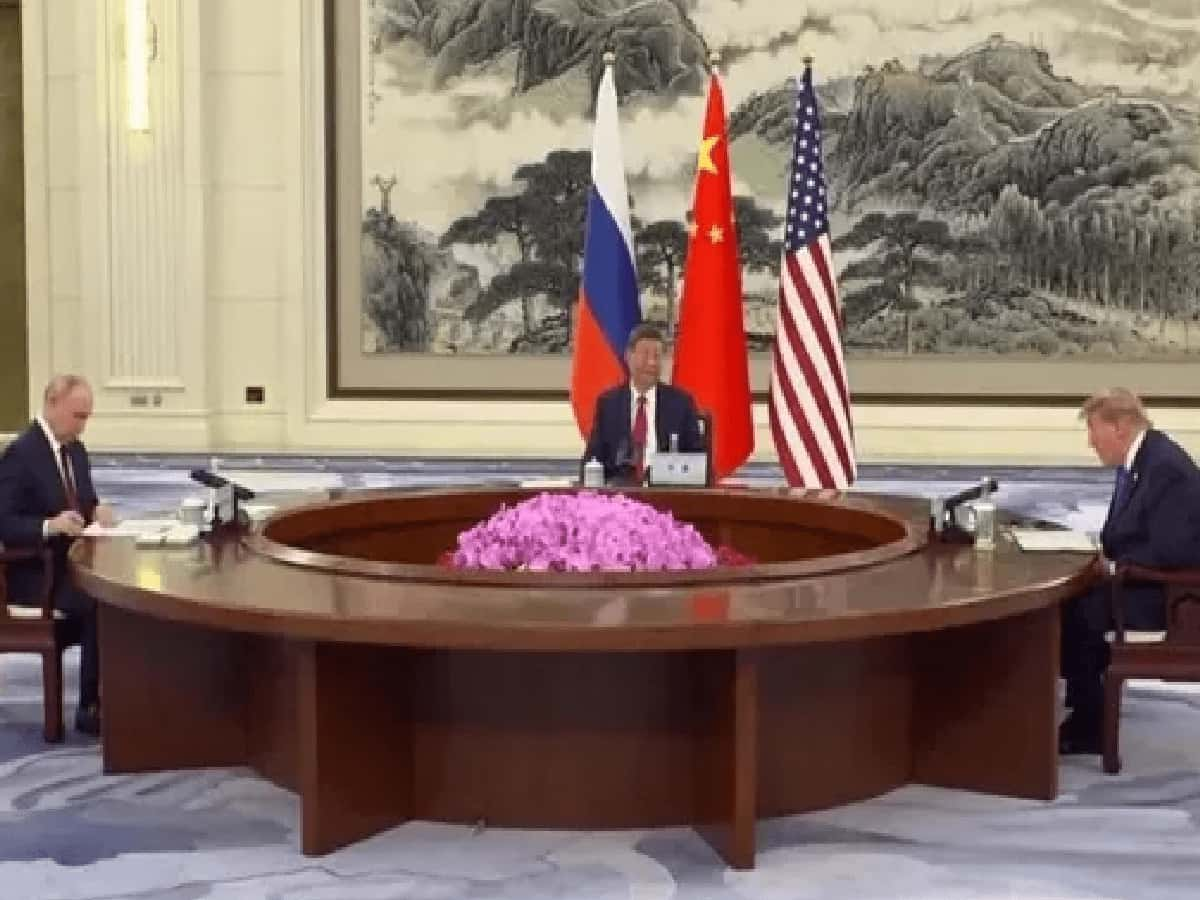
A very important development has emerged from Shenzhen on the front of global diplomacy, international security and nuclear disarmament. The top leaders of the world's three major nuclear superpowers gathered on the same platform, where there was an in-depth discussion on reducing the threat of nuclear weapons and establishing world peace, but despite this high-level conversation that lasted for 70 minutes, a final consensus could not be reached on any concrete nuclear agreement. According to the details received, the historic trilateral meeting held on Thursday between US President Donald Trump, Chinese President Xi Jinping and Russian President Vladimir Putin had raised hopes for a new nuclear arms control agreement, but no concrete initiative could be taken to curb the arms race. However, in the joint 'Peace Declaration' issued after the conclusion of the meeting, the three countries have promised to continue the process of dialogue to reduce nuclear risk and prevent the spread of nuclear weapons. There is a wide discussion about this 70-minute meeting, the joint peace declaration and the statements of the three leaders among the diplomatic experts, international affairs experts, policy makers and common citizens of the country and the world, from Shenzhen and Beijing to Washington, Moscow, New Delhi and Unnao, Kanpur and Lucknow of Uttar Pradesh. Let us know in detail what issues were agreed upon according to Chinese government media, what views were expressed by Trump, Xi Jinping and Putin before and after the meeting and how experts are viewing this diplomatic dialogue. Agreement on energy supply, UN reforms and ICC jurisdiction in the joint 'peace declaration', Trump described as a historic opportunity. According to Chinese state media reports, the importance of stable energy supply has been given special emphasis in the joint peace declaration issued by the three countries. Along with this, points like reform of the United Nations (UN), more refinement of fossil fuels and limiting the jurisdiction of the International Criminal Court (ICC) were also agreed upon. Before the start of the meeting, US President Donald Trump had described Xi Jinping and Vladimir Putin as his friends and said that America, Russia and China can play a special role in reducing the number of nuclear weapons and reducing the risk of their use. Trump described this trilateral dialogue as a history-making opportunity, while in his opening remarks he also targeted the International Criminal Court and called it an 'arbitrary global organization'. Xi Jinping's emphasis on respecting the 'Red Line', Putin said shared responsibility; On the other hand, Chinese President Xi Jinping stressed the need for close cooperation between the three countries to ensure global peace. He clearly said that big powers should not violate each other's 'Red Line' on sensitive issues. While advocating a nuclear-free world, Xi Jinping also called for a complete ban on nuclear weapons and their destruction. At the same time, Russian President Vladimir Putin described maintaining international peace as the common responsibility of the three nuclear powers. After the end of the meeting, positivity was definitely visible in the statements of the three top leaders, but no concrete results could be seen immediately. Xi Jinping described the talks as positive and constructive, while Vladimir Putin called it an open and frank discussion; However, President Trump left the villa without talking to reporters and boarded Air Force One. In diplomatic circles, this meeting is being seen as an important diplomatic step for Trump, because bringing the leaders of China and Russia, America's two major strategic rivals, together on the negotiating table is an important development in itself. Trump wanted to send a message through this initiative that despite global rivalry, the three nuclear powers can come together on topics of common interest, and experts believe that this meeting could pave the way for regular dialogue in the future to reduce the number of nuclear weapons and reduce risks.