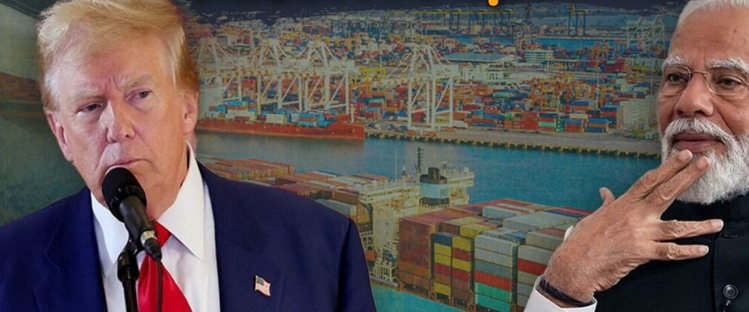
Tariff pressure may once again increase on trade relations between America and India. US President Donald Trump The US administration is preparing to release the results of a new trade investigation against 16 countries including India. This investigation has reportedly been done regarding excess industrial production capacity in these countries. After the report of the US Trade Representative Office (USTR) comes, a proposal may come forward to impose new import duties i.e. tariffs on the products of related countries including India.
According to media reports, America may announce new tariffs this week. The Wall Street Journal report talks about its preparation, while according to Bloomberg, it could be announced on Tuesday also. However, it is not yet clear at what rate the tariff will be imposed on India and which products will be kept under its purview. The Government of India is keeping an eye on this entire incident.
After all, why did America start investigation against 16 countries?
To understand this dispute, it is important to first know what America's objection is. The US administration alleges that some countries have much greater industrial production capacity than their domestic and global demand. That means these countries have the ability to produce more goods than their needs and export that excess production to other countries.
America is concerned that such additional production increases the supply of goods in the global market. This may put pressure on prices and American companies may suffer losses in competition. The Trump administration argues that this affects American industry and domestic manufacturing. On this basis, the US Trade Representative Office had started an investigation against a total of 16 countries and trade areas including India, China and the European Union. The purpose of this investigation is to find out whether additional creation of industrial capacity in these countries is harming American business interests.
However, India does not agree with this allegation. The Government of India says that there is no structural excess industrial capacity in the country. The production capacity in India is being expanded keeping in mind the future demand. In view of the possibility of increase in domestic consumption and demand in India, which is one of the fastest growing major economies in the world, industries are increasing their production capacity.
Why did Trump administration start investigation under Section 301?
There is an important legal provision behind this action of America- Section 301. This is part of US trade law, under which the US can take action against the trade policies or activities of other countries that it considers unfair or harmful to its trade. In fact, the Trump administration suffered a setback in the US Supreme Court when a legal challenge came to light regarding the 'reciprocal tariffs' imposed using emergency powers. After this, the administration started two separate investigations by adopting the route of Section 301 for trade action. The first investigation was regarding the import of products involving forced labour.
America alleged that some countries failed to stop the import of such goods in the production of which forced labor is used. This hurts American exports and business. After this investigation, additional tariff of 10 to 12.5 percent was imposed on imports from more than 50 countries. In the case of India, initially 12.5 percent duty was proposed, but after negotiations and process, the final rate was kept at 10 percent.
The second investigation is regarding alleged excess industrial capacity. The results of this are about to be revealed now. This time too America may propose to impose tariffs, but the final fee will be decided by the process and hearing after investigation.
Why is India not seeing big loss?
At present, the Indian government does not seem to be too worried about the American investigation. Government officials believe that the allegation of excess industrial capacity against India does not stand on strong grounds. India has also presented its stand before America saying that neither any special subsidy nor any kind of government incentive has been given to the industries in the country to create more production capacity than required.
India argues that if a country produces more than domestic demand, it naturally exports to other countries. This in itself cannot be called unfair business activity. India is also making it clear that the production capacity of the industries here is being increased keeping in mind the future demand. The country's economy is expanding rapidly and the consumption of goods in the domestic market is expected to increase in the coming years. In such a situation, increasing production capacity is a normal process of industrial development, not a strategy to harm the American market. However, until America's final decision, it will be difficult to say in which areas India will get relief and which products will remain at risk of additional duties.
What will happen next now? Hearing after report, then final decision on tariff
The process will not end immediately after the USTR report comes. After the findings of the investigation and the proposed tariff are revealed in the report, the concerned countries and parties will be given an opportunity to be heard. After this the US administration will decide the final tariff rate. According to the report, this entire process may take about 45 days. That means there will still be scope for change in the proposed fee and the final fee. India hopes that it will be able to present its position strongly during the hearing and negotiations and will be successful in keeping the final tariff limited. In the first Section 301 investigation, India got the benefit of lower duty than the initial proposal. Therefore, the government hopes that this time too relief can be achieved on the basis of talks and facts.
Why will trade deal be important for India?
After the final tariff is decided, the way for negotiations regarding trade agreement between America and the concerned countries may open. India will try to have such a trade deal with America in which Indian products get better market access compared to other competing countries in the region. This is also important for India because America is one of the major markets for Indian exports. If there is higher duty on Indian products, they may become costlier in the US market. This will likely affect the competitiveness of Indian companies and put pressure on exports. On the other hand, if India achieves comparative advantage for its products through negotiations, it can gain an advantage over China and other exporting countries in Asia.
Legal challenge on America's investigation also possible
There is also a possibility of a legal dispute regarding this new tariff action. Earlier, the tariffs imposed after an investigation related to forced labor were challenged in US courts. Now the proposed tariffs based on excess industrial capacity may also face legal challenge. One reason for this is that the findings of the investigation are being said to be similar in the cases of many countries.
Apart from Canada, Britain, Brazil and Australia, which are America's top 20 trading partners, action is being taken against many other countries. Major countries of Europe are also under this scrutiny as part of the European Union. Apart from this, countries like Norway, Indonesia, Cambodia and Bangladesh are also included in the list. In such a situation, this matter cannot be limited only to the trade dispute between India and America. This may also affect the global trade system and America's tariff policy.
What is the challenge before India?
India currently faces a double challenge. First, to protect our exports from the impact of additional duties in the American market. Second, in talks with America, to prove that India's industrial capacity is in line with the actual and future demand of the market. If the US ultimately imposes higher tariffs, Indian exporters may face difficulties on pricing and competition fronts… but if India can secure a reprieve in the negotiations, it may be in a better position than its regional competitors. Therefore, in the coming days, everyone will be keeping an eye on USTR's report, proposed tariff, hearing and final decision. At present it is clear that the new tariff strategy of the Trump administration can play an important role in deciding the next direction of India-US trade relations.