Trump Says China’s Nuclear Buildup Is ‘Hot and Heavy’ After Xi-Putin Summit/ NEWSLOOKS/ WASHINGTON/ Jehan Mansour/ President Donald Trump warned that China is rapidly expanding its nuclear arsenal after agreeing with Xi Jinping and Vladimir Putin to pursue nuclear-risk dialogue. He also said Washington and Beijing would work on AI safeguards, without providing details of a framework. Trump renewed his support for Jensen Huang’s return to Nvidia and praised his personal relationships with the Chinese and Russian leaders.
Trump on China’s Nuclear Buildup: Quick Look
- Trump said China could catch the United States’ nuclear arsenal within a decade.
- That was Trump’s assessment; the Pentagon projection cited in the report forecasts more than 1,000 Chinese warheads by 2030.
- China’s stockpile remained in the low 600s through 2024, according to the Pentagon.
- The Shenzhen declaration pledged dialogue on nuclear risks and nonproliferation.
- No binding arms-control agreement or weapons-reduction targets were announced.
- Trump said he and Xi discussed joint AI safeguards.
- He again urged Nvidia to give Huang another chance.
- Trump also claimed China and Russia had reduced their involvement in Venezuela.

Trump on China’s Nuclear Buildup: Deep Look
Trump warns China is rapidly expanding its arsenal
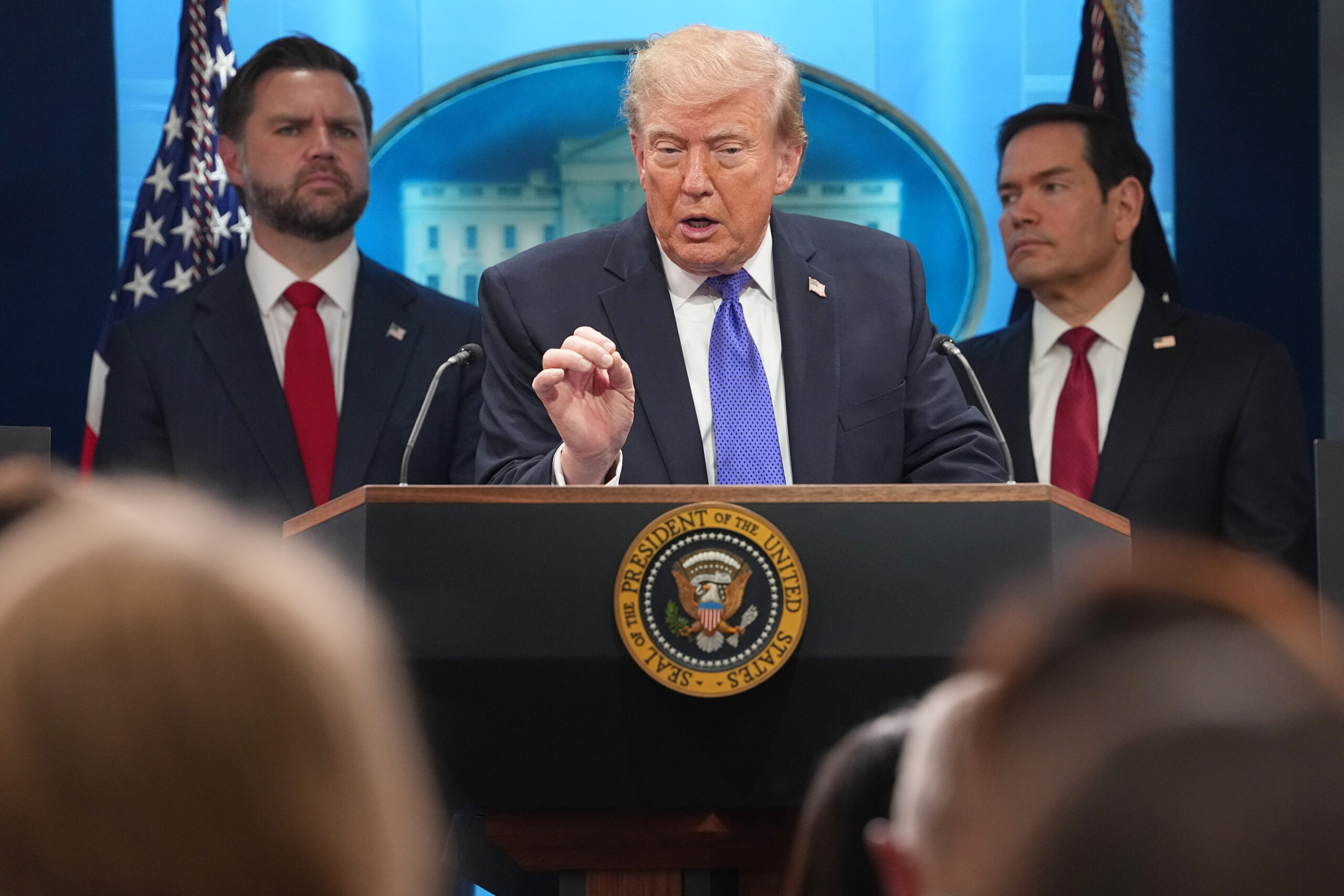
WASHINGTON — President Donald Trump said Friday that China is building nuclear weapons at a “hot and heavy” pace, a day after meeting Chinese President Xi Jinping and Russian President Vladimir Putin for talks that produced a commitment to discuss nuclear risks.
“They’ll catch us within 10 years,” Trump said during a White House news conference. “They’re going at it hot and heavy, but they have a lot.”
His prediction went beyond the specific Pentagon forecast cited in its annual assessment of China’s military capabilities.
That report said China’s nuclear stockpile remained in the low 600s through 2024 and was on track to exceed 1,000 warheads by 2030. The United States and Russia each possess thousands of nuclear weapons.
China has previously rejected suggestions that it is pursuing an arms race. Foreign Ministry spokesperson Mao Ning said in July that Beijing maintains “its nuclear capabilities at the minimum level required for safeguarding national security” and “does not engage in any form of nuclear arms race.”
The Chinese Embassy did not immediately respond to a request for comment on Trump’s remarks.
Summit declaration opens dialogue without setting limits
The three leaders’ meeting in Shenzhen ended with a joint declaration opposing nuclear war and supporting further discussions.
They “affirmed that a nuclear war cannot be won and must never be fought” and said they “will conduct a dialogue on reducing nuclear risks and preventing the proliferation of nuclear weapons.”
Beijing had previously resisted joining arms-control negotiations with Washington and Moscow, pointing to its substantially smaller arsenal.
The declaration established an intention to communicate, rather than a negotiated limit on weapons or a timetable for reductions.
“This statement is far from meaningful arms control. But it’s still a reasonable down payment on stability,” wrote Erin D. Dumbacher, director of the Defense and National Security Program at the Council on Foreign Relations.
Secretary of State Marco Rubio defended the need for regular engagement among the three powers.
“These three countries possess the overwhelming majority of nuclear weapons on this planet,” he said. “The idea that these three leaders should not engage on a regular basis is not just absurd, it’s dangerous.”
Trump says Xi agreed to AI guardrails
Trump said his separate discussions with Xi also included an agreement to “do some joint guardrails” on artificial intelligence.
He did not describe specific safeguards, implementation measures or enforcement arrangements.
The president framed cooperation alongside continued competition, saying the countries needed safeguards “because there really is no third place.”
“Whoever wins, that side wins,” he added.
Ilaria Mazzocco, a senior fellow at the Center for Strategic and International Studies, said establishing shared AI safety rules would be difficult.
“It’s technically difficult, trust is very low, and geopolitically there’s not a lot of incentive in agreeing to doing anything that might restrict your own capabilities if you don’t believe your competitor will also do it,” she said.
President again urges Nvidia to restore Huang
Trump also said he discussed Nvidia co-founder Jensen Huang with Xi, who he said agreed that Huang was “a brilliant man.”
Huang resigned this month amid scrutiny of his relationship with a former Chinese executive at a Singapore-based company suspected of diverting Nvidia chips to China.
The woman has been accused of links to Chinese intelligence, an allegation Beijing denies.
Trump argued that Huang’s role in advancing American chip technology warranted another opportunity.
Huang “put us in a position where we are literally 10 years advanced over other companies,” he said.
“I think the company, if they were smart, they take that brilliant man, accept an apology and let him go back to work,” Trump added.
Advanced computing chips remain central to U.S.-China AI competition. Washington restricts sales of its most sophisticated chips to China and this week issued additional rules limiting remote access to advanced chips and servers.
Trump credits personal diplomacy for broader influence
Trump described the trilateral meeting as having “great electricity” and said “the relationship was fantastic between the three of us.”
He also credited his relationship with Xi for what he described as reduced Chinese involvement in Latin America.
“They were nibbling on the edge of Venezuela, and I asked them to leave, and they left,” Trump said. “They were very much involved with the Panama Canal, and I said, you have to leave.”
Those were Trump’s characterizations of Chinese activity and its response to his requests.
He similarly claimed that Russia had withdrawn its involvement in Venezuela, where U.S. forces captured then-President Nicolás Maduro in January.
“Russia was very much involved with Venezuela. They’re not there anymore, and China is not there anymore,” Trump said. “But we are.”
The remarks reinforced Trump’s emphasis on personal relationships as a diplomatic tool, while the nuclear and AI discussions remained broad commitments awaiting further detail.
More on US News