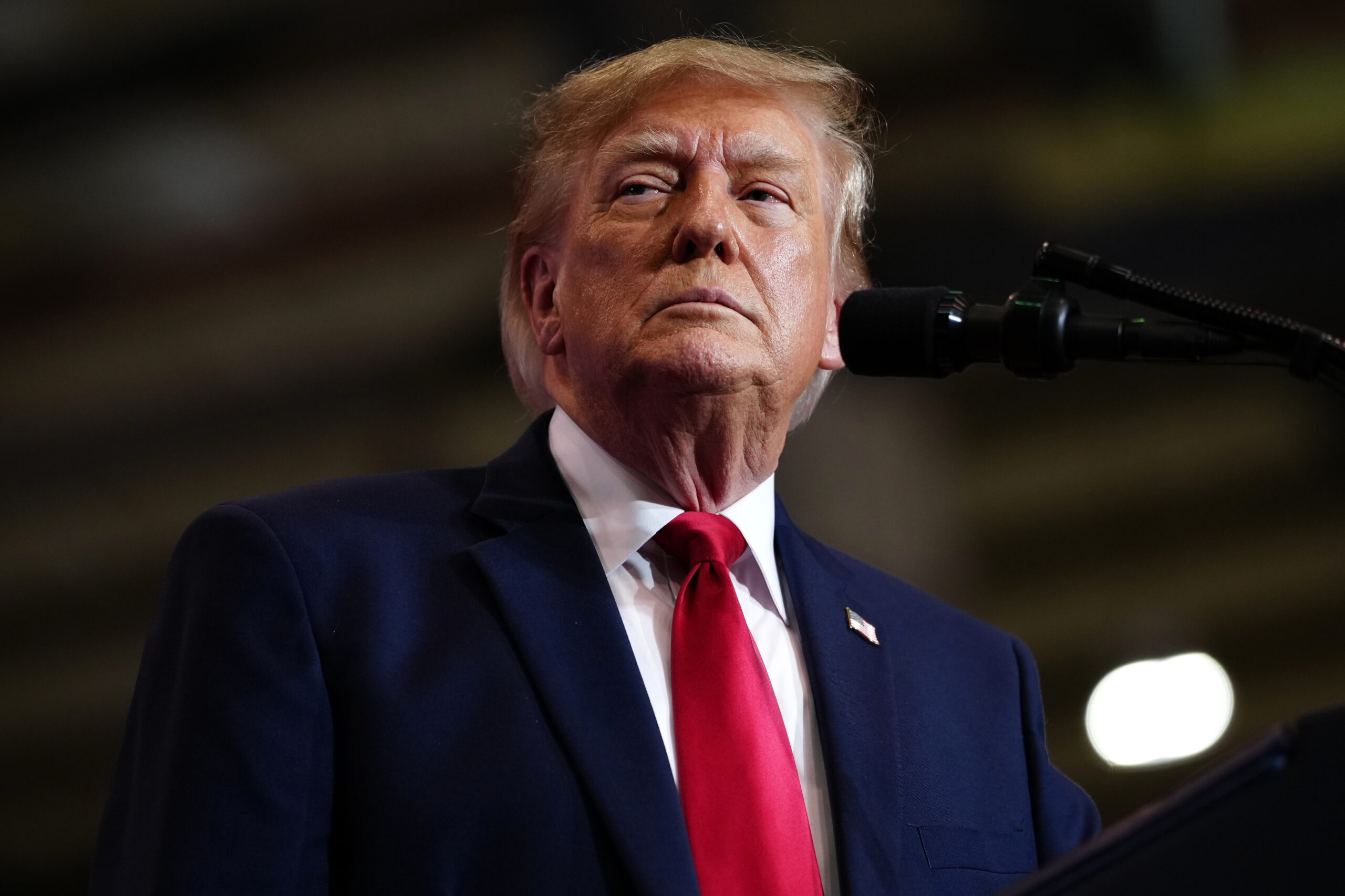
Trump Says He’ll Become ‘Mr. Veto’ if Democrats Win Congress/ NEWSLOOKS/ WASHINGTON/ J. Mansour/ President Donald Trump said he would become “Mr. Veto” if Democrats take control of Congress in the midterm elections. The White House has been preparing strategies to advance his agenda through executive authority under a divided government. Democrats have promised investigations, while Trump suggested repeated vetoes could eventually produce negotiations.
Quick Look
- Veto warning: Trump said he would reject Democratic legislation if Republicans lose Congress.
- Possible negotiations: He predicted lawmakers would eventually seek agreements after repeated vetoes.
- Podcast remarks: Trump spoke Monday with Miranda Devine on the New York Post’s “Pod Force One.”
- White House preparations: Officials have explored ways to advance his agenda without new legislation.
- Democratic oversight: Potential investigations include Trump family business dealings and the Iran war.
- Senate stakes: A Democratic Senate could block judicial and executive-branch confirmations.
- Election outlook: Polls cited in the report favored Democrats in the House, while Senate control remained uncertain.
- Third-term comments: Trump again expressed interest in running but acknowledged the Constitution bars another elected term.
Deep Look
Trump Warns of Veto Battles Under Democratic Congress
President Donald Trump said Monday that he would repeatedly veto legislation if Democrats win control of Congress, while suggesting the confrontation could eventually lead to negotiated agreements.
Speaking with Miranda Devine on the New York Post’s “Pod Force One” podcast, Trump maintained that Republicans could retain the House despite polling indicating a difficult election for his party.
Asked about the possibility of losing both chambers, Trump said: “I guess I’ll become Mr. Veto.”
“They’ll be sending stuff up. You veto it. And eventually, after a month or two of getting all vetoed—they’re just wasting time—they come over, and you make a deal. I think that probably would happen, but hopefully we don’t have to worry about that.”
He returned to the warning later in the interview.
“Look, if we didn’t win—I think we’re going to do great—but if we didn’t win, I’d veto everything,” Trump said. “I’ll be vetoing, vetoing. Then they’ll come along, and we’ll probably make some deals.”
Newsweek said it contacted the White House for additional comment.
White House Prepares for Possible Loss of Congress
The administration has spent months developing contingency plans for advancing Trump’s priorities if Democrats gain congressional power.
According to Reuters reporting cited in the story, deputy chief of staff Stephen Miller and budget director Russell Vought are among the senior officials examining potential executive actions.
A White House official familiar with the discussions said officials were considering “what Trump can legally do on his own, where he could push the limits of his authority and how to defend those decisions in court.”
The preparations reflect an administration that has relied heavily on executive action during Trump’s second term.
A Pew Research Center study cited in the report found that the 119th Congress had enacted 121 laws since convening in January 2025, the second-lowest total at that point among Congresses over the past four decades.
Democrats Plan Investigations if They Win House
Democrats have pledged a series of investigations if they capture the Housepotentially creating sustained scrutiny of Trump’s administration and family.
Proposed inquiries include examinations of Trump family finances and business ventures, along with the administration’s conduct of the Iran war.
Several prominent Democrats have also raised the possibility of impeachment proceedings involving Trump or Defense Secretary Pete Hegseth.
Control of the Senate would give Democrats a separate means of checking the administration by blocking confirmation of judicial and executive-branch nominees, including any potential Supreme Court selection.
Congress could also seek to terminate national emergencies Trump has used to expand his authority. However, Trump could veto such legislation, requiring a two-thirds majority in each chamber to override him.
Narrow Republican Majorities Face Election Test
Republicans entered the election holding narrow advantages in both chambers.
The report listed the House balance at 218 Republicans to 214 Democrats and the Senate at 53 Republicans to 47 members of the Democratic caucus.
Democrats need a net gain of four seats in each chamber to take control.
Polling cited in the report indicated Democrats were favored to win the House, while the Senate remained too close to call.
The outcome will determine how much congressional resistance Trump faces during the final two years of his presidency.
Trump Again Discusses Third-Term Interest
Trump also revisited his interest in seeking another presidential term while acknowledging the constitutional restriction.
“I’d love to run again if I had the chance, but the language is very exacting,” he said.
“They had a poll the other day where I’d beat everybody by so much. I’d love to run, but it’s fine,” Trump continued.
“You know, we have more than two years left. That’s a long time. You can do a lot in that period of time, and you’ve seen the job we’ve done. We have the greatest economy in history.”
The economic assessment was Trump’s characterization.
Past Presidents Have Negotiated With Opposition Congresses
Opposition control of Congress has complicated previous presidencies without preventing major legislation.
Bill Clinton signed welfare reform and the Telecommunications Act in 1996 while Republicans controlled both chambers.
George W. Bush approved the Energy Independence and Security Act in 2007 under a Democratic Congress.
After Republicans captured both chambers in the 2014 midterms, Barack Obama signed measures including the Every Student Succeeds Act, the Fixing America’s Surface Transportation Act and the USA Freedom Act.
During Trump’s first term, Republicans lost the House in the 2018 midterms while expanding their Senate majority.
Joe Biden’s Democratic caucus retained Senate control throughout his presidency, although Republicans won the House during his term. Richard Nixon and George H.W. Bush served with both chambers controlled by the opposition throughout their presidencies.
More on US News