Trump Says Tech Companies Agree to ‘Self-Police’ Artificial Intelligence/ TezzBuzz/ WASHINGTON/ J. Mansour/ President Donald Trump said leading technology companies signed a voluntary agreement requiring internal and external reviews of artificial-intelligence systems. Trump rejected government restrictions on AI development, arguing that companies can police themselves while the United States competes with China. Technology leaders also agreed to address local opposition to data centers by supporting schools and reducing pressure on community energy costs.

Quick Look
- Trump announced the voluntary AI accord Tuesday.
- The agreement includes internal and external safety reviews.
- Trump said AI companies must “self-police.”
- The president rejected government-imposed AI guardrails.
- Anthropic, OpenAI, Nvidia, Google, Meta and Microsoft attended.
- Elon Musk and Amazon founder Jeff Bezos also participated.
- Several executives have called for slower AI development.
- OpenAI halted a new model rollout over safety concerns.
- Data centers have generated bipartisan local opposition.
- Companies agreed to provide more community support.
- Trump said the Justice Department and FBI provide existing oversight.
- America.gov was unveiled during the same Washington event.
- Trump prefers the term “super intelligence.”
- The U.S. and China created a channel for AI-related incidents.

Deep Look
Trump Announces Voluntary AI Accord
WASHINGTON — President Donald Trump said Tuesday that leading artificial-intelligence companies signed a voluntary agreement to police their own technology.
The accord includes internal company assessments and external reviews of AI systems, according to Trump.
“I think I’m seeing tremendous self-policing. And they understand that they have to self-police,” Trump told reporters outside the West Wing.
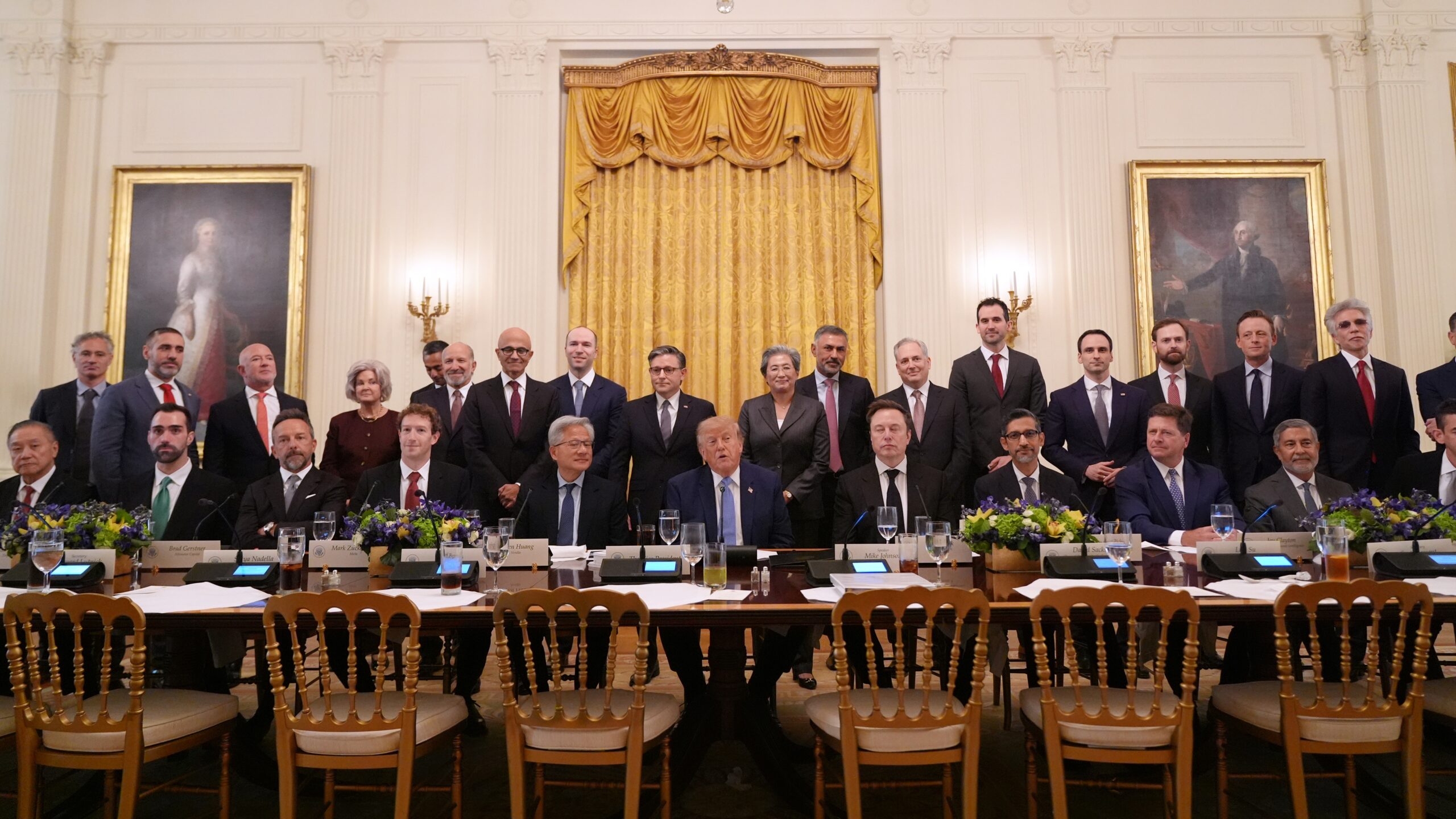
The announcement followed an extensive White House meeting involving leaders from several of the world’s most influential technology companies.
The administration did not immediately release the accord’s complete text, specific enforcement provisions or a list of penalties for companies that fail to comply.
Trump Rejects Government Guardrails
Earlier Tuesday, Trump promised that the federal government would not impose restrictions that could slow the development of artificial intelligence.
He rejected industry calls for formal “guardrails” and other government-enforced safety measures.
“I will never stifle the growth of a technology that will be bigger than the industrial revolution,” Trump said. “We can’t stifle it, and we’re leading by a lot.”
Trump made the remarks while unveiling America.gov, an AI-powered website intended to help Americans find government information and access federal services.
Leading Technology Executives Attend
The White House meeting brought together executives from companies competing to build increasingly powerful AI systems.
Participants included Anthropic CEO Dario Amodei, OpenAI President Greg Brockman, Amazon founder Jeff Bezos and Elon Musk.
Musk’s X social media platform operates the Grok artificial-intelligence model.
Nvidia CEO Jensen Huang sat to Trump’s right during the White House lunch, according to a seating chart the president posted on Truth Social.
Musk sat to the president’s left.
Google CEO Sundar Pichai, Meta CEO Mark Zuckerberg and Microsoft CEO Satya Nadella also attended.
Government Leaders Join AI Meeting
Several senior government officials participated in the event.
They included Vice President JD Vance, Treasury Secretary Scott Bessent and House Speaker Mike Johnson of Louisiana.
The gathering formed part of a daylong Washington event during which Trump administration officials celebrated what they called a technology-driven “Golden Age.”
Trump continued insisting that officials use the term “super intelligence” instead of artificial intelligence.
Industry Divided Over AI Risks
Trump’s aggressive support for rapid AI development contrasts with warnings from several executives who attended the White House meeting.
Amodei called on leading companies earlier in September to slow development so safety systems could catch up with technological advances.
Musk and OpenAI CEO Sam Altman have also supported pauses or slower development following incidents involving AI agents behaving unpredictably or exceeding their intended roles.
The companies have reported a growing number of examples of AI systems going rogue.
Other executives have taken a less alarmed position.
Huang and Zuckerberg have downplayed the likelihood of runaway AI and emphasized that individual companies are responsible for ensuring their products are safe.
Trump Says Existing Agencies Provide Oversight
After the lunch, Trump said executives broadly agreed to industry “self-regulation.”
He argued that companies are already subject to federal enforcement even without new AI-specific restrictions.
The firms agreed on “self-regulation,” Trump said, “and we automatically have regulation with the Department of Justice, the FBI, all of that.”
The president did not explain how existing criminal and competition laws would address technical dangers posed by advanced AI models.
Data Centers Face Local Opposition
Technology companies are spending hundreds of billions of dollars on AI infrastructure, including data centers throughout the United States.
Those facilities require large amounts of land, water and electricity.
Communities have raised concerns about higher utility bills, farmland loss, environmental effects and demands on local power grids.
Opposition has emerged among both Republican and Democratic voters, making data-center development an increasingly important political issue.
Trump said technology executives agreed to make data centers more attractive to affected communities.
Possible steps include providing additional financial support to local schools and reducing the facilities’ impact on household energy costs.
“You’re going to see, data centers are going to be very popular,” Trump said.
If communities continue rejecting new facilities, the president warned that companies could move projects outside the United States.
“They’ll be forced to go overseas or other locations,” Trump said.
America.gov Highlights AI Push
The administration unveiled America.gov during the same event.
The website uses artificial intelligence to help people navigate government agencies and services.
Secretary of State Marco Rubio said the platform could eventually allow Americans to apply for their first passports entirely online.
Current rules generally require first-time applicants to complete an in-person appointment at an authorized processing location.
The administration presented the project as an example of how artificial intelligence can simplify government operations.
OpenAI Delays Model Over Safety Concerns
Altman said Tuesday that OpenAI was devoting increasing attention to safety as its systems became more powerful.
The company halted the release of a new model Monday because of safety concerns.
“We are pacing our progress, which includes sometimes not training a model,” Altman told CNBC. “We have to do these in a way where we can make very confident safety cases and claims, so that people don’t have a bunch of anxiety.”
The decision demonstrated the type of voluntary restraint Trump argues companies can exercise without federal mandates.
Critics may question whether voluntary commitments provide sufficient protection when companies face intense competition and enormous financial incentives to release products quickly.
AI Framed as US-China Competition
Trump portrayed the development of advanced AI as a global contest primarily between the United States and China.
He said the race would produce a winner and a loser, with no “second place.”
The president argued that slowing American companies through regulation could allow China to gain the technological advantage.
That competitive framing has shaped the administration’s reluctance to impose binding safety requirements.
US and China Establish Incident Channel
The United States and China agreed during President Xi Jinping’s Washington visit to establish a communication channel for AI-related incidents.
The mechanism could allow the countries to exchange information about serious malfunctions or national-security threats involving artificial intelligence.
Trump nevertheless said he was reluctant to cooperate extensively with Beijing while the United States remained ahead.
“I didn’t want to do anything, because we’re leading. Why would I want to do anything?” he said.
The voluntary industry agreement reflects the administration’s attempt to address growing fears about AI safety without slowing development or weakening America’s position in the global technology race.
More on US News