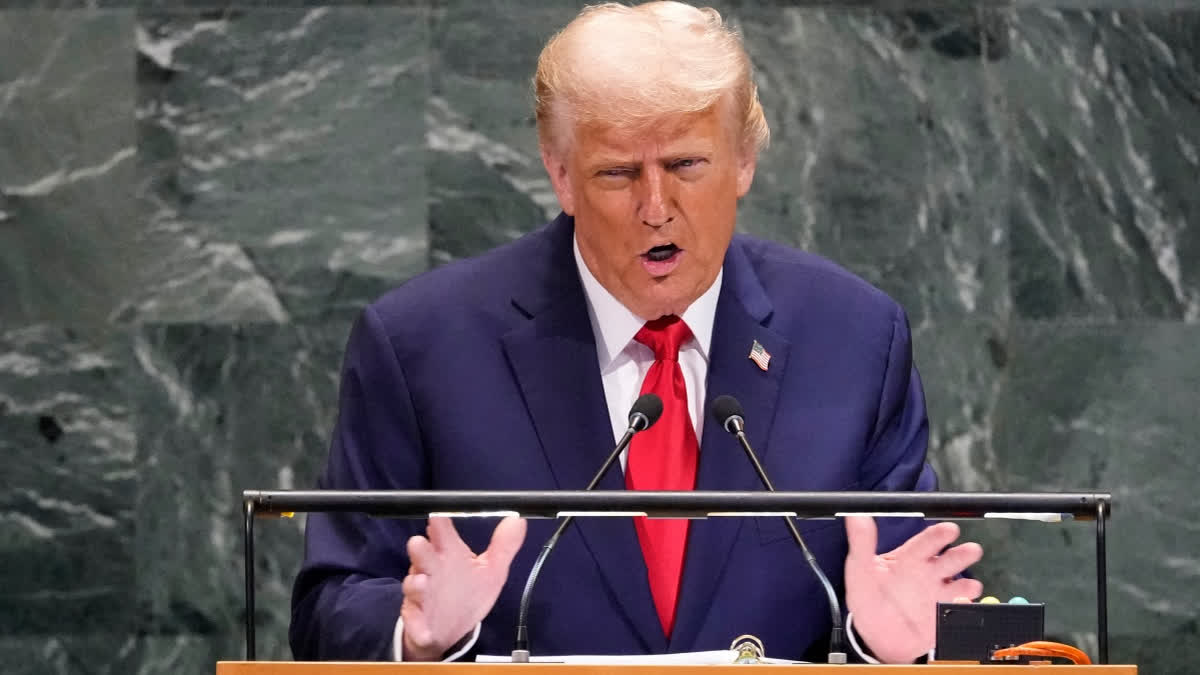
New York: Maybe President Donald Trump really does believe that tariff is the most beautiful word in the dictionary.
Despite higher prices, criticism from trade experts and displeasure among voters, Trump holds fast to his belief that imposing the highest import duties on US trading partners since the Great Depression is a winner.
A recent poll suggests that is a big gamble with less than a month before the November 3 midterms. Most US adults disapprove of his trade policies, with more than 64 per cent saying he has gone too far with his latest tariffs, compared with 58 per cent in January.
A look at the political, legal and economic challenges to the Republican president’s approach to trade.
Where Trump’s ever-changing tariffs stand today
The United States has set taxes on imports from most countries in the low double digits, although the rates have gone up and down because of legal setbacks as well as Trump’s habit of changing them seemingly on a whim.
In the biggest round last year, Trump levied what he called reciprocal tariffs and other duties on dozens of countries. He cited a 1977 law that he said allowed him to act without congressional approval in an economic emergency.
After the Supreme Court struck that down in February, Trump turned to an array of other trade laws to accomplish his goals.
The primary one he is using now, Section 301 of the Trade Act of 1974, allows him to impose tariffs on countries that he believes are engaging in unfair trade practices, such as not adequately enforcing a ban on forced labour. The new duties range from 10 per cent to 12.5 per cent on imports from 60 economies, including big US trading partners such as the European Union, India, Japan, Canada and Mexico.
Why trade experts think Trump is causing more damage than good
Trump is taking a sledgehammer to a relatively open global trading system that many mainstream economists think has benefited the US enormously. It has helped boost growth, keep prices low and make US businesses more competitive and often dominant in global industries.
The US is the second-largest exporter in the world, after China. It exported USD 3.4 trillion in goods and services last year, far ahead of third place Germany’s USD 2.3 trillion.
Although Trump claims foreign exporters are paying tariffs, it is mostly Americans who are footing the bill. Studies, including ones from New York Fed and Harvard, have shown that overseas companies have largely not lowered their prices to offset the tariffs that US businesses pay at the border. Those businesses are absorbing the added costs or passing them along to consumers through higher prices.
The White House responds that the factory boom is already underway and points to statistics showing that manufacturing jobs, after falling last year, are on the upswing and work in certain nonresidential construction trades is rising, too.
Factory construction jobs of today mean more manufacturing jobs down the road once those factories come online, said White House spokeswoman Taylor Rogers.
Mixed evidence that countries are ripping off the US
In the four years after China joined the World Trade Organisation in 2001, nearly 3 million US manufacturing jobs were lost, accelerating a shift away from factory work. Even global trade enthusiasts recognise the damage. Many US companies struggled to compete with an influx of discounted products from China, which has suppressed consumption to encourage exports
It also is true that some countries have higher tariffs than the US, manipulate their currencies lower to ensure to make their exports to the US cheaper and help industries with subsidies.
But tariffs among US major trading partners are low, often comparable to US rates and sometimes lower.
Before the trade war, the US rate averaged 1.47 per cent for goods from the European Union, slightly above the average 1.35 per cent imposed by the EU on American products, according to the Brussels think tank Bruegel. Europeans are big buyers of what America wants to sell. About 30 per cent of European imports are from US-owned companies, according to the European Central Bank.
The relationship with Canada, America’s big trading partner to the north, was also similar before trade talks broke down this summer. Canada’s effective tariff rate on US imports was about 2.4 per cent, less than half the 5 per cent that the US had on Canadian imports, according to calculations by Oxford Economics.
Now the countries are mired in a tit-for-tat dispute, with both countries escalating tariffs on each other.