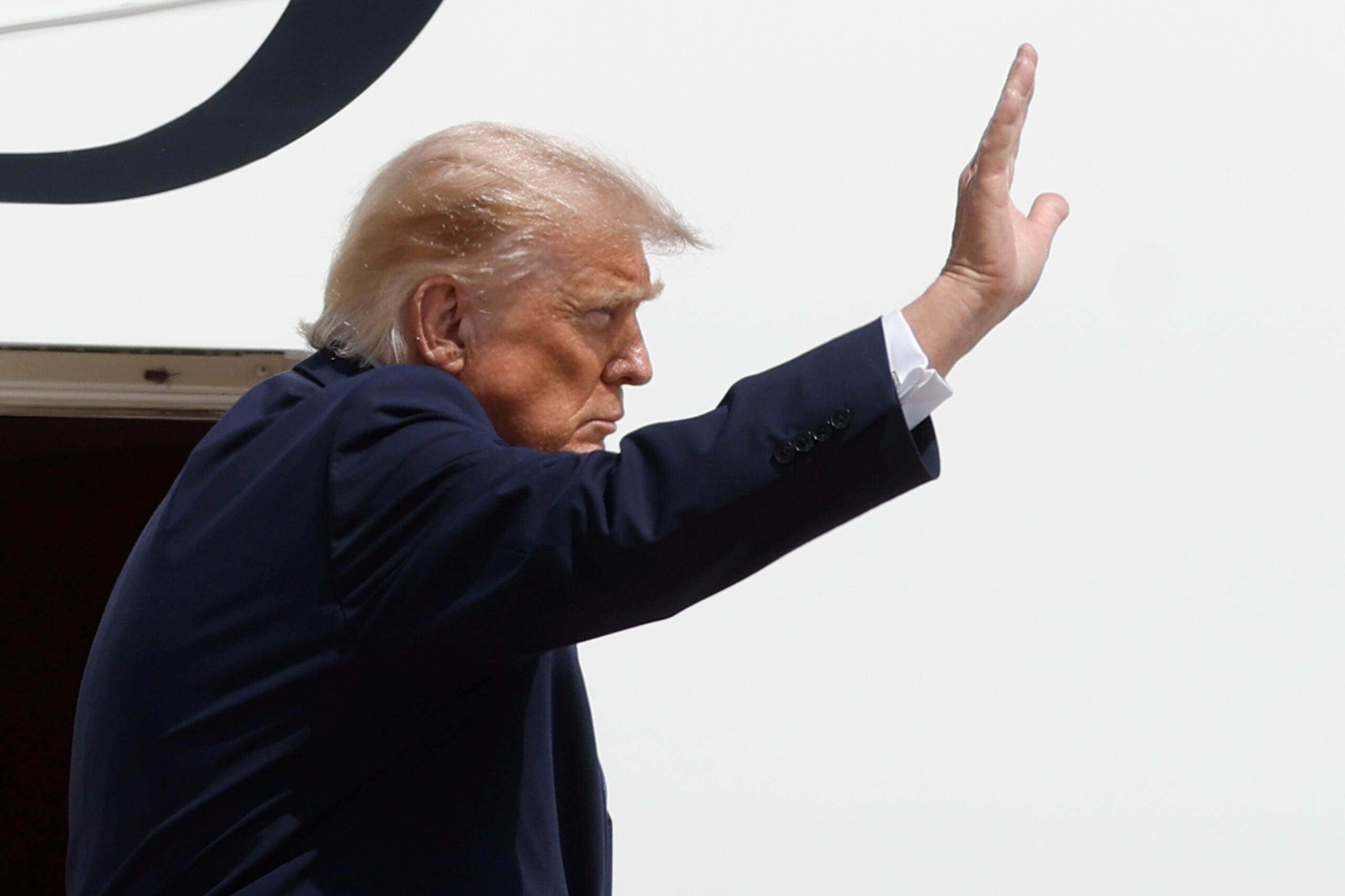
Trump Still Teases a Third Term but Talks More About Life After the White House/ TezzBuzz/ WASHINGTON/ J. Mansour/ President Donald Trump continues to tease the possibility of seeking a third term in 2028, despite acknowledging that the Constitution bars anyone from being elected president more than twice. At the same time, Trump has increasingly described what he expects to do after leaving the White House in January 2029, repeatedly imagining himself at home watching his successor take credit for his accomplishments. The mixed messages come nine weeks before the midterm elections as Trump approaches the period when second-term presidents traditionally confront questions about diminishing political influence and their legacy.

Quick Look
- Trump has repeatedly suggested he could seek another presidential term in 2028 despite the constitutional two-term limit.
- More recently, he has increasingly talked publicly about his life after leaving office in January 2029.
- Trump has imagined sitting at home watching his successor claim credit for achievements he says originated during his administration.
- At a Pennsylvania rally, Trump said he might be home complaining that the next president was taking credit for his work.
- In Georgia, he said, “I may be crying” after leaving office.
- In Michigan, Trump again injected uncertainty, saying Americans “may” have a different president in two and a half years.
- Trump joked at the White House Correspondents’ Association dinner that “the third time will be better yet” before saying he was kidding and later wearing a 2028 campaign cap.
- The 22nd Amendment prohibits anyone from being elected president more than twice.
- Trump has previously suggested there could be “methods” or “loopholes” for pursuing another term, although he has also said he does not believe in using them.
- Trump recently acknowledged, “I’d love to run, but the law is very strong.”
- Experts say second-term presidents often become increasingly focused on their legacy as their final years in office approach.
- Trump has undertaken major projects at the White House and around Washington, including a ballroom that he says will primarily benefit future presidents.


Trump Talks More About a Future Outside the White House
WASHINGTON — President Donald Trump has spent years teasing the possibility of serving beyond the constitutional two-term limit, promoting 2028 imagery, wearing campaign caps and discussing potential ways he might remain in power.
But recently, the president has increasingly begun talking about something different: what his life could look like after leaving the White House.
Trump’s second term is scheduled to end in January 2029, and his recent speeches have included repeated predictions that he will be sitting at home watching a successor take credit for accomplishments that Trump believes began under his administration.
“Your next president is going to say, ‘What a great job I did,’” Trump told an event on Long Island, New York, this month. “He’ll be sitting around, watching television. A real stiff. Unless you vote Republican, of course.”
Midterms Bring ‘Lame Duck’ Questions Closer
The shift comes at a politically significant moment.
The midterm elections are nine weeks away, bringing Trump closer to the period in a second-term presidency when attention increasingly turns toward succession and the limits of a departing president’s political influence.
Trump has long resisted allowing his political future to appear constrained. From his first term and throughout his return to the White House, he has repeatedly left open the possibility of remaining president beyond eight years.
Brian Kalt, a Michigan State University constitutional law professor, said Trump’s sometimes contradictory statements allow him considerable political flexibility.
“He is all over the place,” Kalt said. “And what that does is, it allows him to point to his own words to support any number of mutually exclusive things.”
Trump could later say, “’Oh yeah, I made it clear that I wasn’t gonna run,’” Kalt said. “Or, if he decides that he will, he could say, ’Well, you know, I never said I wouldn’t.’”
White House Rejects Suggestions Trump Is Focused on Leaving
The White House rejects the idea that Trump is increasingly preoccupied with the end of his presidency or the legacy he will leave.
White House spokesperson Olivia Wales said Trump “is fighting every day” to fulfill his promises on issues including violent crime, the U.S.-Mexico border and prescription drug prices.
“The only legacy President Trump is concerned with is making America greater than ever before,” Wales said.
Still, Trump himself has repeatedly raised the subject of what happens when he is no longer president.
Trump Imagines Watching His Successor From Home
During a recent rally in Pennsylvania, Trump predicted that his successor would eventually claim credit for achievements produced during his presidency.
“Whoever the next president is, he’s going to be talking about what a brilliant president he is. And I’ll be home. And I’ll be saying, ’That son of a gun,’ because we did the job.”
A week later in Georgia, Trump again predicted, “I’ll be sitting home.”
“I may be crying,” he added while warning that Democrats could regain control of the Senate and eliminate the filibuster, making it easier for them to pass their legislative priorities.
Trump Still Leaves the Door Open to 2028
Trump’s talk about post-presidential life has not ended his hints about remaining in office.
During an appearance in Michigan, he said, “In two and a half years, you may have a different president — may,” placing particular emphasis on the final word.
“I’ll be sitting home. I’ll be reading the papers. I’ll be watching television,” Trump continued before criticizing his predecessor, Joe Biden.
At the rescheduled White House Correspondents’ Association dinner last month, Trump again played with the possibility of another campaign.
“Just like my presidency, the second time is always better,” Trump joked, adding that “the third time will be better yet. I’m only kidding.”
He later finished the speech wearing a 2028 campaign cap.
22nd Amendment Bars a Third Election
Whatever Trump’s political rhetoric, the Constitution establishes a clear limit.
The 22nd Amendment says no person can be elected president more than twice.
It was ratified in 1951, six years after President Franklin Delano Roosevelt died early in his fourth term.
Before Roosevelt, presidents had followed the two-term tradition established by George Washington.
Trump has nonetheless periodically discussed possible ways around the restriction.
Only months after returning to the White House, he told NBC News, “There are methods which you could” use to seek a third term.
One scenario discussed involved Trump becoming Vice President JD Vance’s running mate in 2028with Vance later stepping aside if they won.
“There are others, too,” Trump said at the time.
He subsequently told Time Magazine, “There are some loopholes,” although he also said he did not believe in using them.
Trump Acknowledges Legal Barrier
Trump has continued promoting “Trump 2028” logos and his “Make America Great Again” slogan on social media.
But his comments have not always suggested that another campaign is realistic.
At other moments, Trump has explicitly acknowledged the constitutional obstacle.
“I’d love to run, but the law is very strong,” he recently told reporters.
Kalt, who has written about whether a twice-elected president could attempt to return to office through the vice presidency, said Trump’s rhetoric can be interpreted in different ways.
“People do tend to find, in Trump’s words, whatever it is that they want to hear,” he said.
Trump Could Be Confronting the ‘Lame Duck’ Factor
The changing rhetoric may also reflect a challenge familiar to second-term presidents.
Presidential power and influence often begin to decline during the final two years of a second term, particularly when the president’s party performs poorly in midterm elections.
Trump’s increasing references to his eventual departure could also suggest growing attention to his legacy, something previous presidents have confronted as their time in office approached its end.
Paul Begala, a former adviser to President Bill Clinton, said second-term presidents routinely reach that stage.
“They all, particularly as they cross the midpoint of their second term, start thinking about legacy,” Begala said.
“They all banish the word. I know Clinton and Bush, they said, ’Can’t use the L-word.’ But they do,” he added. “They all think about it. And the staff thinks about it and the Cabinet thinks about it.”
Previous Presidents Turned Toward Legacy
Trump would not be unusual in becoming increasingly concerned about unfinished work or how history will remember his presidency.
During his final two years in office, Clinton devoted significant energy to trying to broker a Middle East peace agreement.
President George W. Bush used the phrase “sprint to the finish” during his final year in 2008.
Biden adopted a “run through the tape” approach after abandoning his reelection campaign.
Trump Leaves His Mark on Washington
Trump has also sought to reshape the physical appearance of the White House and parts of Washington, drawing on his background as a New York real estate developer.
His projects include a towering arch near the Lincoln Memorial, restored fountains, a Rose Garden patio, a helipad and extensive gilded additions to the White House.
Another major project is a massive White House ballroom that construction crews are working to complete despite legal challenges.
Trump has said the ballroom is expected to be completed late in 2028 — only months before his current term expires.
“It’s not for me, ’cause I’m going to be here a very short period of time” when construction is finished, Trump recently said.
“I’ll be there for four, five, six months. This is for future presidents.”
For a president who has repeatedly entertained the idea of remaining in office beyond 2029, the comment was one of his clearest acknowledgments yet that the White House will eventually belong to someone else.
More on US News