Trump Touts White House Ballroom as He Deflects Blame for Midterm Losses/ NEWSLOOKS/ WASHINGTON/ J. Mansour/ President Donald Trump focused his first extended public remarks after Republicans’ midterm defeat on his White House ballroom project. He rejected personal responsibility for the election results, blaming Republican candidates despite repeatedly asking supporters to treat him as if he were on the ballot. AP polling showed widespread dissatisfaction with his priorities, while Vice President JD Vance blamed the Iran war for the losses.

Quick Look
- Ballroom appearance: Trump unexpectedly gathered reporters at the White House construction site Wednesday.
- Election response: He said voters “didn’t like the candidates” and rejected calling the outcome his defeat.
- Voter dissatisfaction: About two-thirds said Trump had the wrong priorities.
- Approval rating: Only about 4 in 10 voters approved of his presidential performance.
- Campaign messaging: An AP analysis found at least 40 appeals asking voters to imagine Trump on the ballot.
- Republican losses: Democrats captured Congress and won Senate races in longtime GOP strongholds.
- Different diagnosis: Vance said the Iran war caused the defeat.
- Results accepted: Trump initially pledged to accept the outcome without alleging widespread fraud.


Deep Look
Trump Highlights Ballroom After Republican Election Defeat
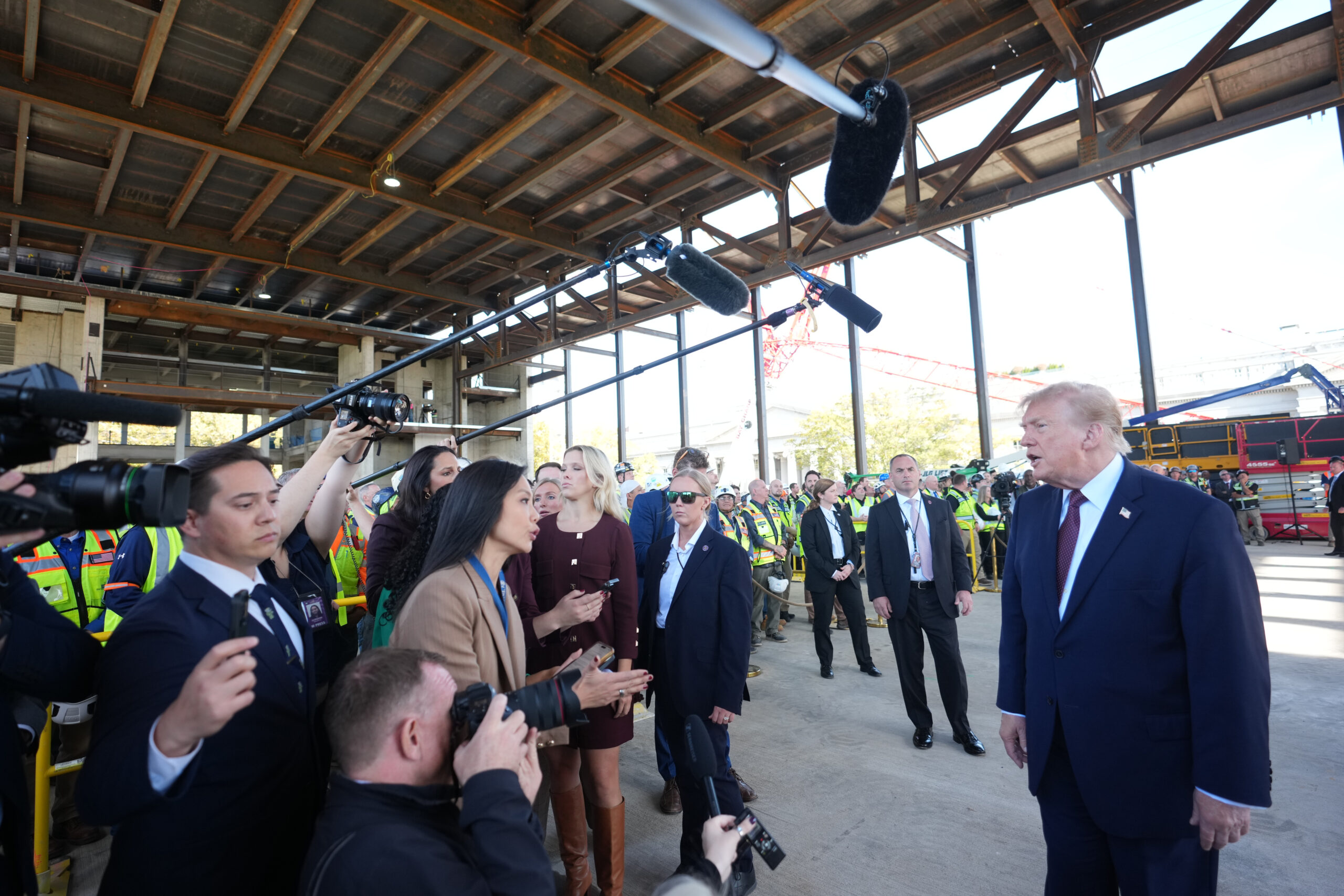
WASHINGTON — President Donald Trump used extended public comments Wednesday to celebrate construction of his White House ballroom, turning attention to the project as Republicans confronted sweeping midterm losses and voters questioned his priorities.
Trump summoned reporters to the construction site despite originally having no public events on his schedule. He presided over the installation of the final beam, which he said he would sign.
“I just want to thank everybody for being here. This has been a structure the likes of which has never been seen anywhere,” Trump said.
The appearance followed an election that handed Democrats control of Congress and delivered Republican defeats in states the party had long considered secure.
It also came as The AP Voter Poll found that about two-thirds of voters believed Trump did not have the right priorities. An overwhelming majority of those voters supported Democratic House candidates. Roughly one-third said his priorities were right.
Trump Rejects Personal Responsibility for Losses
Trump’s initial election-night response included a pledge to accept the results and a willingness to work with Democrats. But he also sought to separate his political standing from his party’s defeat.
“I don’t like to consider it a defeat for me. I wasn’t on the ballot,” Trump told Fox News.
Voters, he argued, “didn’t like the candidates.”
On social media, he went further, insisting that had he been running, “We would have won IN A LANDSLIDE!”
The polling suggested his standing complicated Republican campaigns. Only about 4 in 10 voters nationally approved of his performance as president.
In Ohio, Iowa, Maine and North Carolina, where Republicans lost Senate races, majorities of voters described the GOP nominees as “too supportive” of Trump.
Democrats also broke through in Kansas, which had not elected a Democratic senator since 1932, and South Carolina. In Texas, they ended a statewide election drought stretching back more than three decades.
Campaign Appeals Placed Trump at the Center
Trump’s effort to distance himself from the results followed a campaign in which he repeatedly urged supporters to “pretend I’m on the ballot.”
An Associated Press analysis of 39 speeches and rallies since Sept. 1 found that he used a version of that appeal in 30 of them.
Because he repeated it within some speeches, the analysis counted at least 40 instances of Trump asking voters to approach the election as though they were voting for him.
He had nevertheless begun preparing an alternative explanation months earlier.
In August, Trump told Punchbowl News that voters were angry at Republicans “but they’re not angry at me.”
Texas Defeats Prompt Criticism of Republican Allies
Before the election, Trump warned that a defeat for Texas Republican Senate nominee Ken Paxton would be the fault of “WEAK and INEFFECTIVE Political Hacks like John Cornyn and Karl Rove.”
Trump had endorsed Paxton over incumbent Sen. John Cornynwho was considered a safer Republican option. Paxton entered the contest carrying political vulnerabilities and lost to Democrat James Talarico.
Rove, a longtime Republican strategist, helped George W. Bush win the presidency.
Trump also turned on Texas Gov. Greg Abbott after Democrat Gina Hinojosa defeated him.
The president wrote that if Abbott “hadn’t become a RINO in the last six months of his Political Life, he wouldn’t have lost,” accusing his former ally of becoming a “Republican in Name Only.”
Response Echoes Trump’s Approach After 2018
Trump similarly blamed defeated Republicans after Democrats captured the House during his first term in 2018.
Utah Rep. Mia Love, who had distanced herself from him, “gave me no love, but then she lost. Too bad,” Trump said at the time.
He also criticized defeated Republicans Carlos Curbelo of Florida, Mike Coffman of Colorado, Barbara Comstock of Virginia and Peter Roskam of Illinois for failing to embrace him.
“My name wasn’t on the ballot,” he said then.
Other presidents have publicly acknowledged responsibility after major midterm setbacks. Barack Obama described Democrats’ 2010 losses as “a shellacking,” while George W. Bush called the Republican defeat in 2006 “a thumping.”
Trump Initially Accepts Results Without Broad Fraud Claims
In the immediate aftermath of Tuesday’s election, Trump did not repeat the sweeping fraud allegations he has made after previous defeats.
Following his 2020 loss, he falsely claimed the election had been stolen despite recounts, audits and court proceedings affirming Joe Biden’s victory. His own attorney general said there was no evidence of widespread fraud.
Before this year’s voting, however, Trump had again suggested Democratic victories could only result from cheating.
At a rally in Youngstown, Ohio, he said “the only way” Democrats “can win elections is to rig the election.” Democrats subsequently won the state’s Senate and gubernatorial races.
He also wrote that Minnesota Republican Senate candidate Michele Tafoya could lose only “if they cheat by playing games with the Ballots.” Tafoya lost.
In Alaska, Trump called for prosecuting Democratic Senate candidate Mary Peltola after reports that her campaign appeared involved in recruiting a candidate with the same name as Republican Sen. Dan Sullivan. Peltola denies involvement.
Pattern Extends Beyond Election Setbacks
Trump’s resistance to accepting responsibility has surfaced throughout his political career.
During a lengthy government shutdown in 2019, he said, “The buck stops with everybody,” after previously declaring he would be proud to take responsibility for a shutdown over border funding.
In 2020, when questioned about inadequate coronavirus testing, he said, “I don’t take responsibility at all.”
After bipartisan criticism forced the deletion of a racist social media post depicting Barack and Michelle Obama as primates earlier this year, Trump refused to apologize.
“I didn’t make a mistake,” he said.
More recently, he blamed Biden for inflation concerns despite his predecessor having been out of office for more than 18 months.
Trump also continued blaming vandalism for problems with the Lincoln Memorial Reflecting Pool renovationalthough the federal prosecutor’s office attributed the damage to poor workmanship.
Vance Points Directly to the Iran War
Trump has defended the war he launched with Israel against Iran in February by arguing that earlier administrations squandered decades of opportunities to address Tehran’s nuclear ambitions.
Vice President JD Vance offered a more direct explanation for the Republican election defeat.
“The reason we lost is the war,” Vance wrote Wednesday.
Trump himself had anticipated that voters’ judgment could eventually fall on him.
“If we don’t win the midterms, they’re going to blame me,” he said at an Oct. 10 rally in Clarksville, Tennessee.
“You better get out there and vote.”
More on US News