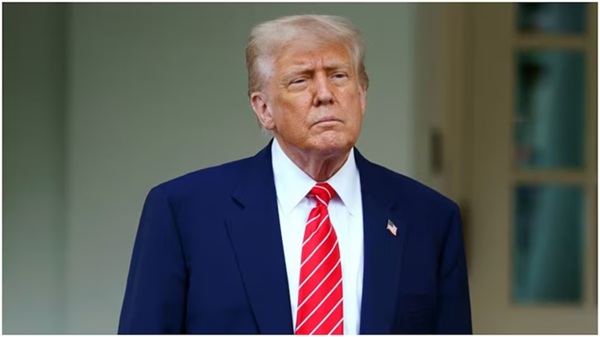
Washington: US President Donald Trump has indicated he is currently distancing himself from the possibility of another major military operation against Iran. The US now appears to be pursuing a strategy of increasing economic and diplomatic pressure on Tehran rather than military action. In an interview with Axios on Sunday, Trump took a relatively softer stance on Iran and stated that his administration is currently moving forward in a less aggressive manner.
Trump said the US is monitoring Iran’s deteriorating economy and rising inflation. According to him, Iran’s economic situation is so dire that it doesn’t even have enough money to pay its soldiers.
“We are negotiating”
Trump said, “Given Iran’s high inflation and the fact that they don’t have enough money, we are remaining calm and engaging in partial negotiations with them.”
According to the US President, Iran’s weak economic situation and the US naval blockade have increased pressure on Tehran. In such a situation, Washington does not feel the need for a major military operation immediately.
Also Read | War simmering in West Asia for 163 days: Trump’s Gaza plan rejected, Iran’s new condition on Hormuz
Gulf allies advise halting military action
Trump also stated that his Gulf allies have advised avoiding large-scale military action and continuing economic and diplomatic pressure. Crude oil prices in the US remain around $75 per barrel, giving the Trump administration an opportunity to maintain pressure on Iran without rushing into military action.
Comparing the entire incident to a game of chess, Trump indicated that a solution could eventually emerge. Therefore, Washington appears to prioritize a strategy of maintaining pressure on Tehran for now.
Why is the Strait of Hormuz agreement stuck?
On the other hand, a potential agreement between the US, Iran, and Oman to restore shipping through the Strait of Hormuz has become entangled. Mohammad Bagher Zolqadr, head of Iran’s Supreme National Security Council, laid out several conditions on Saturday.
He demands that the US completely end the war, lift the naval blockade, and withdraw its troops. Iran also demanded the lifting of sanctions, the restoration of frozen assets, and war reparations.
Zolqadr also demanded an end to US threats and perceived humiliation of Iran, and an end to US military action against Iran’s allies in the region.
The US has refused to accept Iran’s restrictions on shipping passing through the Strait of Hormuz, including attempts to impose tolls on commercial vessels.
Is Trump’s focus on Hormuz more than the nuclear deal?
According to a report in The Wall Street Journal, if Iran fully resumes shipping through the Strait of Hormuz, Trump may consider reducing military pressure even without a new nuclear deal. If this occurs, it would be a significant shift in US policy.
In fact, reaching a deal on Iran’s nuclear program has been a top priority for Washington for the past several months. However, advancing negotiations on Tehran’s nuclear program has proven increasingly difficult.
Trump’s Claims Regarding Nuclear Sites
Trump believes that it will be extremely difficult for Iran to rebuild its nuclear capabilities after damage to its nuclear sites. The US is also confident that its intelligence agencies will detect any clandestine nuclear activities by Iran.
Trump also downplayed concerns about Iran’s underground uranium reserves. During the NATO summit in July, he stated that the nuclear material is buried deep underground and other countries will not be able to obtain it.
In this context, reopening the Strait of Hormuz may become a more immediate priority for the Trump administration than a comprehensive nuclear agreement. This allows the US to maintain economic pressure on Iran without escalating military conflict.