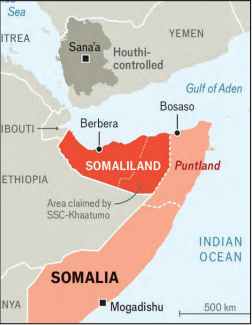
Turkey and China are consolidating their strategic influence in Somalia while sharpening their diplomatic focus on Somaliland, placing the Horn of Africa at the centre of an increasingly consequential geopolitical contest. India, despite its considerable maritime and commercial interests in the western Indian Ocean, has yet to publicly articulate a dedicated strategy towards Somaliland.
The developments come as Turkey expands military infrastructure, offshore energy exploration and aerospace ambitions in Somalia, while China strengthens its opposition to Somaliland’s international recognition and its relationship with Taiwan.
Somaliland, which has maintained separate governing institutions since 1991, is simultaneously exploring closer economic and strategic engagement with India.
Turkey’s presence in Somalia has evolved from humanitarian assistance into one of Ankara’s most significant overseas military and economic partnerships. The TURKSOM military training facility, inaugurated in Mogadishu in 2017, has trained thousands of Somali security personnel. In February 2024, Turkey and Somalia signed a 10-year defence and maritime cooperation agreement, followed by an oil and gas exploration agreement in March. The agreements expanded Ankara’s involvement in maritime security, naval training and hydrocarbon development along Somalia’s coastline.
Turkey’s latest strategic investment is a proposed rocket launch facility near Warsheikh, approximately 70 kilometres north of Mogadishu. The project reportedly covers about 900 square kilometres and carries an estimated construction cost of $350 million.
A November 9 investigation by Nordic Monitor, citing Turkish Space Agency financial documents, reported an allocation of 2.1 billion Turkish lira, approximately $42 million, for transfer to Turkey’s Defence Industry Support Fund under its national space-access programme. The investigation raised questions about the facility’s potential use for long-range ballistic missile testing. However, the disclosed documents do not establish that the funding has been spent on missile infrastructure or that military testing has been authorised.
Separately, Turkey announced a nearly $399 million space agency budget for 2027-2029, with the Somali spaceport forming part of its plans for independent satellite launch capabilities.
The expansion establishes a growing Turkish military, maritime, energy and aerospace presence on the African coast of the Indian Ocean.
China’s strategy centres on Somalia’s territorial integrity, maritime interests and its opposition to Somaliland’s diplomatic relationship with Taiwan.
Beijing maintains a military support base in Djibouti, near the Bab el-Mandeb Strait, giving it a permanent security presence close to one of the world’s most strategically important maritime corridors.
Somaliland’s relationship with Taiwan has emerged as a major point of contention. The two established reciprocal representative offices in 2020, expanding cooperation in technology, healthcare and development. On June 12, 2026, Somaliland opened a new representative office in Taipei. Somaliland’s representative maintained that Hargeisa had the right to determine its own international relationships despite pressure from Beijing and Mogadishu.
China subsequently reinforced its position. On October 23, Beijing and Djibouti issued a joint statement opposing Somaliland’s recognition as an independent state and rejecting its cooperation with Taiwan. The statement reaffirmed their support for Somalia’s sovereignty and territorial integrity.
China’s opposition also followed Israel’s December 2025 recognition of Somaliland, a development rejected by Somalia and Beijing.
While Turkey and China have different strategic objectives, both support Mogadishu’s territorial position, leaving Somaliland facing diplomatic resistance from two influential international powers.
Amid the expanding Turkish and Chinese presence, Somaliland is exploring closer engagement with India across infrastructure, energy, healthcare, technology, education and maritime logistics.
The territory occupies a strategic position along the Gulf of Aden, overlooking shipping routes connecting the Indian Ocean with the Red Sea and Suez Canal. Berbera, its principal commercial port, is already an important regional logistics asset. Zeila, Bulhar and Lughaya have also emerged as potential locations for future maritime infrastructure development, although their commercial feasibility requires further assessment.
Oil and gas exploration, fisheries, renewable energy, telecommunications, healthcare and education are among the sectors offering potential opportunities for Indian companies.
Somaliland’s leadership is seeking international partnerships capable of generating employment, developing infrastructure and strengthening economic independence. India is emerging as one of the countries it is looking towards.
India’s position contrasts with the expanding institutional engagement of Turkey and China in Somalia. New Delhi maintains diplomatic relations with Mogadishu and has reiterated its support for Somalia’s sovereignty and territorial integrity. It has not announced recognition of Somaliland or a dedicated diplomatic framework for engagement with Hargeisa.
No comparable India-Somaliland strategic agreement has been publicly announced. India’s commercial interests in the region are nevertheless substantial.
The Gulf of Aden and Bab el-Mandeb form a vital maritime passage for Indian trade with Europe, Africa and the Middle East. Security disruptions in these waters can increase shipping costs, insurance premiums and transit times.
Turkey’s military and aerospace expansion, combined with China’s established naval presence in Djibouti, adds to the strategic significance of the region for Indian maritime planners.
The Horn of Africa is witnessing a convergence of military expansion, maritime competition, energy exploration and diplomatic rivalries.
Turkey has secured a decade-long defence cooperation framework with Somalia and is developing a major aerospace project on its coastline. China has reinforced its opposition to Somaliland’s recognition while maintaining strategic interests in neighbouring Djibouti and the wider Red Sea corridor.
The contrast is increasingly visible: Ankara and Beijing have established diplomatic and institutional positions in Somalia, while India’s engagement with Somaliland remains without a publicly announced strategic framework.
With Turkey and China expanding their influence in Somalia and increasing diplomatic attention on Somaliland, New Delhi’s absence from the emerging Somaliland-specific strategic equation is becoming an important question in the geopolitics of the western Indian Ocean.
Dr Savio Rodrigues, PhD, is a strategic affairs thinker, author, journalist, and Founder & Editor-in-Chief of Goa Chronicle, specialising in geopolitics, national security, public affairs, strategic communications, and peacebuilding.