

The South Korean capital of Seoul retained the No. 1 spot for the second consecutive year while Japan’s Tokyo ranked second in the Best Student Cities 2027 ranking released by British higher education analytics firm Quacquarelli Symonds last week.
To be considered for inclusion, each city must have a population of over 250,000 and be home to at least two universities featured in the most recent QS World University Rankings.
The eligible cities were evaluated based on six key categories: university rankings, student mix, desirability, employer activity, affordability, and student view.
Seoul scored a perfect 100 in the global university rankings criterion and posted an employer activity score of 94.1.
Students and graduates of Seoul universities rate their experience highly. One respondent to the student survey said: “The diverse culture makes for a great experience, and everything is so convenient,” while another described it as “a city which has the possibilities of a truly metropolitan city without almost any danger,” as quoted by the QS.
Seoul is also a high-tech hub for innovation, with technology companies clustered in two main locations: Gangnam and Digital Media City. As one of the most financially competitive cities in the world, Seoul is home to some of the largest wholesale, retail, and electronics markets in South Korea.
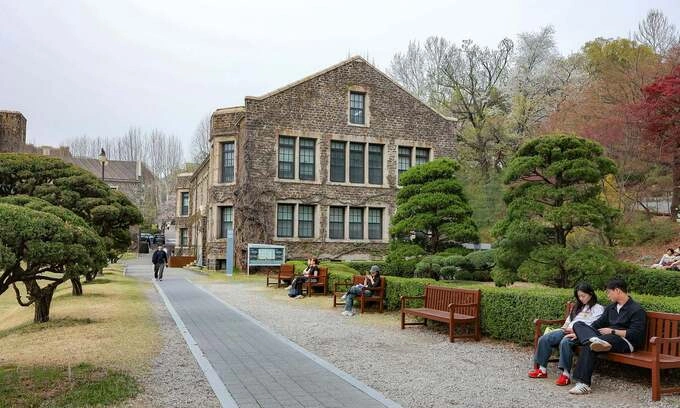
Students at Yonsei University in Seoul, South Korea, April 2025. Photo by Dang Le |
Tokyo earned a perfect 100 for employer activity and scored 94 for desirability. The desirability metric analyzed a city’s safety, pollution levels, and how many respondents actively wanted to study there.
“Tokyo’s streets are not only clean, they’re also extremely safe for locals and foreigners, making it a great place to study in. And with a top-notch transportation system, you’re guaranteed to be able to experience all it has to offer in a comfortable and reliable way,” according to QS.
The firm added that Tokyo is one of the world’s major international financial centers, housing the headquarters of some of the world’s biggest investment banks, insurance companies, and global firms. Consequently, “students who graduate from university in Tokyo are truly spoilt for choice.”
Several Asia-Pacific cities climbed the rankinh this year, which evaluates a total of 150 cities globally. Beijing made one of the biggest jumps, rising 19 places to the 12th position. Melbourne, Sydney, Taipei, Singapore, and Kuala Lumpur also improved by between one and 11 positions.
Europe maintained a strong presence with six cities in the top 10. This group was led by London in third place, while Munich tied for the fifth position. However, several European cities recorded notable declines.
The United States had only one city in the top 20: Boston. North American cities continue to benefit from strong university reputations and employment opportunities, but high living costs remain a major drawback.
The affordability issue is a common challenge across the traditional “big four” international education destinations: the U.S., U.K., Canada, and Australia.
QS Best Student Cities 2027 – Top 20:
Rank | City | Country/Territory |
1 | Seoul | South Korea |
2 | Tokyo | Japan |
3 | London | United Kingdom |
4 | Melbourne | Australia |
5 | Munich | Germany |
6 | Sydney | Australia |
7 | Paris | France |
8 | Berlin | Germany |
9 | Vienna | Austria |
10 | Zurich | Switzerland |
11 | Singapore | Singapore |
12 | Beijing | China |
13 | Edinburgh | United Kingdom |
14 | Taipei | Taiwan |
15 | Kuala Lumpur | Malaysia |
16 | Kyoto | Japan |
17 | Hong Kong | China |
18 | Boston | United States |
19 | Amsterdam | Netherlands |
20 | Montreal | Canada |
Comments are closed.