To Tu Ha, deputy general director of Airports Corporation of Vietnam (ACV), said the aviation sector has recorded 28 incidents involving unmanned aerial vehicles over the past year.
Most involved recreational drones or camera-equipped quadcopters, which are posing a growing threat to civil aviation, Ha said at a seminar titled “From Drones to Kites: Aviation Challenges in Urban Areas,” organized by Your Three newspaper on Aug. 21.
The recent series of incidents began at Tho Xuan airport in Thanh Hoa Province in mid-June 2025. The most serious occurred at Tan Son Nhat on Aug. 11, when drones entered the airport’s operating area twice in one day.
|
Passengers queue for check-in procedures at Tan Son Nhat airport on Aug. 11, 2026. Photo by Read/Tuan Viet |
Tan Son Nhat, Vietnam’s busiest airport, is surrounded by densely populated neighborhoods and handles an average of about 48 flights an hour.
The incursions forced the airport to suspend operations for around two hours. Dozens of domestic and international flights had to circle or remain in holding patterns, while normal operations took nearly half a day to fully recover, Ha said.
He stressed that the estimated VND60 billion in losses was only preliminary.
The figure does not include further costs borne by airlines from longer flight times, additional fuel consumption and reduced aircraft utilization. Ha said detecting small drones remains difficult.
Pilots can usually identify only their approximate position, while ground crews still depend heavily on visual observation and binoculars. Small UAVs can also change direction quickly, making them hard to track.
Nguyen Khac Minh, deputy head of the Culture and Social Affairs Division of the Tan Son Nhat Ward People’s Committee, said many residents buy camera-equipped drones for photography or filming without realizing that strict aviation restrictions apply around airports.
Even operators who have obtained permission sometimes fly higher or farther than allowed, making enforcement difficult, he said.
Minh also said there were too few signs in open areas around the airport warning residents that drone flights are prohibited.
Tighter controls and new detection systems
Ha called for stricter control of UAVs throughout their lifecycle, from import and registration to user identification and flight approval.
Such a system, he said, would make it easier to identify unauthorized drones and hold operators accountable.
Tan Son Nhat recently received two UAV surveillance and early-warning systems developed by the Ministry of Public Security. The systems began trial operations on Aug. 21.
 |
|
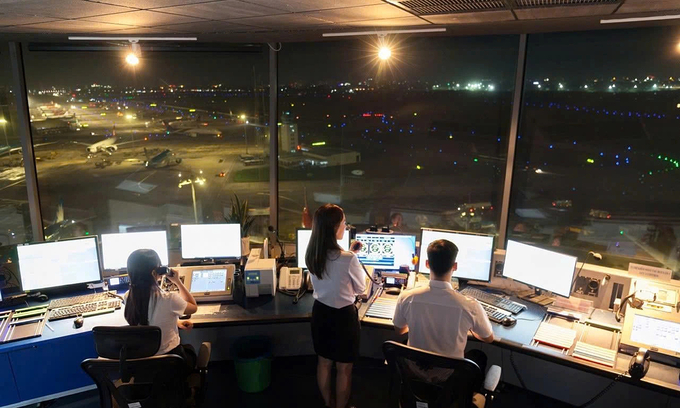
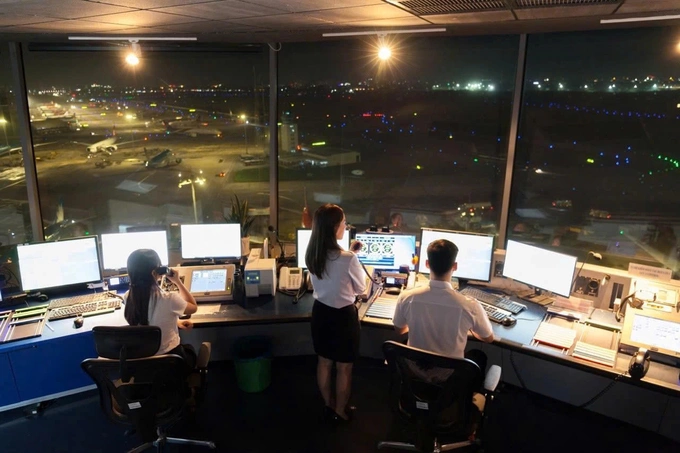
Staff work a shift at the Tan Son Nhat Air Traffic Control Tower. Photo by Vietnam Air Traffic Management Corporation |
Nguyen Thien Tong, former head of the Department of Aeronautical/Aerospace Engineering at Ho Chi Minh City University of Technology under Vietnam National University, said authorities should develop a more comprehensive legal framework for UAVs.
He argued that regulations should allow drones to be used safely for commercial, service and recreational purposes rather than relying on blanket bans or overly restrictive limits.
Instead, he said Vietnam should develop a regulated low-altitude airspace system that balances the growing use of drones with aviation safety.