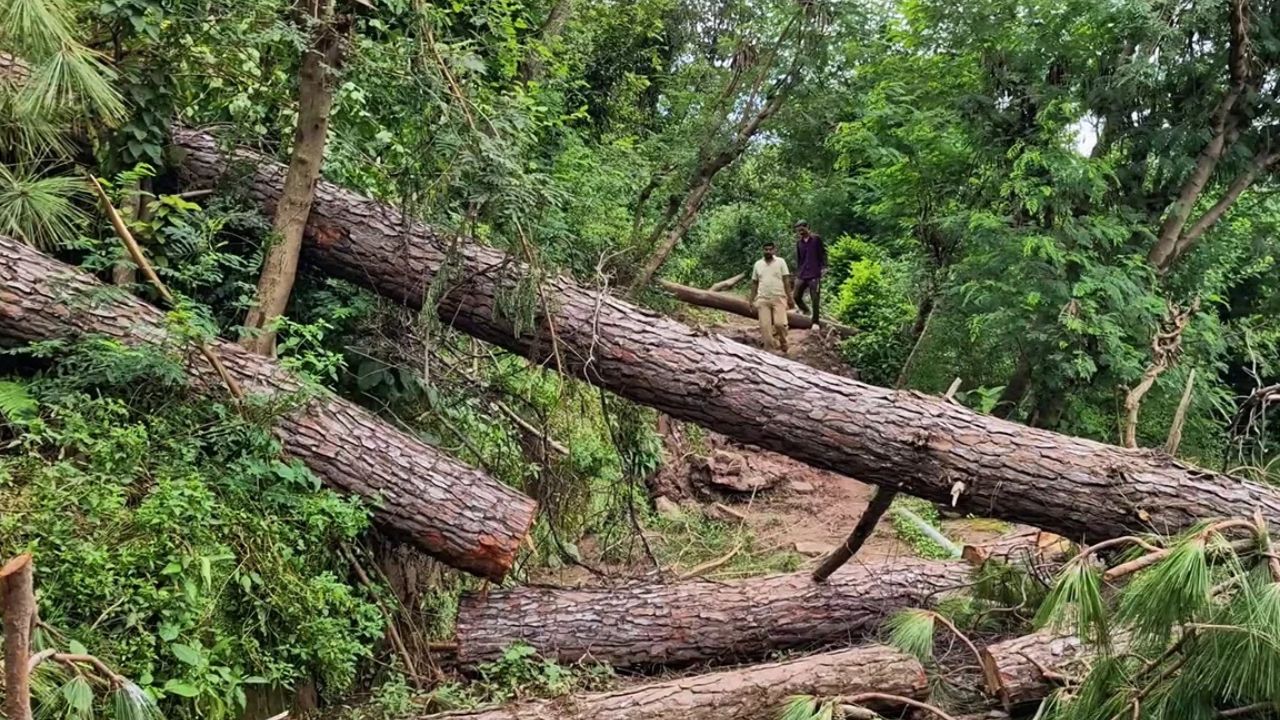
After the case of damage to the forests in Udanti Sitanadi Tiger Reserve of Chhattisgarh came to light, the Forest Department is now going to take the help of special technology to save the lives of trees. According to the Indian Express report, more than 500 trees have been allegedly damaged by encroachers in Karka village of this tiger reserve spread in Dhamtari and Gariaband districts. To save these trees, the Forest Department is preparing to conduct 'bridge grafting' i.e. surgery on trees with the help of experts.
During inspection by the Forest Department, about 2,500 trees were found surrounded in the reserve area. These mainly include Sal, Beeja and Tendu trees. This process of damaging tree trunks by cutting the bark from all sides is called 'girdling'. Due to this, the growth of trees stops and gradually the risk of their drying increases.
Which technology will be used?
The forest department is now preparing to use 'bridge grafting' technique to save the affected trees. In this process, a healthy branch is added above or around the damaged part of the tree in such a way that it can help in creating a path for the transport of nutrients between the cut part of the bark. With this technique, an attempt is made to save those trees whose trunk has been damaged, but in which there is a possibility of survival. However, it is not necessary that every tree can be saved through this process.
Who is 'Tree Doctor' Vijay Nishant?
The Forest Department is going to take the expertise of Vijay Nishant for the treatment of trees. He is known as the 'Tree Doctor' for his work in the field of conservation through the Project Vriksha Foundation. According to Varun Jain, Deputy Director of Udanti Sitanadi Tiger Reserve, Nishant will visit the reserve soon. During this time he will assess the condition of the affected trees, identify which trees can be saved and suggest suitable techniques for their treatment.
Has such an attempt been made before?
Bridge grafting has already been used to save trees in Udanti Sitanadi Tiger Reserve. In the year 2022, damaged trees were treated through this technique in Touranga Range. However, the success rate in that attempt was only about 10 percent. This experience showed that more expertise, better technology and continuous care after treatment is needed to save trees.
According to Varun Jain, the Forest Department currently takes measures like applying a mixture of cow dung and soil on the damaged area and covering it with sacks, but due to limited experience and technical knowledge, these methods have not achieved much success. Therefore, now it has been decided to take help from experts.
Why is monsoon important for tree surgery?
Right timing plays an important role in the success of techniques like tree restoration and bridge grafting. According to the Forest Department, tissue growth in trees is more active before monsoon, which can increase the chances of treatment being successful.