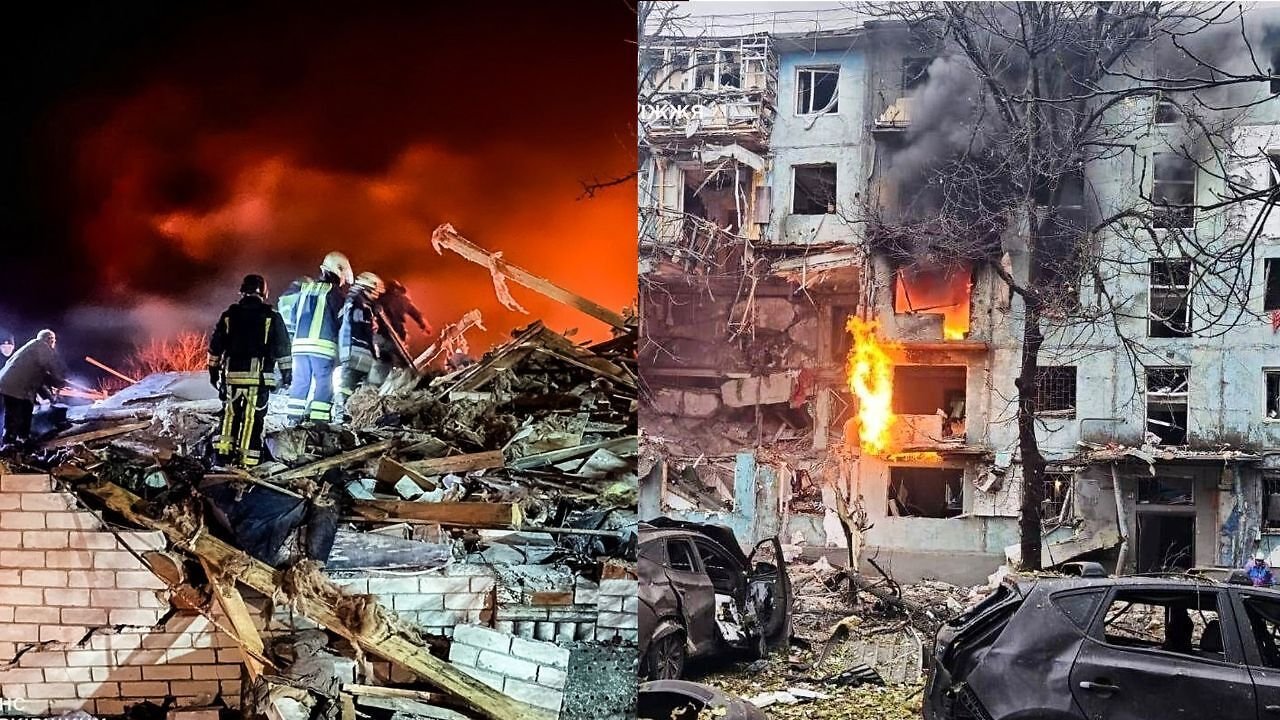
In the fierce war that has been going on between Russia and Ukraine for almost five years, on one hand the exercise of peace talks has intensified at the diplomatic level, while on the other hand the intensity of attacks on the battlefield has reached its peak. In its biggest ever air attack, Ukraine fired about 1,200 drones (1,198 drones) in different parts of Russia overnight. According to confirmation from the Russian Defense Ministry and regional governors, the deadly drone attack caused a massive fire at a major oil refinery and industrial area in the southern Russian city of Volgograd, while more than 7 people (7 to 9 civilians and employees according to local reports) were killed and several people were seriously injured in the attacks in different areas. The attack comes at a time when US President Donald Trump's special envoys have held marathon meetings with Russian President Vladimir Putin in Moscow and Ukrainian President Volodymyr Zelensky in Dublin on a peace deal. Panic created in 17 regions of Russia, 7 energy facilities including Volgograd Refinery were targeted. The Russian Defense Ministry has issued an official statement claiming that their air defense system intercepted and shot down a total of 1,198 Ukrainian drones over 17 different regions of Russia, the Black Sea and Crimea overnight. Despite this, a large number of drones managed to reach their targets. Volgograd Governor Andrei Bocharov confirmed that four workers working there died on the spot and two were injured after a drone fell on an industrial area, while deaths were also reported in other border areas. At the same time, the General Staff of the Ukrainian Army has claimed that in this special operation, seven major oil refineries of Russia – including the centers included in the country's five largest fuel facilities – were successfully targeted. In response, Russia also retaliated with missiles and 117 drones on a hospital and energy grid in Kiev, resulting in the loss of many lives and disruption of power supply in Ukraine. Peace talks from Abu Dhabi to Moscow and Dublin: Putin agrees to include Europe Interestingly, this devastating attack has taken place at a time when US-mediated trilateral peace talks between Russia and Ukraine have been concluded in Abu Dhabi, United Arab Emirates (UAE). In this talk, both the countries have agreed on the biggest prisoner exchange of the war so far. Soon after, US Special Envoys Steve Witkoff and Jared Kushner went to Moscow and met President Vladimir Putin and then reached Dublin, the capital of Ireland, and discussed with President Zelensky. Jared Kushner announced on social media that Russia has now agreed to include European partners in the next round of peace talks to address territorial disputes as well as Europe's broader security arrangement after the war. What is Europe's plan amid peace talks? European leaders become strict regarding NATO and ceasefire Even though America and Russia are talking about including Europe in peace talks, the leaders of European Union (EU) and NATO (NATO) are adopting a very cautious and aggressive stance regarding Putin's conditions. Three key pillars of Europe's strategy have emerged during the meeting of more than 40 European countries in Dublin: Key points of Europe's strategy Official stance and plan of European leaders 1. Complete ceasefire before talks (Ceasefire First) EU's top diplomat Kaja Kallas has made it clear that Russia will have to immediately give a ceasefire before any peace talks can be taken forward, while Putin wants to agree to the terms without ceasefire. 2. No compromise with NATO's security structure German Chancellor Friedrich Merz bluntly said that Europe has no need to renegotiate its existing security arrangement (NATO) with Russia; Europe is considering this as a 'diplomatic trap' of Putin. 3. A common European representative and independent security guarantee Luxembourg Prime Minister Luke Frieden said that Europe cannot leave its future to America or Russia alone. European countries are working on a plan to appoint a common negotiator and provide concrete security guarantees to Ukraine after the war. Starlink speed limit and Putin's old demands increased the confusion. Another major turning point in this whole incident came when Ukrainian President Zelensky complained that the speed limit (100 mph) imposed near the frontline on Elon Musk's company SpaceX's military satellite network Starshield (Starshield / Starlink) was making it difficult for his interceptor drones to stop Russian jet-powered drones. On the other hand, Kremlin aide Yuri Ushakov has made it clear that President Putin has reiterated to the US envoys his old demands for the year 2021—including the withdrawal of NATO forces from Eastern Europe and a complete ban on the deployment of any European peacekeeping force in Ukraine. In such a situation, the buzz of 1,200 drones on one side and the tug of war over diplomatic terms on the other side have made it clear that the path to peace is still very difficult.