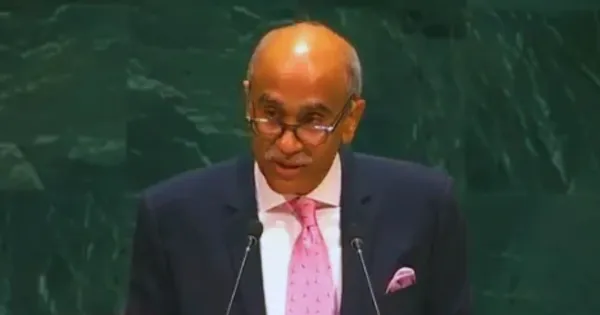
United Nations. India has given a sharp reaction on the veto power in the plenary meeting of the United Nations General Assembly. India has said that it would not be appropriate to create a new category of permanent members without the right to veto. India's Permanent Representative to the United Nations Ambassador Harish Parvataneni said on Monday that as long as the provision of veto exists, all permanent members of the Council should get this right even after reforms.
He said that fairness and justice require that all permanent members have equal rights and responsibilities. He said, “India's position regarding the veto is principled and well known… We once again reiterate that as long as the provision of veto exists, all the permanent members of the Council formed after the reform should have this right.”
Parvataneni, while addressing the Plenary Session of the Inter-Governmental Dialogue (IGN) on 'Thematic Discussion on the Question of Veto' in the UN General Assembly, said that by creating a new category of permanent members without the right of veto under the Security Council reform, the countries included in this category would actually become “second class” members.
India targets P5 countries regarding veto power
Currently, the 15-member UN Security Council has five permanent members – China, France, Russia, Britain and the US. All of them have the right to veto. Apart from this, the council has 10 temporary members, who are elected for a two-year term. This will not change the way the five permanent members (P5) take decisions. India has been consistently demanding expansion of the number of members in both permanent and temporary categories.
Creating a separate category of new permanent members without veto power in the United Nations Security Council (UNSC) would effectively make them “second-tier” members and decision-making rights would remain with the existing five permanent members. -Parvataneni Harish, India's Permanent Representative to the UN
There will be no improvement merely by increasing temporary members.
India has warned that if reform efforts are limited to merely increasing the number of non-permanent members, they will almost prove “failure”. India has been at the forefront of ongoing efforts to reform the Security Council for many years. India says that this institution, created in 1945, is not suitable for the 21st century and does not reflect the current geopolitical realities. India has consistently insisted that it is rightfully entitled to permanent membership in the Security Council.
India's claim on permanent membership
India is also trying to get a non-permanent seat in the Security Council for the term 2028-29. Elections for this tenure are to be held in June next year. There will be a contest between India and Tajikistan for the only seat allotted to the Asia-Pacific group. India had earlier been a member of the Security Council in 2021-22. This was his eighth term on the council. Earlier, India had also been a member of the Council in 1950-51, 1967-68, 1972-73, 1977-78, 1984-85, 1991-92 and 2011-12.