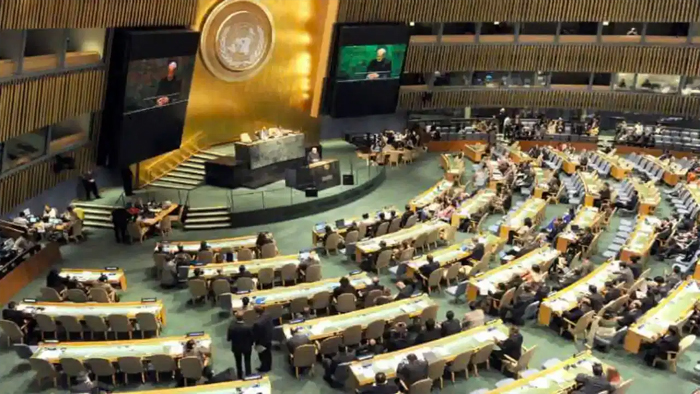
New Delhi: A proposal to ban the death penalty worldwide has been passed in the United Nations General Assembly (UNGA). In the voting held on Friday (November 13), 133 countries voted in its support, although India voted against this proposal. In this resolution, an appeal was made to all countries to stop the use of death penalty and take steps towards abolishing it.
According to the information, 133 countries of the world supported banning the death penalty. Whereas 33 countries including India protested. While 16 countries remained away from voting. However, despite opposition, this proposal was passed.
193 member countries of the United Nations General Assembly on Friday voted on the proposal to ban the death penalty presented by Mexico. During the voting, 133 countries voted in favor of the resolution, 33 countries voted against it, while 16 countries abstained from voting.
Apart from India, Bahrain, China, Egypt, Iran, Iraq, Japan, Kuwait, Maldives, Oman, Pakistan, Qatar, Saudi Arabia and America also voted against the resolution. This proposal was presented by Mexico. In this, an appeal was made to all the countries to stop hanging. Its objective was to gradually move towards abolishing the death penalty.
India said that there is no consensus in the world to abolish death penalty. It is wrong to call the hanging carried out after completing the legal process as 'murder committed by the government'. Bhavika Mangalanandan, First Secretary of India's Permanent Mission to the United Nations, said that there is no consensus among the countries of the world on abolishing the death penalty. He said that every country has the right to decide its own laws and punishments.
Bhavika Mangalanandan said, 'International law allows death penalty with certain conditions. In India, this punishment is given only after the complete legal process. In such a situation, it is wrong to call it a murder committed by the government. He also said that some people are trying to present their personal views as international law. India had also opposed such proposals in 2016, 2018 and 2024.
In India, death penalty is part of the law, but it is not given in every crime. According to the rules of the Supreme Court, it can be given only in the most serious cases i.e. 'rarest of rare' cases. India told the United Nations that many legal procedures are followed before hanging. The accused is considered innocent until his guilt is proven. If death sentence is given by the lower court, its confirmation by the higher court is necessary. The court also considers the reasons for reducing the sentence.
The UN resolution said that people who commit crimes under the age of 18 should not be given the death penalty. Even if a person's age at the time of the crime cannot be determined, he should not be hanged. Apart from this, an appeal was also made to exempt pregnant women, mentally or intellectually disabled people and the elderly from the death penalty. The resolution also asked countries to reduce the number of crimes for which death penalty can be imposed. An appeal was made to remove rules that make it mandatory to impose the death penalty for any crime.
The resolution said that despite the increasing trend to limit the use of death penalty across the world, there has been an increase in recorded incidents of executions in the year 2025. Deep concern was expressed about this. The resolution appealed to all countries to gradually limit the use of death penalty.