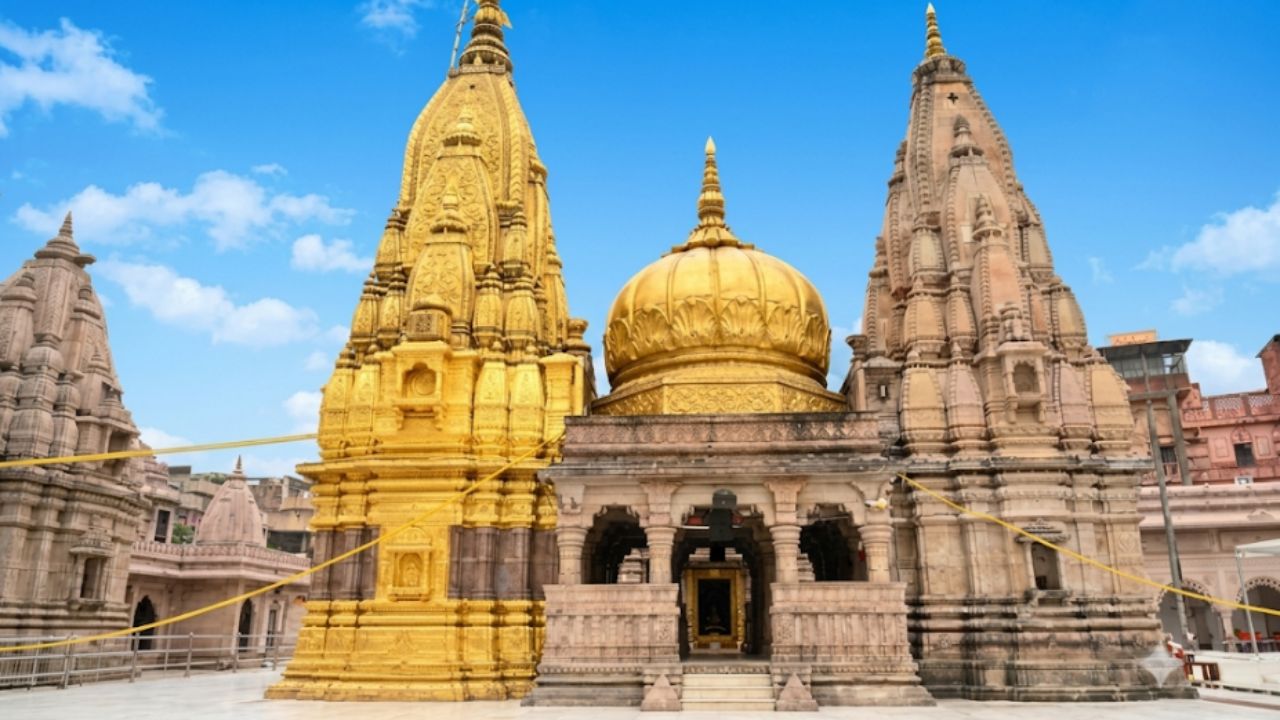
Varanasi and Kashi are considered very important pilgrimage sites in Hindu religion. The oldest mention of Varanasi is found in the Mahabharata. It is told in the religious text Mahabharata that some places on earth are very sacred. Some of these places have become sacred due to the contact with sages and some places have become sacred due to the influence of Gods and Goddesses. In such a situation, Kashi of Uttar Pradesh is very sacred for Shiva devotees. It is said in Shiv Shastra that Lord Shiva is present in every particle of Kashi. For this reason, there are many Shiva temples in Kashi but Vishwanath Temple of Kashi is a very miraculous temple.
In the Kashi section of the religious text Skanda Purana, it is mentioned about 511 Shivalayas of Kashi, out of which 11 are self-established, 46 are established by different Gods, 47 are established by Rishis, 7 are established by the planets, 40 are established by the Ganas and there are 295 other Lingas. Sawan is the favorite month of Shiva. There are two reasons for this. First, when Lord Shiva's body started feeling burning due to drinking poison, the other gods offered water to calm him down. Secondly, Mother Parvati observed a strict fast in this month to attain Shiva. Kashi Vishwanath Temple is considered extremely miraculous. In such a situation, let us know what is the story of Nath Vishwanath Temple.
Also read: When is Dev Diwali, how is this festival celebrated in Varanasi? know this
Vishwanath temple is special for tantric accomplishment
Shri Kashi Vishwanath Jyotirlinga is in two parts. On the right side, Mother Bhagwati is seated in the form of Shakti, while on the other side, Lord Shiva is seated in a beautiful form. That is why Kashi is called Mukti Kshetra. The path of salvation is paved only in Kashi due to Goddess Bhagwati being seated on the right side. It is only in Kashi that a person attains salvation and is freed from the bondage of life and death. Lord Shiva himself enlightens the people here by giving Tarak Mantra. A person who died an untimely death cannot attain salvation without worshiping Shiva here. The most important is the Shikhar of the sanctum sanctorum in Baba Vishwanath Darbar, in which the dome above is adorned with Shri Yantra, which is the best place for Tantric Siddhi. Shri Yantra is considered important for Tantra Sadhana.
From the point of view of Tantra, there are four main gates in the court of Baba Vishwanath, which are as follows. The first is peace door, second is art door, third is prestige door and fourth is retirement door. These four gates have different places in the system. This will not be found in the whole world, where Shiva and Shakti are present together and Tantra is the door.
Also read: Weekly Horoscope: From Aries to Pisces, how will be the condition of all the 12 zodiac signs this week?
Kashi is identified with Kashi Vishwanath. Lakhs of devotees come here every day. It is a different matter that after the demolition of Ram temple in Ayodhya, this temple was declared a high security zone and special deployment of heavy security personnel was made. Devotees are searched and given entry half a kilometer before the temple, where cameras, mobiles, watches and pens are kept here.
Five aartis are performed in Vishwanath temple.
Mangala, Bhog, Sapt Rishi, Shringar and Shayan Aarti. In this, first of all the priest applies Bhabhut, Bhasmi etc. on his body to bring himself in the form of Shiva. After this, ashes, achaman, panchamrit bath and clothes are offered to Baba Vishwanath ji. Then adornment is done with sandalwood, Rudraksha rosary, Belpatra, Abir-Gulal and finally flower garland. In the evening Shringaar Aarti, Baba is adorned like a king with a gold crown and other gems, whereas during the night time Shringaar Aarti, no one enters the sanctum sanctorum. In this Aarti, devotees sing hymns in the rhythm of Damru and bells and the Aarti continues. In Shringaar Aarti, the priest performs Aarti sitting, whereas in the remaining four Aarti, he performs Aarti while standing.
Also read: What rules should be kept in mind while breaking the fast during Chhath? Don't make this mistake
History of Baba Vishwanath Temple
Kashi Vishwanath Temple has been in Kashi since time immemorial. It is found in the scriptures that the present Jyotirlinga was physically visible in the form of Baba Vishwanath. That is why Avimukteshwar in the form of Adi Linga has been considered as the first Linga. It is also mentioned in Mahabharata and Upanishads. There are many things related to the history of Baba Vishwanath, which perhaps very few people would know. Dr. AS Bhatt has mentioned in his book 'Daan Harawali' that after Emperor Akbar, Todarmal had rebuilt the temple in 1558. In 1669, Aurangzeb attacked and damaged this temple. This temple was renovated by Queen Ahilyabai Holkar of Indore in 1777.
Baba has been residing in Kashi since time immemorial. There are descriptions in religious scriptures even before the Mahabharata period. In history books, there is mention of temples and their destruction in the period from 11th to 15th century. Jinaprabh Suri, a contemporary of Mohammad Tughlaq (1325), has written in the book 'Vividh Kalp Tirtha' that Baba Vishwanath was called Dev Kshetra. Author Furer has also written that during the time of Firoz Shah Tughlaq, some temples were converted into mosques. In 1460, Vachaspati described in his book 'Tirtha Chintamani' that Avimukteshwar and Visheshwar are of the same gender.
Also read: Today's Horoscope: From Aries to Pisces, which zodiac signs will have luck today?
Aurangzeb had demolished the temple
Aurangzeb attacked the temple in 1669. At that time, the priests there had hidden the Linga in the Gyanvapi well to save it. The then Kaviraj Chandrabhan Kashmiri had written a letter to Aurangzeb saying, 'O King, see the charisma of the temple, even after falling, there is light in it.' Aurangzeb wanted to change the name of Kashi to Mohammadabad.
After this, Queen Ahilyabai Holkar of Indore renovated the Kashi Vishwanath Temple in 1777. This temple was built in 30 square feet. Its peak is 51 feet. The Queen herself had built five pavilions in this temple. In 1853, King Ranjit Singh of Punjab had gilded the pinnacles of the temple with 22 tonnes of gold.