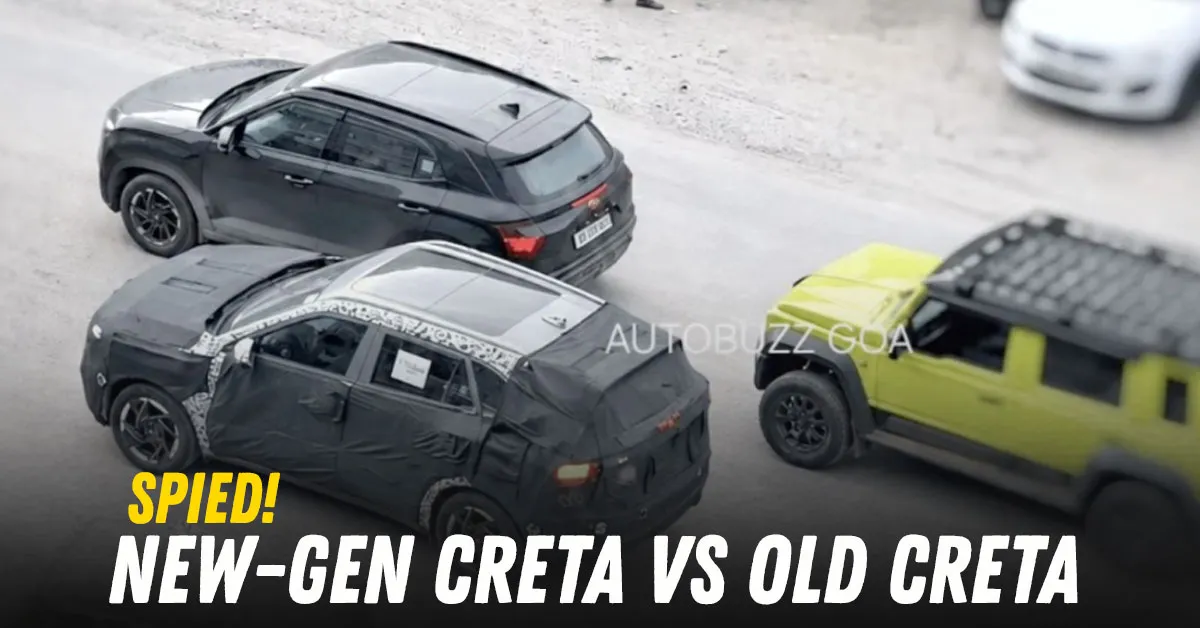
Hyundai is working on the next generation of its most popular SUV, the Creta. Expected to be out in early 2027, the new generational upgrade will bring big changes to the SUV. The project has already entered the testing phase. In the latest set of spy pictures, the camouflaged test mule is seen alongside an older-generation Creta, showing the size difference between the two.
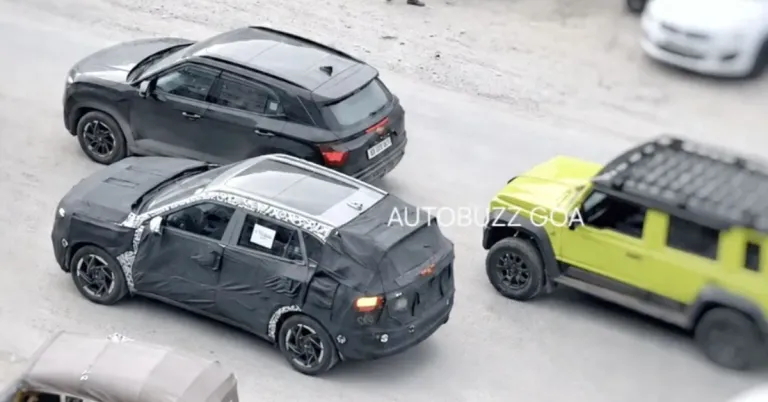
These images are from somewhere in the hills of Northern India. In these, the test mule is seen alongside an old Creta. This gives us an opportunity to compare the two side-by-side. The test mule is clearly larger in comparison. Interestingly, a Maruti Jimny can also be seen nearby. It looks significantly smaller in comparison.
The silhouette seems to have changed in the new generation. It appears to have a more upright and squarer stance. The heavy camouflage makes it difficult to confirm the final design. The rear quarter glass seems to be different from the one on the older car.
The spy shots also show the dual-pane panoramic sunroof. The roof design seems almost similar to that of the current model. The new car will have fresh lighting elements, which have been neatly concealed by the camouflage. The new Creta will ride on new alloy wheels, which are visible in these images.
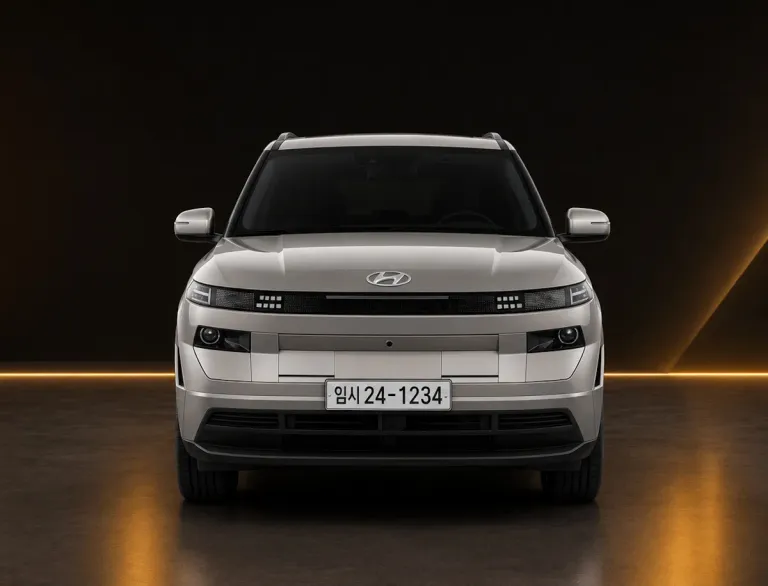
The front design will be new. The SUV will likely have a taller bonnet and more upright front fascia. It will have a stronger road presence than the previous model. The overall design will evolve into something cleaner and more futuristic. It will be a sharp departure from that of the previous model. Previously, it was expected that the new Creta could draw design inspirations from the Hyundai Crater concept shown at the 2025 Los Angeles Auto Show. It remains to be seen if this would be the case.
Designed by Hyundai’s California design studio, the Crater concept, Hyundai says, previews the next phase of its SUV future. It is based on the ‘Art of Steel’ philosophy.
The outgoing Creta is based on Hyundai’s K2 platform. It measures 4330 mm in length, 1790 mm in width, and 1635 mm in height. The next-generation model will be underpinned by the third-generation K3 platform. This is the same platform used in the second-generation Seltos. Like the Seltos, the Creta is also expected to grow in size with the generational update. The exact extent of this growth remains unknown for now. The K3 platform is expected to improve the safety, comfort and dynamics.
Being a full generational update, the new Creta is expected to get a fresh interior design. The cabin is expected to offer more space, particularly at the rear. It will look more modern and will be tech-heavy. The overall choice of colours and material quality will improve. The layout will be clean and functional. The feature list will be revised on the new model.
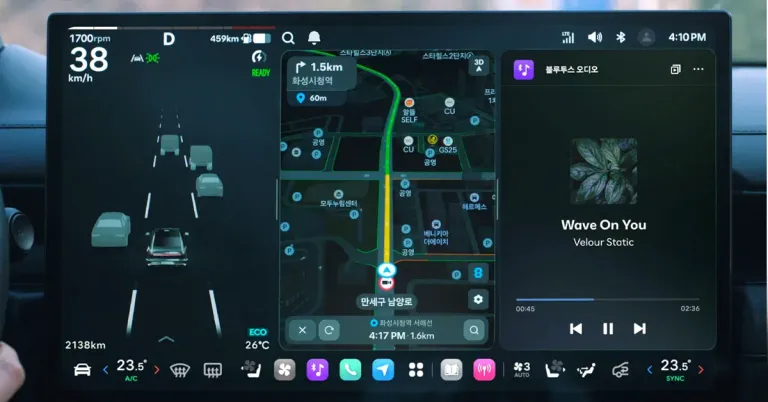
The most important addition will, however, be the carmaker’s Pleos Connect infotainment system. The outgoing Creta comes with a 10.25-inch infotainment touchscreen and 10.25-inch instrument cluster. Instead of these, the Pleos Connect system will use a large (read massive) central touchscreen and a sleek driver’s display.
The exact size of the central screen remains unknown for now. Physical controls will be retained for easier and hassle-free access, and minimal driver distraction. The user interface will also be new and more user-friendly.
Features like the wireless charger, panoramic sunroof, ambient lighting, dual-zone climate control, ventilated seats etc will be carried over to the next-generation Creta as well. It may also feature shift-by-wire technology.
The next-generation Creta is expected to use the three familiar engines- 1.5-litre naturally aspirated petrol, 1.5-litre turbocharged diesel and 1.5-litre turbocharged petrol, initially. Both manual and automatic transmissions will be retained.
In the coming years, a new 1.5-litre strong hybrid petrol engine is also likely to be introduced on this SUV. It will reportedly excel with its performance and fuel efficiency. The hybrid powertrain is still under development and hasn’t made its global debut yet. Its power and torque figures remain under the wraps.
Spy shot souce: Carcharcha