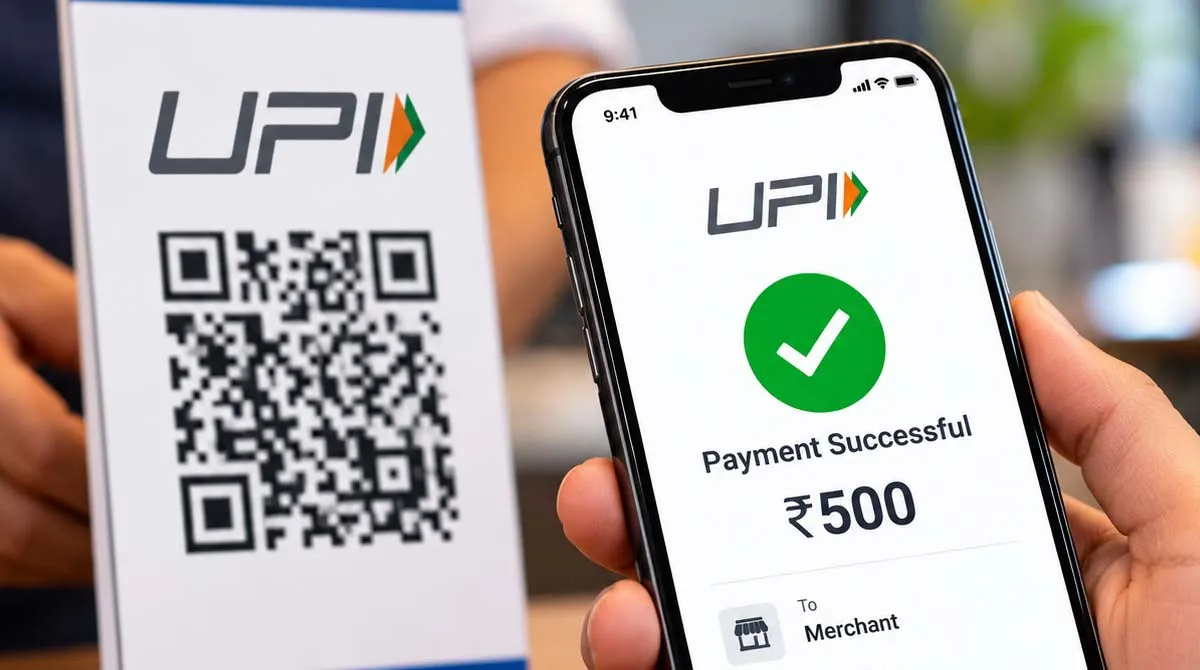
Where will all the MDR money go? Government cleared the confusion
These days there is a stir all around regarding digital payments. Finance Minister Nirmala Sitharaman has completely rejected all the allegations of the opposition that the decision to impose 0.4 percent merchant discount rate (MDR) on some UPI transactions above Rs 2000 was taken under some pressure. He has made it clear that this step has been taken to make the digital payment system more strong and better.
In a special conversation with PTI, the Finance Minister said that this decision has been taken completely professionally and thoughtfully. This has been decided jointly by the National Payments Corporation of India (NPCI), payment banks and merchant banks, and not forcibly imposed by the government. He also stressed that MDR is not a tax of any kind and not a single rupee of it is going to go to the government treasury. Taking aim at the opposition, he said that only issues are being created without understanding the whole thing.
Know who will get every penny of MDR?
The biggest question in people's minds is that if this is not a tax, then to whom will the money collected from it go? The Finance Minister has put the full account of this in front of everyone. He clearly said that this is neither a cess nor a surcharge, hence its money will not go to the Consolidated Fund of India at all.
All this money will be distributed directly among different institutions and banks associated with the UPI ecosystem. Let us know which shareholder will get how much share:
- 40 percent of the MDR collected will go directly to the customers' own banks.
- About 30 percent will go to the payment gateway.
- About 20 percent share will go to the UPI app through which the payment is made.
- The remaining 10 percent will go to the account of the sponsor bank of the UPI app.
Know when will the new rules come into effect and who will be affected?
Let us tell you that from October 15, 0.4 percent MDR is going to be applicable on person-to-merchant (P2M) UPI payments of more than Rs 2000. The most reassuring thing is that this charge will be imposed on shopkeepers i.e. merchants, it will not have any impact on the pockets of common customers. Apart from this, the maximum charge for transactions of Rs 75,000 or more has been fixed at Rs 300. Money transactions between common people and most everyday merchant payments will remain free as before.
Different rules have also been set according to different sectors. For essential services like railways, telecom, fuel and insurance, there will be a flat charge of only Rs 5 on every transaction above Rs 2000. Whereas for capital market related transactions like mutual funds and stock broking, a very low rate of 0.02 percent will be applicable, the maximum limit of which will be Rs 300.
Relief to small shopkeepers and new order of NPCI
The government and NPCI have taken special care of small traders. Small merchants who take payments up to Rs 1 lakh per month through UPI QR code will be completely exempted from this new charge. This means that this new rule will not have any impact on about 96 percent of the merchant transactions in the country.
Let us remind you that NPCI, the organization operating the UPI platform, had issued a circular in this regard on September 15 itself. Its main objective is to make the digital payment system sustainable in the long run. Along with this, a special fund will also be created to promote small shopkeepers, in which 5 percent of the total MDR collection will be deposited. With this excellent initiative, the scope of digital payments in the country will expand more rapidly.