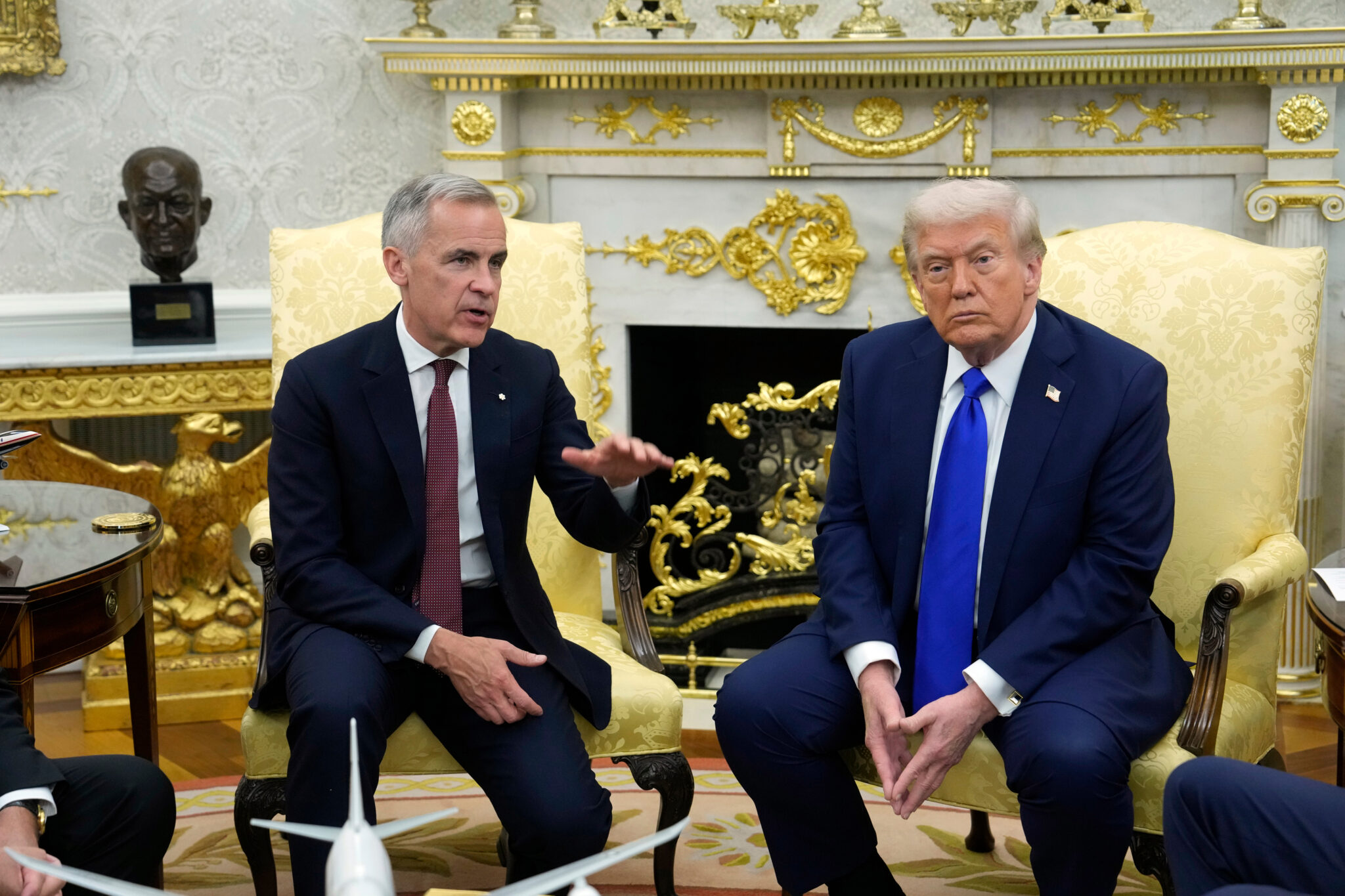
US and Canada Race to Avert Trump’s 50% Tariffs Before Deadline/ TezzBuzz/ WASHINGTON/ J. Mansour/ The United States and Canada are holding intensive negotiations to prevent 50% tariffs on $20 billion in Canadian products from taking effect Wednesday. Washington is seeking Canadian purchases of U.S. military equipment, participation in Trump’s Golden Dome system and greater access to critical minerals. Canada wants relief from existing steel, aluminum and lumber tariffs but faces domestic pressure not to appear to surrender to Trump’s demands.
Quick Look
- Trump’s tariff deadline is 12:01 a.m. Wednesday.
- The proposed 50% duties cover $20 billion in Canadian products.
- Affected goods range from hockey sticks to tongue depressors.
- Trump and Prime Minister Mark Carney spoke Monday.
- Canadian and U.S. trade officials also held negotiations.
- Approximately 72% of Canadian goods exports go to the United States.
- About $2 billion in goods cross the border daily.
- Nearly 330,000 people cross the border each day.
- Washington wants Canada to buy more U.S. defense equipment.
- U.S. demands reportedly include F-35 fighter purchases.
- Trump also wants Canada involved in Golden Dome.
- Washington seeks greater access to Canadian critical minerals.
- Canada wants relief from steel and aluminum tariffs.
- Ottawa also seeks lower duties on softwood lumber.
- Trump invoked Section 338 of a 1930 tariff law.
- The provision has never previously been used.
- It allows tariffs as high as 50% without an investigation.
- The tariff threat gives Washington leverage in USMCA negotiations.

Deep Look
US and Canada seek tariff truce
WASHINGTON — The United States and Canada are negotiating intensively ahead of a deadline for President Donald Trump’s proposed 50% tariffs on Canadian products.
The duties are scheduled to take effect at 12:01 a.m. Wednesday unless the two countries reach an agreement.
They would apply to approximately $20 billion in Canadian goods, including products ranging from hockey sticks to tongue depressors.
The negotiations represent a last-minute effort to prevent another major escalation in North American trade tensions.
Carney describes talks as delicate
“We are negotiating,” Canadian Prime Minister Mark Carney told reporters Monday in French. “The negotiations are very intense and delicate. This is not the time to talk about negotiations in public.”
Carney and Trump discussed the trade dispute by telephone Monday afternoon.
The call underscored the urgency of the negotiations as officials attempted to reach an agreement before the deadline.
Carney’s office offered few details about the discussion.
Longstanding relationship faces unusual strain
The United States and Canada have disputed trade policy for decades, particularly over Canadian softwood lumber and access to Canada’s protected dairy industry.
Despite those disagreements, the countries remained close allies and major trading partners.
Canadian troops fought alongside American forces in Afghanistan following the Sept. 11, 2001, attacks.
The 5,525-mile border is undefended, and approximately 330,000 people cross it each day.
Daily trade between the two countries totals about $2 billion, while roughly 800,000 Canadians live in the United States.
Trump departs from traditional cooperation
Trump’s approach marks a significant departure from the historically cooperative relationship.
He has imposed tariffs on Canadian products as part of a broader effort to move manufacturing back to the United States.
The president has also repeatedly discussed turning Canada into America’s 51st state.
Those remarks have angered Canadians and increased political pressure on Carney to resist further U.S. demands.
Petition targets US ambassador
A petition calling for the expulsion of U.S. Ambassador Pete Hoekstra has collected nearly 218,000 signatures since July 21.
Hoekstra is a Trump ally.
The petition accuses him of having “normalized” Trump’s statements about annexing Canada.
Public anger over the administration’s rhetoric could make it harder for Canadian officials to offer concessions during negotiations.
Both sides seek an off-ramp
Canada sends nearly 72% of its goods exports to the United States, making continued access to the American market economically vital.
The Trump administration also faces risks from imposing additional tariffs.
U.S. importers pay the duties and often transfer the cost to consumers through higher prices.
That could worsen voters’ concerns about living expenses ahead of the November midterm elections.
Trade expert expects compromise effort
“I don’t think either side really wants these tariffs to come into effect,’’ said Ryan Majerus, a partner at King & Spalding and former U.S. trade official. “There’s a pretty strong push on both sides to find an off ramp here.’’
The two governments nevertheless need an agreement that can be presented domestically as a meaningful victory.
Trump is seeking concessions that advance his defense, industrial and strategic objectives.
Carney needs relief substantial enough to justify any compromises Canada makes.
US seeks defense purchases
Majerus said Washington wants Canada to purchase additional American military equipment.
That includes F-35 fighter aircraft.
The United States is also pressing Canada to participate in Trump’s proposed “Golden Dome” missile-defense system.
Such agreements could benefit U.S. defense companies while allowing Trump to argue that Canada is contributing more to continental security.
Critical minerals part of negotiations
Washington also wants greater access to Canadian critical minerals.
These materials are essential for defense equipment, electronics, electric vehicles and other advanced technologies.
Expanded access would help the United States reduce its reliance on supplies from China.
American officials increasingly view critical minerals as an issue of national and economic security.
Canada seeks tariff relief
Canada wants the United States to reduce or remove duties on steel and aluminum.
Ottawa also seeks relief from U.S. tariffs on Canadian softwood lumber.
Washington argues that Canada unfairly subsidizes its lumber industry.
The lumber dispute has persisted for decades, periodically producing duties and legal challenges.
Supreme Court struck down earlier tariffs
Trump has made tariffs a defining element of his second-term economic policy.
Last year, he imposed double-digit duties on imports from nearly every country, citing the U.S. trade deficit as a national emergency.
The Supreme Court ruled in February that Trump had exceeded his authority.
The decision invalidated those tariffs and opened the possibility of federal refunds to importers.
Trump rebuilds tariff system
Following the court decision, Trump searched for alternative legal authority to restore his tariff policy.
Last month, he imposed duties ranging from 10% to 12.5% on 59 countries and the European Union.
Those trading partners account for 99% of U.S. imports.
The administration accused them of failing to impose or enforce adequate restrictions on products made with forced labor.
Trump invokes Depression-era law
For Canada, Trump relied on Section 338 of the Tariff Act of 1930.
The law is associated with the Smoot-Hawley tariffs enacted during the Great Depression.
Economists and historians widely blame those duties for restricting global trade and worsening the economic downturn.
Trump invoked Section 338 to impose 50% tariffs on products representing approximately 5% of Canadian exports to the United States.
Section 338 has never been used
The Section 338 tariff authority has never previously been used.
It allows the president to impose duties of up to 50% on imports from countries accused of discriminating against American businesses.
Unlike actions under Section 301 of the Trade Act of 1974, Section 338 does not require an investigation.
The law also establishes no limit on how long the tariffs may remain in effect.
Trump cites Canadian discrimination
Trump says Canada discriminates against American exports involving automobiles, alcohol and cheese.
He has also criticized Canada for retaliating against earlier U.S. tariffs.
Canada and China were the only countries to respond with duties of their own when Trump imposed levies last year.
The administration says it will not tolerate retaliation against American trade measures.
Greer warns against retaliation
“If a country retaliates against us, we’re obviously not going to tolerate that,” U.S. Trade Representative Jamieson Greer said Friday at the Iowa State Fair.
“We’ll take action. My sense is the Canadians, they want to have a more conciliatory approach, but we’ll see.”
His remarks signaled that further Canadian retaliation could produce another American response.
That raises the possibility of a wider cycle of tariffs and counter-tariffs.
Tariffs add leverage in USMCA talks
The United States, Mexico and Canada are renegotiating the USMCA regional trade agreement.
Trump pressured both neighboring countries to accept the deal during his first term as a replacement for NAFTA.
The new tariff threat gives Washington additional leverage to seek concessions from Ottawa during the review.
However, a full trade conflict could make constructive USMCA negotiations difficult.
Trade war could obstruct renegotiation
“From Carney’s perspective, you need (USMCA) to be renegotiated,” said Christopher Gundermann of the Center for Strategic and International Studies. “You can’t renegotiate it with a massive trade war going on.’’
Canada therefore has a strong interest in preventing the duties from taking effect.
At the same time, agreeing under intense pressure could weaken Carney politically and encourage future U.S. demands.
Canadian anger limits Carney
Canada could retaliate again if Trump’s 50% tariffs take effect.
However, additional countermeasures would deepen the economic confrontation and raise costs on both sides of the border.
Carney must balance the country’s economic dependence on U.S. trade against public demands for a firm response.
Any deal viewed as one-sided could provoke a domestic backlash.
Government cannot appear to surrender
Canada’s government “cannot look like it is simply caving to the Trump administration’s demands,’’ said Daniel Béland, a political science professor at McGill University.
“Making further concessions without getting something meaningful in exchange would probably lead to a strong backlash … The risk is for the Carney government to make Canada look weak and, therefore, even more vulnerable to future trade and geopolitical bullying on the part of the Trump administration.”
The political limits leave negotiators with little time and a narrow path toward compromise.
Negotiations continue before deadline
Canadian Minister for U.S. Trade Dominic LeBlanc met Greer on Monday.
He disclosed little afterward about the negotiations or whether an agreement was close.
“The work is continuing,’’ LeBlanc said. “We continue to do our job.’’
Unless negotiators find an acceptable off-ramp, the 50% tariffs will begin affecting Canadian goods early Wednesday.
More on US News