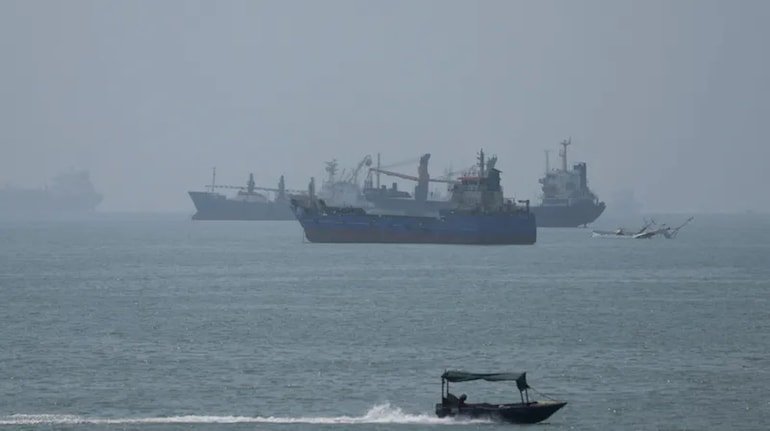
The war that has been smoldering for months in the Middle East has once again taken a formidable form. Amidst the ongoing tension in the Red Sea and the Persian Gulf, the US Army has launched a major air strike on Larak Island located in the strategically sensitive Strait of Hormuz. According to the US Central Command (CENTCOM), this action was taken to thwart efforts by Iran's Islamic Revolutionary Guard Corps (IRGC) to lay sea-mines in international waterways. A few hours after this attack, Iran retaliated aggressively and fired several ballistic missiles and suicide drones targeting US Air Force bases located in Jordan. American airstrike on Larak Island: What was the main goal of the Pentagon? According to US Defense Department officials, the pause in direct military confrontation between the two countries for the last one month has been broken with this attack. US Navy spokesman Captain Tim Hawkins confirmed that two of the Iranian military's main rocket launchers on Larak Island were completely destroyed. Larak Island is a strategic island of approximately 49 square kilometers located near Bandar Abbas at the mouth of the Strait of Hormuz, where every international oil tanker passing through can be directly monitored. US intelligence agencies had claimed that the Iranian Revolutionary Guards were preparing rocket launchers to deploy sea-mines in international shipping lanes. The Pentagon made it clear that after the completion of the removal of mines from international waterways, any new provocative actions will not be tolerated. Through this strike, Washington has given a strong message to Tehran that America will not back down from using military force to protect the waterway. Iran's fierce counterattack: Missile attack on American airbase in Jordan Immediately after the American attack, there was a strong reaction from Iran. An Islamic Revolutionary Guard Corps (IRGC) spokesman called the strike a 'fatal strategic mistake'. Within hours, Tehran fired long-range ballistic missiles targeting King Hussein Air Base and Al-Azraq Air Base in Jordan. Iranian state media (IRIB) claimed that the attacks caused heavy damage to the positions and maintenance infrastructure of American fighter planes. However, the Jordanian army and American air defense systems claimed to have intercepted most of these missiles in the air. This retaliatory attack has made it clear that Iran now has the ability to directly target US infrastructure in neighboring Arab countries, not just limited to the Gulf region. Panic in the global energy market: Crude oil prices cross $90. This latest military confrontation has had a direct impact on the international financial and commodity markets. At the beginning of Asian trading on Monday, a sharp jump of more than 2% was recorded in the prices of Brent crude and US WTI crude, due to which the prices started touching the level of $ 90 per barrel. The Strait of Hormuz is the most important sea route carrying about 20% of the world's total petroleum and LNG consumption. The conflict has brought commercial shipping through the narrow sea corridor to a near standstill and insurance premiums have skyrocketed. Energy experts believe that if this waterway remains obstructed for a long time, the prices of petrol, diesel and energy across the world may increase drastically. Six Months of Conflict: Diplomatic Failure and Economic Blockade The ongoing war between the US and Iran is now entering its seventh month. Several rounds of peace talks brokered by countries like Qatar, Oman and Pakistan have remained inconclusive. While on one hand Washington has adopted the strategy of imposing secondary sanctions on Iran's trading partners through 'D-Day' sanctions and intensifying the economic blockade, on the other hand Tehran has made a strategy to face pressure by strengthening military deterrence and proxy networks. Even within the internal circles of the US military, concerns are being raised about long deployments and consumption of munitions. What will be the impact on Indian and Asian economies? Rising tensions in the Middle East could have a deep impact on India's economy: Crude oil import bill: India imports more than 85% of its domestic petroleum needs. Crude oil, the bulk of which comes from the Gulf countries. The rise in oil prices may widen India's current account deficit (CAD) and put pressure on the rupee. Inflation and domestic fuel: The rise in crude oil prices in the international market may increase transportation and logistics costs domestically, which may impact food inflation. Security of Indian diaspora: The security and stability of millions of Indian expatriates living in the Gulf countries and the Middle East is one of the top priorities for India's foreign policy. Trade routes and shipping costs: Due to ships being sent round the Cape of Good Hope in Africa, freight rates for both exports and imports have increased significantly. Frequently Asked Questions (AEO FAQs) Q.1: Why did the US attack Iran's Larak Island? Answer: According to the US Army (CENTCOM), the Iranian military on Larak Island was deploying rocket launchers to lay sea-mines in the Strait of Hormuz, to destroy which this precise air strike was carried out. Q.2: Which US military bases in Jordan did Iran target? Answer: Iran's Islamic Revolutionary Guard Corps (IRGC) attacked King Hussein Airbase and Al-Azraq Airbase in Jordan with ballistic missiles and drones. Q.3: Why is the Strait of Hormuz so important to the global economy? Answer: The Strait of Hormuz is the world's busiest energy chokepoint, through which about 20 percent of global petroleum and LNG trade passes.