
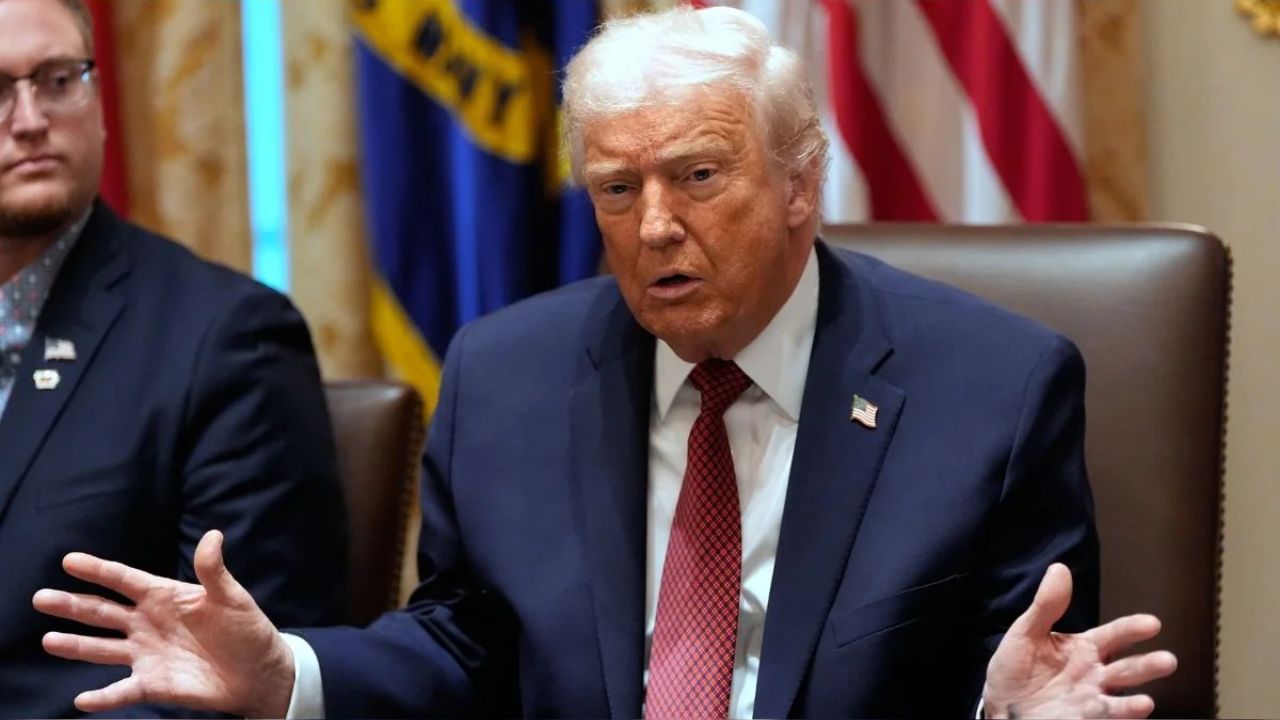

Washington. After seven consecutive failures, the US Senate has finally passed an important resolution limiting the war powers of current US President Donald Trump. This proposal has been brought specifically to stop any military action against Iran. This step of the Senate is being considered a big blow to the Trump administration, because now the President will not be able to declare war against Iran on his own will.
Voting took place on this proposal in the Senate. 50 votes were cast in favor of this proposal, while 47 votes were cast against it. The most surprising thing was that four MPs (Senators) of the current US President Trump’s own Republican Party rebelled and supported the opposition party (Democrats) and voted in favor of the proposal. The four Republican leaders who voted against Trump are Susan Collins, Lisa Murkowski, Rand Paul and Bill Cassidy. According to CBS News, this was the eighth attempt by the Democratic Party to pass this proposal, which has now been successful.
What is the real meaning of this proposal passed in the Senate?
This proposal was introduced by Democratic Party Senator Tim Kaine. The simple and clear meaning of this proposal is that the current US President Trump cannot attack Iran without the approval of the Parliament. It is clearly written in the proposal that until the Congress (US Parliament) officially declares war or receives special approval for the use of military force, the President will have to keep the US military away from any kind of hostilities against Iran. This law directly curbs the powers of the President.
How have Democratic leaders reacted to this victory?
There is immense enthusiasm among Democratic leaders after the passing of this proposal. California’s Democrat Senator Adam Schiff wrote on the social media platform ‘X’ that Senate Democrats have once again voted to end this ‘unconstitutional war’. He thanked Republican colleagues who supported this proposal while fulfilling their constitutional responsibility. At the same time, Senator Bernie Sanders also welcomed this step, saying that the American people do not want to spend billions of dollars on endless wars. He said that the public wants us to solve the major problems of the country and end this unconstitutional war immediately.
Why did current US President Trump stop the attack on Iran?
All this is happening in the Senate at a time when a peace deal is being negotiated between the US and Iran. Earlier on Monday, Trump himself had revealed that he had stopped a major ‘planned attack’ on Iran. In a long post on his ‘Truth Social’ account, Trump said that Qatar’s Emir Sheikh Tamim bin Hamad Al Thani, Saudi Arabia’s Crown Prince Mohammed bin Salman and United Arab Emirates (UAE) President Mohammed bin Zayed Al Nahyan had made a special appeal to him to avoid this attack. These leaders believed that serious talks are going on now and a good agreement can be reached.
What is the biggest condition of the peace agreement?
After the appeal of top leaders of Gulf countries, Trump postponed the attack on Tuesday, but he has also put one of his biggest conditions before the world. Current US President Trump has said in very clear words that the most important thing in this peace agreement will be that ‘Iran will not have any nuclear weapons.’ Trump said that out of respect for the Gulf leaders, he has given strict instructions to his War Secretary Pete Hegseth and Joint Chiefs of Staff Chairman General Daniel Cain to stop Tuesday’s attack.
What will be America’s next step if talks fail?
Even though America has stopped military action against Iran for now, the danger has not been completely averted. Trump has put his army on alert mode. He has given a clear warning in his post that he has instructed the US Army that if no acceptable agreement can be reached with Iran, then the army should be fully prepared to launch a ‘full scale assault’ against Iran with full force at a moment’s notice. That means if peace talks fail, a devastating attack on Iran is certain.

Comments are closed.