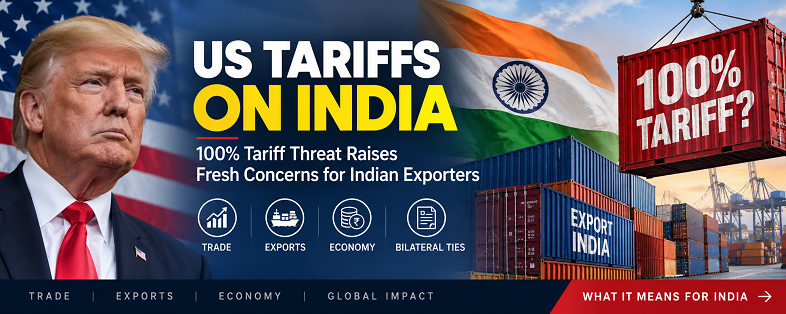

NEW DELHI, September 19, 2026: India-US trade relations are facing a fresh tariff challenge after US President Donald Trump signed legislation giving his administration authority to impose tariffs of up to 100 per cent on countries that continue to purchase large quantities of Russian oil and gas. India, one of the major buyers of Russian crude, could potentially be affected, although the new law does not automatically impose a 100 per cent tariff on Indian goods.
The legislation, known as the Lindsey O. Graham Sanctioning Russia and Iran Act of 2026provides the US President with expanded powers to penalise major buyers of Russian energy. The measure allows tariffs of as much as 100 per cent on goods from up to five major purchasers of Russian oil and gas. The legislation does not specify that India will definitely face the maximum tariff, leaving the actual application dependent on subsequent decisions by the US administration.
The development comes after a series of changes in US tariff policy affecting Indian exports. In July, the United States finalised a separate Section 301 measure related to forced-labour import restrictions, imposing an additional 10 per cent duty on Indian goods covered by the measure. India had initially faced a proposed 12.5 per cent rate, which was subsequently reduced to 10 per cent in the final action.
India’s Commerce Ministry has been engaging with Washington on the tariff issue and on the broader India-US bilateral trade agreement. According to the Indian government, several categories of exports—including generic pharmaceuticals, smartphones and specified products—remain outside the additional Section 301 duty. Products already subject to Section 232 measures, including steel, aluminium and auto parts, are also excluded from the additional 10 per cent measure.
The latest tariff threat is particularly significant because of the role of the US market in India’s merchandise exports. Reuters reported that Indian goods shipments to the United States rose to $42.79 billion during April-August 2026, compared with $40.39 billion in the corresponding period a year earlier. Any substantial increase in duties could therefore affect exporters competing on price in the US market.
India has meanwhile stressed the importance of protecting its energy security while continuing discussions with Washington. New Delhi has conveyed that measures targeting countries buying Russian oil could have implications for bilateral economic relations as well as international energy markets. The government has also reiterated its interest in maintaining a balanced and mutually beneficial trade relationship with the United States.
The situation also has implications for Indian businesses beyond exporters. Higher US duties could influence pricing, supply-chain decisions, sourcing strategies and investment plans for companies with significant exposure to the American market. At the same time, the eventual impact will depend on whether additional tariffs are actually imposed, which products are covered, and whether exemptions or trade arrangements are negotiated.
For now, the latest development represents a tariff risk rather than a confirmed 100 per cent duty on Indian imports. The US administration has authority to take further action, but the timing, coverage and eventual tariff rate remain subject to future decisions. India and the United States continue to have an economic relationship spanning merchandise trade, technology, pharmaceuticals, services, energy and investment, making the outcome of ongoing trade negotiations significant for businesses on both sides.