
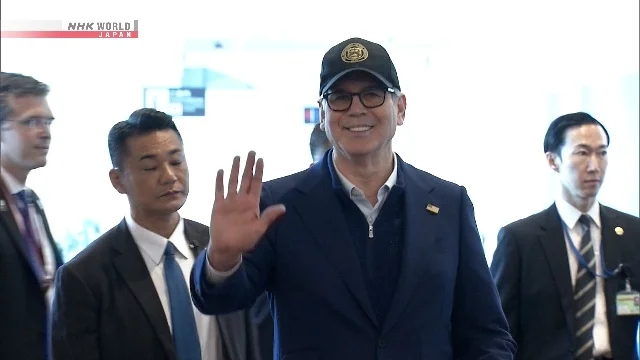

Tokyo, 12 May : United States Treasury Secretary Scott Bessent commenced his third official visit to Japan on Monday, holding pivotal discussions with Finance Minister Satsuki Katayama that underscore mounting trans-Pacific tensions over monetary strategy and currency interventions.
Bessent, renowned for his incisive macroeconomic acumen honed during a storied tenure as a hedge fund titan, arrived amid heightened scrutiny of Tokyo’s recent multimillion-yen interventions to bolster a depreciating currency. These maneuvers, executed last week, have drawn Bessent’s prior censure, as he champions Bank of Japan interest rate normalization over ad hoc market props, arguing the former better anchors inflation expectations and mitigates excessive forex volatility.
The itinerary’s gravity stems from a fractious January prelude at the Davos World Economic Forum, where Bessent delivered what Japanese insiders described as a stern dressing-down to Katayama. During a sidebar parley, he unleashed a torrent of policy prescriptions—delivered with such velocity that her note-taker labored to transcribe them—amid a Japanese sovereign bond rout contaminating U.S. Treasury yields. Publicly, via Fox Business, Bessent amplified the exhortation, voicing certitude that Tokyo would quell the disorder; Katayama’s subsequent pledge of “responsible and sustainable” fiscal stewardship duly assuaged investor jitters.
This assertive posture, informed by Bessent’s lucrative Japan wagers in his pre-public service career, signals Washington’s intolerance for allied policies inadvertently stoking U.S. borrowing costs, already ballooning under sustained deficits.
Prime Minister Sanae Takaichi confronts a dichotomous challenge: harnessing U.S. approbation evident in Bessent’s en route detour before a Trump-Xi summit—while safeguarding her expansionary playbook of stimulus infusions and tax relief, poised to elevate Japan’s debt-to-GDP ratio beyond 260 percent. Bessent’s advocacy for “sound” BOJ autonomy clashes with Takaichi’s aversion to rate hikes, echoing Abenomics-era laxity but ill-suited, in his view, to today’s inflationary milieu.
Official U.S. readouts from prior Katayama sit-downs reaffirm alliance bedrock spanning OECD tax accords and energy security yet invariably pivot to monetary rectitude, with Bessent decrying “inherent undesirability” of yen gyrations and urging communicative policy rigor.

Comments are closed.