
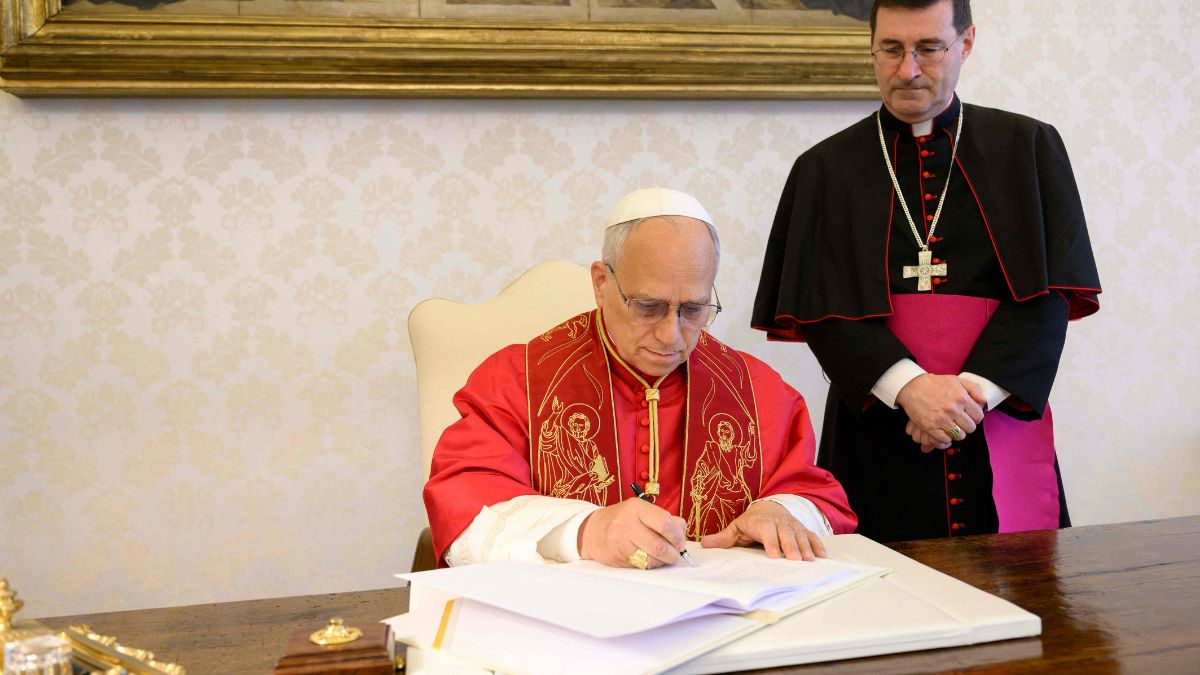

Pope Leo XIV has issued a sweeping 42,300-word encyclical, Magnifica Humanitas (“Magnificent Humanity”), laying out the Catholic Church’s most comprehensive moral framework yet for the age of artificial intelligence. The document was signed on May 15, on the 135th anniversary of Rerum Novarum, the landmark 1891 encyclical of Pope Leo XIII that addressed worker exploitation during the Industrial Revolution.
Magnifica Humanitas seeks to define how humanity should confront a technological revolution that, the Pope argues, is advancing faster than the ethical systems meant to govern it. Rather than rejecting artificial intelligence outright, Leo acknowledges its extraordinary potential to reduce suffering, improve health care and expand human knowledge. But he insists that technological progress must remain subordinate to human dignity and the common good, rather than to commercial monopolies or geopolitical competition. At the heart of the encyclical lies a repeated warning: AI must be “disarmed” of the logic of domination, exclusion and death, and brought under meaningful democratic regulation.
A major focus of the document is the growing disruption AI could inflict on the global workforce. Leo warns that any society that guarantees meaningful employment only to a privileged minority risks not merely economic instability, but “anthropological regression” and the collapse of social peace. The timing of the encyclical was deliberate.
Just as his predecessor confronted the moral crises created by industrial capitalism, Leo XIV is attempting to adapt Catholic social teaching to the disruptions of the AI era. He argues unequivocally that corporate profitability cannot justify the systematic elimination of human labour. Work, he writes, is not merely an economic necessity but a source of dignity, maturity and personal fulfilment. For that reason, governments and corporations have a moral obligation to provide verifiable retraining programmes and protections for workers displaced by automation.
The encyclical is particularly critical of what the Pope calls the modern “culture of power” emerging in Silicon Valley. Leo condemns the concentration of computing infrastructure, AI models and global data flows in the hands of a small number of private companies, arguing that such concentration creates new inequalities while evading democratic oversight. He warns that the world is entering a new age of “digital colonialism”, in which powerful states and corporations extract health, behavioural and demographic data from populations across the globe.
According to the Pope, these vast datasets have become the new “rare earths” of global power. They are used to train predictive systems that increasingly determine who receives credit, employment, medical treatment or social visibility. To prevent human beings from being reduced to data profiles, Leo insists that algorithms influencing public life must remain transparent, contestable and subject to independent oversight.
Yet the encyclical reserves its strongest language for the military uses of artificial intelligence. Arguing that machines can never bear moral responsibility, Leo says it is morally reprehensible to allow lethal decisions to be made by autonomous systems. Human conscience, he writes, cannot be replicated through computation, and no algorithm can make warfare ethically acceptable.
The Pope also warns that unmanned systems lower the psychological threshold for conflict. By distancing societies from the human cost of violence, AI-driven warfare risks transforming military defence into perpetual threat prediction and automated escalation. In what many theologians are describing as a historic shift, Leo effectively declares the Church’s traditional “just war” doctrine outdated in the face of modern autonomous weaponry. He calls for urgent international action to prevent an AI arms race and demands that artificial intelligence be stripped of militaristic applications.
Beyond economics and warfare, Magnifica Humanitas ventures into deeper philosophical territory. Leo explicitly rejects transhumanism and posthumanism, ideological currents popular in parts of Silicon Valley that treat technological enhancement as a pathway to human perfectibility.
Human beings, the Pope writes, do not acquire wisdom through data processing alone. They grow through relationships, love, suffering, joy and physical existence in the world. Equating machine cognition with human intelligence therefore represents, in his view, a profound category error.
The Pope also devotes significant attention to children and digital life. He warns that unsupervised exposure to AI-generated content and immersive digital systems is already affecting psychological development, emotional regulation and attention spans among the young. The encyclical calls for urgent safeguards to protect children from manipulative algorithmic environments designed primarily for commercial engagement.
In one of the document’s most striking sections, Leo explores the possibility that AI could create “new digital slaveries” by normalising forms of exploitation hidden beneath technological convenience. In doing so, he takes the unprecedented step of formally apologising for the Vatican’s historical role in legitimising slavery. The Pope acknowledges that earlier pontiffs granted European powers authority to enslave Indigenous populations and expresses regret that the Church did not issue an unequivocal condemnation of slavery until 1888.
He describes that delayed moral response as “a wound in Christian memory” and draws a direct parallel with the present AI revolution. The lesson, he argues, is that societies often fail to recognise the ethical consequences of transformative technologies until exploitation has already become deeply entrenched.
Despite the encyclical’s sharp criticism of the technology industry, the Vatican also sought to present itself as open to dialogue. The document was jointly presented with Christopher Olah, co-founder of the American AI company Anthropic. Olah publicly echoed many of the Pope’s concerns, acknowledging that AI laboratories operate under intense commercial and geopolitical pressures that frequently conflict with ethical restraint. He agreed that external oversight is necessary, particularly given the scale of potential labour displacement AI could produce.
The partnership also carries geopolitical significance. Anthropic is currently engaged in a high-profile legal dispute with the Trump administration over the company’s refusal to provide the US military with unrestricted access to parts of its AI technology. That confrontation has already become a flashpoint in the wider debate over whether advanced artificial intelligence should remain subject to civilian and ethical constraints once national security interests enter the equation.
Through Magnifica Humanitas, Pope Leo XIV has attempted to position the Catholic Church at the centre of one of the defining moral debates of the 21st century. The encyclical does not call for halting technological progress. Instead, it argues that humanity must decide whether AI will remain a tool serving human flourishing, or become a system that reshapes human life according to the priorities of power, efficiency and control.
Comments are closed.