Mainland China remained Vietnam’s largest source market, with 3.95 million visitors, accounting for about 22.3% of the total.
South Korea ranked second with approximately 3.05 million visitors, or 17.3%.
|
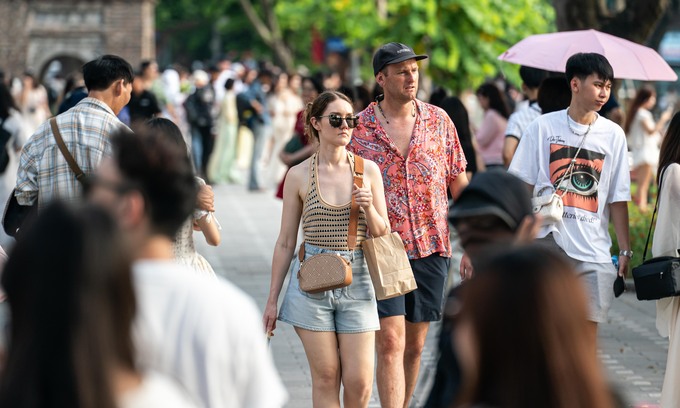
Foreign tourists walk in Hanoi, October 2026. Photo by VnExpress/Hoang Giang |
Russia ranked third with 1.1 million, followed by Taiwan (964,000) and the U.S. (746,000), according to the General Statistics Office.
The rest of the top 10 were Cambodia (688,000), Japan (674,000), India (670,000), the Philippines (522,000) and Australia (485,000).
In September, foreign visitors declined by 11.3% from August but rose by 16.5% year-on-year to 1.77 million.
Martin Koerner, commercial director of The Anam Group, a chain of luxury resort hotels in Vietnam, said what is particularly encouraging is Vietnam’s diversification of source markets.
European arrivals increased by more than 50%, while arrivals from markets including the United States, Australia and India also recorded strong growth. This makes Vietnam less dependent on only one or two major Asian source markets, he added.
“Vietnam is no longer seen simply as an inexpensive holiday destination. Increasingly, it is being
recognized as a destination capable of delivering sophisticated, world-class hospitality,” Koerner said.
Several Southeast Asian countries have faced declines in international arrivals amid the impact of the Middle East crisis.
Thailand received 22.6 million international visitors from January to September, down 3.65% year-on-year, while Singapore recorded 11.43 million in the first eight months, a 1.7% decline from a year earlier.
Just over 2 million international tourists visited Cambodia during the first eight months of 2026, down nearly half from the same period last year, The Phnom Penh Post reported.