

The national flag carrier Vietnam Airlines on Friday took delivery of an Airbus A320 under a three-year lease agreement and is expected to add an Airbus A321 in July.
The fleet expansion will provide nearly 23,000 additional seats per month on the domestic market, primarily serving trunk routes such as Hanoi–HCMC and major tourist destinations including Da Nang, Nha Trang, Quy Nhon, and Hue.
On Wednesday, Vietravel Airlines received an A321 aircraft. It currently operates a fleet of four aircraft, three of which are company-owned.
During the second half of the year, the airline aims to add seven more aircraft to increase capacity during the peak summer travel season.
With the expanded fleet, in addition to resuming domestic routes such as Hanoi–Cam Ranh, the airline plans to launch new services this year, including Hanoi–Buon Ma Thuot, HCMC–Shenzhen, and Hanoi–Macau.
Sun PhuQuoc Airways recently took delivery of its 11th aircraft and expects to receive another 15 Airbus A320/A321 aircraft by the end of August, bringing its fleet to 26 aircraft less than a year after beginning operations.
Vietjet, which is operating a fleet of 135 aircraft, has placed orders for nearly 600 narrow-body and wide-body jets, reinforcing its position as one of the region’s largest airline fleets. Its orders include Airbus aircraft and an operating lease agreement for 10 Comac C909 aircraft.
In February, Vietnam Airlines signed an agreement to purchase 50 Boeing 737 MAX 8 aircraft, with deliveries scheduled between 2030 and 2032.
The fleet expansion comes after the aviation industry faced significant aircraft shortages caused by supply chain disruptions and the widespread recall of Pratt & Whitney engines, which grounded numerous aircraft and reduced industry-wide capacity.
Fuel cost pressures have also begun to ease. The price of Jet A-1 fuel has fallen below US$120 per barrel after previously surging due to geopolitical tensions, according to the International Air Transport Association.
As fuel accounts for roughly 30% to 40% of airlines’ operating costs, the decline is expected to improve carriers’ ability to expand capacity.
Passenger demand continues to be the primary driver of the market. Vietnam’s airports handled 54.6 million passengers during the first five months of the year, an increase of more than 10% from the same period last year, according to the Civil Aviation Authority of Vietnam. International passenger traffic reached 22.6 million, up more than 18%.
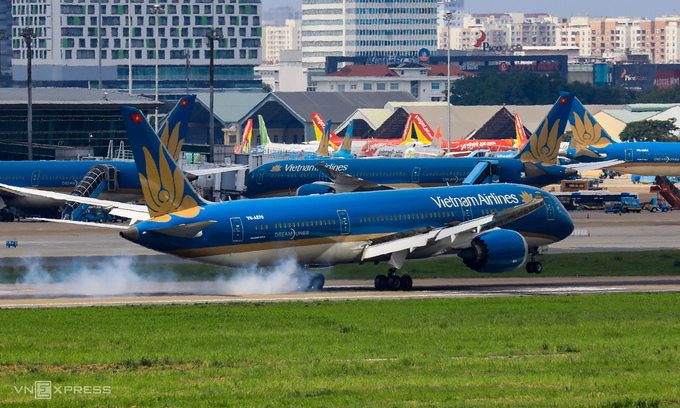
Aircraft seen at Tan Son Nhat International Airport in HCMC. Photo by VnExpress/Quynh Tran |
Vietnam is regarded as one of the fastest-growing aviation markets in the region, according to the Vietnam Country Commercial Guide published by the U.S. Department of Commerce.
Over the long term, Vietnam’s national airport system development master plan targets average annual passenger growth of 7.5% to 8.5% and cargo growth of 8.4% to 9.7%.
By 2030, the country’s airport network is expected to handle approximately 278 million passengers and 4.1 million metric tons of cargo annually.
Aviation analyst Nguyen Thien Tong said the simultaneous fleet expansion by local airlines is consistent with the industry’s recovery, although supply and demand will need to remain balanced over the medium and long term.
He said fleet expansion is necessary to meet growing demand, but aviation is a capital-intensive industry with long investment payback periods. If capacity expands faster than demand, competitive pressures could intensify.
However, he noted that most of the aircraft currently on order are new-generation models that consume approximately 15% to 20% less fuel than previous generations, improving operational efficiency.
“A newer fleet helps reduce costs and improve operational efficiency over the long term,” he said.
Tong added that amid rising international demand, continued airport infrastructure expansion, and substantial market potential, the race to expand airline fleets reflects expectations for a new growth cycle in Vietnam’s aviation industry.
However, the success of these investments will depend on airlines’ ability to balance capacity expansion with the market’s actual absorption in the years ahead.

Comments are closed.