
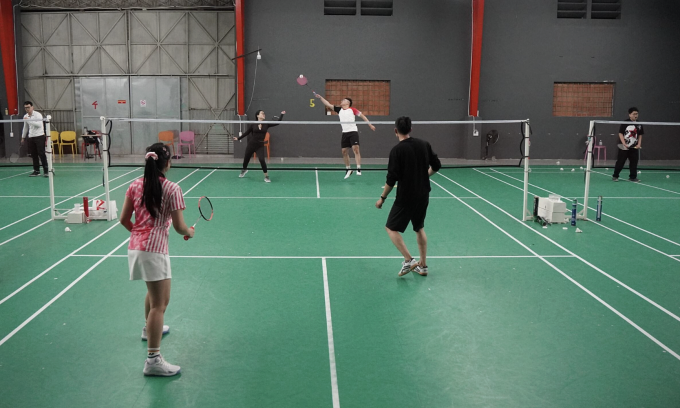

At 10 p.m., Ngoc Huyen arrives at a badminton court in Khuong Dinh Ward, Hanoi, where nearly 10 people are already waiting.
For the past two months, the 23-year-old communications employee has played badminton two or three nights a week from 10 p.m. to 12:30 a.m. Because of her work schedule, Huyen usually gets home at 8 p.m., leaving only the late evening for exercise.
“Since badminton courts started opening late into the evening, I have been exercising during these hours to relieve stress and sleep better,” she says.
Badminton players on a court in Khuong Dinh Ward, Hanoi, at around 11 p.m., May 2026. Photo by Read/Phan Ngan |
In HCMC, Le Hoang, 28, spends most days playing pickleball from 11 p.m. to 1 a.m. He says courts are often fully booked during peak hours between 5 and 8 p.m., with reservations needing to be made one month in advance.
“After work, I eat, rest and then head to the court. At night, the roads are less crowded, the weather is cooler and there are more venues available.”
For shift workers, late-night sports are often the most practical option. Tran Phuong, 32, who manages a beverage chain, works daily from 2 p.m. to 10:30 p.m. Although she has most mornings free, she says she often feels sluggish during that time and has no one to play with.
“Playing sports at 11 p.m. suits the lifestyle of someone working in the service industry like me better.”
About 30 out of 100 sports centers surveyed by Read say they operate past 11 p.m. Most are in inner-city wards such as Cau Giay, Thanh Xuan, Thanh Liet, Yen Hoa, Hoan Kiem and Long Bien in Hanoi, and Go Vap, Binh Thanh, and Saigon in HCMC.
Late-night sports, previously centered on football and gymnasiums, now include pickleball, badminton, and tennis. People aged 22-35 and office workers account for 60-70% of customers, with the most common playing hours being from 11 p.m. to 1-2 a.m.
The growing demand has prompted many sports venues to adjust their operations. Minh Tu, owner of a chain of 24 pickleball courts in Long Bien Ward, Hanoi, says she recently extended their opening hours to 1 a.m. from 10 p.m. to accommodate customers’ demand.
“We tell players to watch their noise levels to avoid disturbing nearby residents.”
In HCMC, Thanh Tuan, 39, owner of a pickleball court in An Khanh Ward, says he often remains open until 2 a.m. He says the number of customers booking his court between 9 p.m. and 1 a.m. has doubled since the beginning of 2026. Most of them are people who finish work late, though some choose the time slot because the fees are 10-20% cheaper.
“During the summer heat, nighttime slots are fully booked all week.”
The trend has also spread to gyms. Nguyen The Thanh Tung, director of a gym chain in HCMC, says he was unable to meet customer demand by closing at 10 p.m. and so is now open 24/7.
“People in major urban areas like HCMC lead busy lives with heavy work demands and limited time for exercise. We stay open overnight to serve this customer group.”
 |
People work out overnight at a gym in Go Vap District, HCMC, March 2024. Photo by Read/Ngoc Ngan |
Economist Associate Professor Dinh Trong Thinh says the rise of late-night sports reflects the growth of the night economy in major cities, a trend caused by dense populations and increasing work pressure.
“It stimulates supporting services such as transport and food businesses at nighttime.”
Dr. Nguyen Viet Chung, head of the mental health department at E Hospital in Hanoi, says some people naturally have later sleep-wake cycles than the general population. For them, exercising at night does not affect bodily functions as long as they get enough sleep during the day.
However, for people with normal circadian rhythms, intense physical activity under bright lights late at night can suppress melatonin, the hormone regulating sleep, causing difficulty sleeping or even insomnia, he warns.
Trinh Kien, deputy director of the Center for Physical Education and Sports at the Vietnam National University, Hanoi, says people who can only exercise late due to work commitments should limit themselves to two or three sessions a week and alternate with rest days to safeguard their health.
After two months of exercising late at night, Ngoc Huyen says going to bed at 2 a.m. leaves her exhausted during busy workweeks. “I realized exercise is beneficial, but sleep is even more important.”
Comments are closed.