Delegates were taking up the draft Law on Urban Development, which covers planning, infrastructure, science and technology, education and health care.
Son said its provisions on sending education administrators and teachers to study, conduct research and take up visiting lectureships at home and abroad would help lift the quality of the workforce.
Missing, he said, is a mechanism for the reverse flow, particularly for lecturers and scientists coming to work at universities and vocational education institutions.
“Sending teachers and lecturers out for training is good, but attraction policies are also very important,” he said.
Many Vietnamese intellectuals, lecturers and scientists based overseas want to return or to collaborate with domestic universities, Son said.
He proposed giving the city exceptional support and remuneration to bring them in.
“If the city has a special policy, similar to the mechanism for attracting science and technology personnel, this will be a very valuable resource,” he said.
The approach would align with Politburo Resolution 23 on overseas Vietnamese affairs, issued Aug. 2, he added. He described the pool of overseas Vietnamese intellectuals as a major resource that should be channeled into universities and vocational institutions.
|
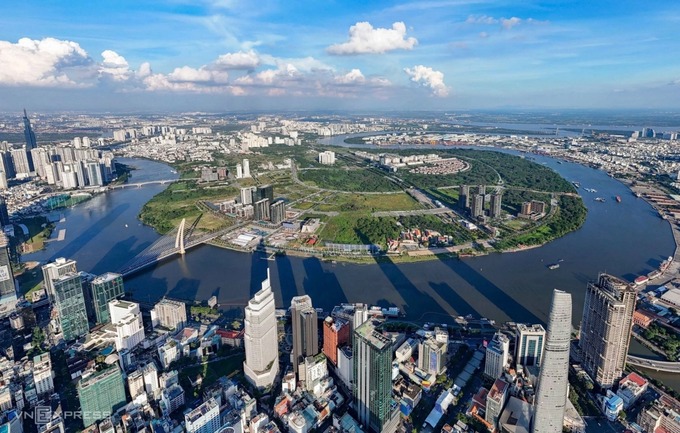
Thu Thiem, part of Ho Chi Minh City’s eastern zone, is slated under city planning to become an international financial center. Photo by Read/Quynh Tran |
Special mechanisms for university urban zones
The draft offers special incentives for people with aptitude, talent or outstanding achievements. Son said the city should also be able to award scholarships at its own discretion to students in priority disciplines.
“Scholarship policy should not be reserved only for high achievers. It should also steer students toward the fields and sectors the city needs,” he said.
The draft already sets out exceptional mechanisms for attracting and making full use of personnel in science, technology and innovation.
Son asked lawmakers to specify which organizations may use them, and to clarify whether they apply only to agencies under the city government or extend to universities, public service units and businesses operating in the city. Without a defined scope, he said, agencies will struggle to implement the provisions.
The minister also called for special mechanisms for university urban zones along the lines of those governing high-tech parks.
The zones are not only teaching sites, he said, but concentrations of research and innovation activity, including corporate research and development centers.
Son said the right framework would help universities mobilize resources, deepen cooperation with businesses, and accelerate research and knowledge transfer.
The National Assembly is scheduled to debate the draft law in plenary session on Aug. 11. A vote is set for Aug. 24, as part of a package of eight laws and one resolution.
Ho Chi Minh City accounts for roughly a quarter of Vietnam’s GDP and about a third of state budget revenue, with annual economic output above $100 billion across a population of some 14 million, making it the country’s largest economy, according to municipal government figures.