
Vision going blurry during heavy workouts? Ophthalmologist explains why this happens: ‘Pressure increases inside eyes…’

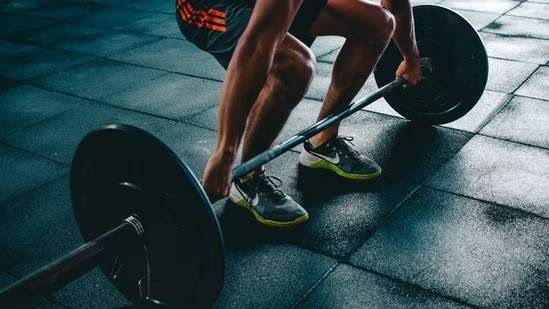
Are you pulling a heavy weight and suddenly your vision goes dark, dims for a few seconds, or slips out of focus? Don’t be so quick to dismiss it as just physical exertion. There may be a real connection between your vision and your workout, especially when exercises are done with improper breathing or technique.
Why is this a matter of concern, and how can it be prevented to reduce the risk of complications? We asked ophthalmologist Dr Divya Jain, senior consultant at Sharp Sight Eye Hospitals, who acknowledged that there is indeed a connection between intense physical exercise and eye health. She also expressed concern over how it ‘does not get nearly enough attention.’
What is the heavy workout- vision link?
You may think you are pushing your limits, burning your calories in hardcore mode, but if you are not maintaining proper form, your vision may be affected.
Dr Jain shared, “The truth is that extremely heavy exertion, particularly with improper breathing technique, can generate significant and sudden increases in intraocular pressure; the pressure inside the eye.” Heavy lifting, especially when paired with breath-holding or poor breathing patterns, can sharply raise pressure inside the eyes, leading to vision dimming.
But don’t panic yet, as the ophthalmologist assured that for most people, this is temporary and harmless. So when does it become a problem? “For someone with an undetected vulnerability, the consequences can be severe and sometimes irreversible,” she said.
What do you need to be careful of?
The ophthalmologist briefly touched upon the Valsalva manoeuvre, where you hold your breath and strain during intense lifts. This results in increased pressure not just in the chest and abdomen but across the body’s vascular system, including the eyes. Because of this, intraocular pressure can rise suddenly.
Here’s the difference in how healthy eyes and eyes with an underlying condition respond to this.
“In a healthy eye with good vascular integrity, this resolves without consequence. But in eyes already under structural pressure, from conditions like glaucoma, a thinned retina, uncontrolled hypertension or high myopia, that spike can trigger a vascular event: a retinal blood vessel bursting, a branch or central retinal artery occlusion, or in more serious cases, a sudden retinal detachment,” the ophthalmologist differentiated how healthy and unhealthy eyes react.
Moreover, which exercises require you to hold your breath? The doctor mentioned that prolonged breath holding occurs during heavy compound lifts, squats, deadlifts, and overhead press. Hence, when you are doing these exercises, maintain proper form and do them carefully.
Further, Dr Jain observed that many patients delay seeking help after experiencing vision disturbances during exercises, dismissing them as fatigue. But if one has underlying conditions like retinal artery occlusion or detachment, then the treatment window becomes narrow, and delays can cause permanent vision loss.
Symptoms
Here are some symptoms you need to watch out for:
- Sudden loss or darkening of vision (even briefly)
- A sudden increase in floaters (many appearing at once)
- Flashes of light, especially in peripheral vision
- A shadow or “curtain” over part of the visual field
Note to readers: This article is for informational purposes only and not a substitute for professional medical advice. Always seek the advice of your doctor with any questions about a medical condition.

Comments are closed.