
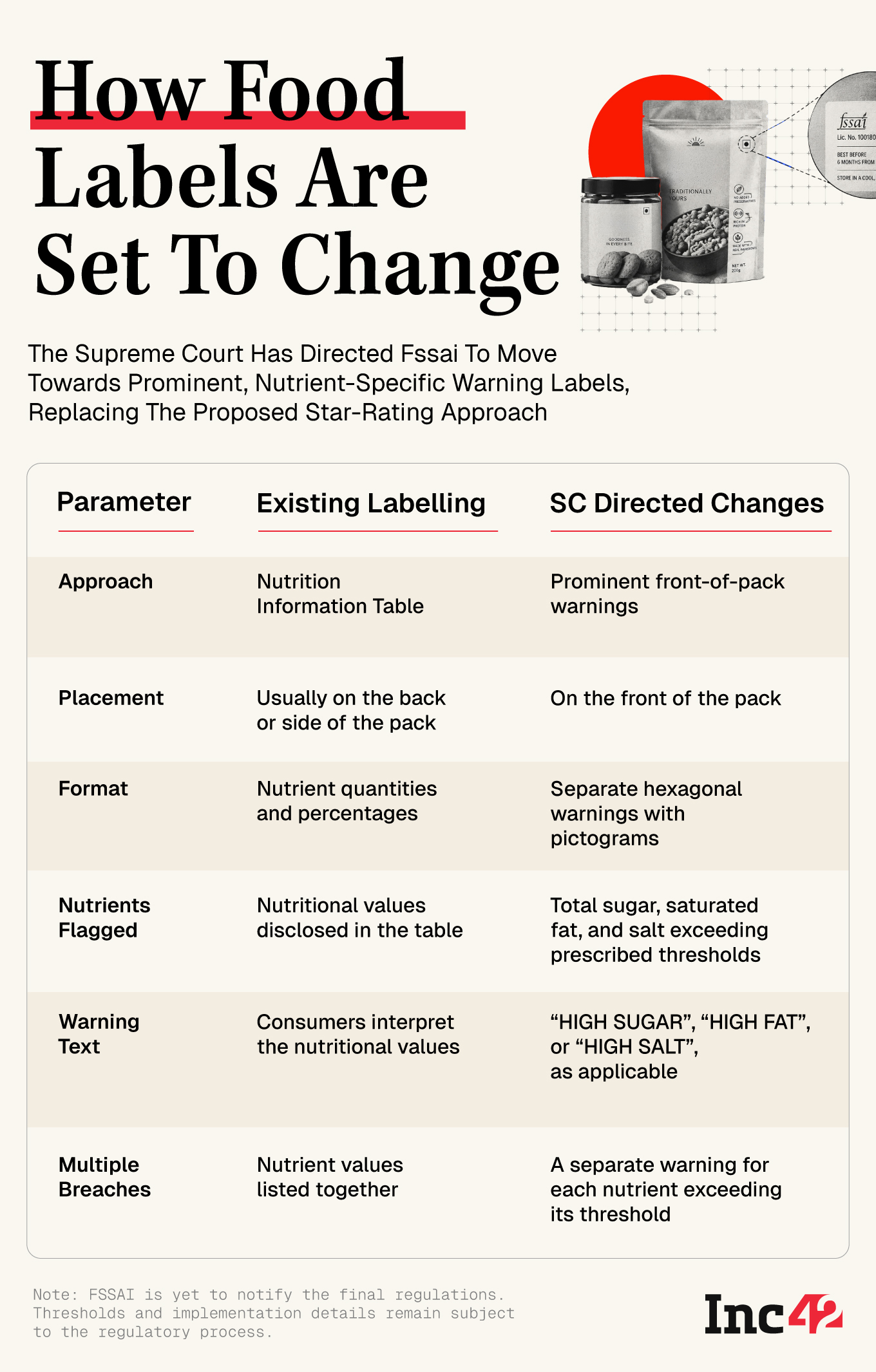
The Supreme Court has directed the FSSAI to introduce separate pictorial warnings for packaged foods high in sugar, saturated fat, or salt, and revisit the thresholds that trigger these labels.
Products marketed as healthier alternatives would carry warnings alongside their health claims, while reducing sugar, salt, or fat could require changes to recipes and manufacturing processes.
Brands could face higher testing, packaging, and inventory costs, with a 365-day compliance window after notification. FSSAI has around four months from the judgment to finalise the rules.
A packet of millet chips marketed as guilt-free could carry a warning for high salt. A snack claiming “no added sugar” could still need a high-sugar label.
These are among the implications of the Supreme Court’s direction to the Food Safety and Standards Authority of India (FSSAI) to introduce separate front-of-pack pictorial warnings for packaged foods high in sugar, saturated fat, or salt.
For food brands built around healthier ingredients, the warnings could highlight a gap in their positioning – products made without refined sugar or artificial additives can still be high in sugar, saturated fat, or salt.
The November 26 judgment requires separate red hexagons carrying pictograms and the corresponding declarations “HIGH SUGAR”, “HIGH FAT”, or “HIGH SALT”, rather than combining multiple warnings within one symbol. The court also directed FSSAI to reassess the thresholds using total sugars and saturated fat, rather than added sugar and added fat.
The public-health backdrop is significant. A 2023 report by the World Health Organisation (WHO) and the Indian Council for Research on International Economic Relations found that India’s ultra-processed food sector recorded a compound annual growth rate of 13.4% in retail sales value between 2011 and 2021.
The judgment also cited estimates that non-communicable diseases account for around 63% of deaths in India.
The warning labels are intended to help consumers identify products high in sugar, saturated fat, or salt at the point of purchase. For food and beverage brands, this means assessing which products would need warnings and whether recipes can be changed to bring them below the prescribed limits without compromising taste, shelf life, or affordability.
The FSSAI proposed approximately four months from the judgment to complete the regulatory process, including consultation and finalisation. Separately, the court accepted a 365-day transition period from notification for companies to comply.
With thresholds and exemptions still to be finalised, the impact will depend on both a product’s nutritional composition and the proposition on which it is sold.
Health Claims Face Scrutiny
Kannan Sitaram, cofounder and partner at Fireside Ventures, which has backed food and beverage brands including Troovy, Slurrp Farm, and Vahdam, believes warning labels may have a smaller effect on categories consumers already regard as indulgences.
“Much like cigarette packs carrying warnings, people know these products are not necessarily good for them, but consumption is also driven by habit. So, I don’t think chocolates, mithai or potato chips will see a major impact simply because a warning label is introduced,” he said.
Brands selling products as healthier alternatives could face greater scrutiny. Breakfast cereals, protein bars, flavoured beverages, and snacks promoted around better nutrition may attract questions if a warning appears alongside those claims.
“In India, the effect may be greater on products sold as healthy, since a pack that claims ‘no added sugar’ may still carry a ‘High Sugar’ warning. It may be less for sweets and snacks bought as treats, where consumers already know what they are buying,” said Jeevan Ballav Panda, partner at Khaitan & Co.
With the framework set to consider total sugars, brands using fruit-based sweeteners may need to explain why their “no added sugar” products still carry a high-sugar warning.
Scrutiny of packaging claims already predates the ruling. In September, Inc42 reported that at least 20 clean-label D2C brands had received notices from the FSSAI since May this year over claims involving sugar, natural ingredients, organic products, and other health positioning.
MasterChow subsequently dropped “100% Natural” from its ramen packaging, while Pluckk told Inc42 it would add “contains naturally occurring sugar” alongside its “no added sugar” claim.
Sitaram believes greater nutritional transparency could also help consumers distinguish between products that merely market themselves as healthy and those with better nutritional profiles.
As Inc42 reported earlier, food brands will need to explain more clearly why consumers should choose their products and pay a premium for them.
Reworking Recipes And Processes
Improving nutritional profiles could help brands make this case, but reducing sugar, salt, or fat without affecting the product is difficult. These ingredients influence flavour, texture, moisture retention, crispness, and shelf life.
The challenge is particularly relevant to frozen and ready-to-eat foods, which must retain their taste and texture through manufacturing, storage, and preparation.
“Sugar, salt, and fat do heavy lifting in aroma, umami, richness, and crunch. Dropping them without rethinking the flavour architecture can leave food tasting bland or flat,” said Mithun Appaiah, who heads Wow! Momo’s FMCG business. The company sells packaged frozen momos alongside its restaurant offering.
Appaiah said brands may need to experiment with spices, herbs, acids, and alternative ingredients to preserve the eating experience. This could require R&D, taste trials, nutritional testing, and shelf-life checks across individual products.
Manufacturing processes could provide another route. Sitaram pointed to vacuum frying as a technique that could help reduce oil uptake compared with conventional frying, although adopting such processes can increase production costs. Brands could also explore technologies that deliver sweet or salty tastes with less sugar or salt.
“If consumers are willing to pay for it, brands could change their production processes to bring down fat levels,” he added.
For premium brands, higher production costs could further test consumers’ willingness to pay.
The ingredients used to preserve taste and shelf life will also face scrutiny. The court directed FSSAI to monitor whether artificial preservatives or other additives are used to undermine the objectives of the warning-label framework, and take corrective measures where necessary.
Packaging And Inventory Costs
Even brands that retain their recipes would need to redesign packaging across products and pack sizes to accommodate the warnings.
Panda said packaging reprints may be a relatively smaller expense given the 365-day transition period. Testing individual products and redesigning packs to accommodate separate warnings could nevertheless add to costs.
The SC judgment requires each hexagon to be proportionate to the principal display panel, specifying a minimum of 4%-5% of that panel unless explicit reasons justify a departure. The text and pictograms must remain prominent and legible.
The warnings would occupy space that brands currently use for product names, health claims, and other selling points. Accommodating multiple warnings could require more substantial design changes, particularly on smaller packs.
Smaller companies could face higher costs per unit because their lower production volumes offer less scope to spread testing and redesign expenses.
For larger, fast-moving brands, coordinating the transition across packaging suppliers, warehouses, retailers, and online listings could be a significant operational task.
“Beyond artwork, testing, and print plates, the biggest hidden cost for fast-moving brands is timing, aligning print runs, managing existing packaging stock, and rolling out updates across physical and digital channels without waste or stockouts,” Appaiah said.
The eventual burden, however, will depend on the thresholds, exemptions and labelling specifications FSSAI finalises.
Meanwhile, the SC also flagged the risk of businesses stockpiling unlabelled packaging or accelerating production before the deadline. It directed the FSSAI to prevent such practices and plan how products already manufactured without warnings would be phased out.
Clarity Before The Rollout
For brands, clarity is needed on both the treatment of existing stock and the requirements for future production. Panda said consultation would allow businesses to submit scientific data and raise concerns about nutrient thresholds, product categories, and the feasibility of reformulation.
The FSSAI’s proposed process includes a 60-day consultation on the draft amendments, followed by an examination of comments, regulatory approval, and publication of the final notification. The court has also ordered a clear, reasoned list of exempted foods.
Appaiah sought clarity on label dimensions, placement, colour, and digital display requirements early enough for companies to coordinate changes without disrupting inventory and supply chains.
Sitaram, meanwhile, said consumer education will be essential to making nutritional transparency useful beyond the compliance exercise.
For food and beverage brands, the new rules mean explaining what the warnings reveal about their products and backing that message with nutritional improvements. The test will be whether they can do so while keeping taste and affordability intact.
Edited By Vinaykumar Rai