Eldest son Howard went to Augustana College but left after clashing with his roommates. He later attended other schools but never graduated, according to Business Insider.
Youngest son Peter also dropped out of Stanford University to pursue a music career even when he “didn’t have a clue” how to become a professional musician.
Buffett’s eldest child and only daughter Susan, better known as Susie, came closest, leaving college just three credits short of graduation.
But Buffett apparently never pushed them to finish college. He even made a joke about the matter in a 2018 interview with FOX Business: “My children, if you pool their credits, you got a degree.”
He also did not steer them toward any specific career and instead encouraged them to find something they loved to do as much as he loved to make money.
He passed on to his children the advice he had received from his father: “Look for the job you’d take if you didn’t need a job.”
|
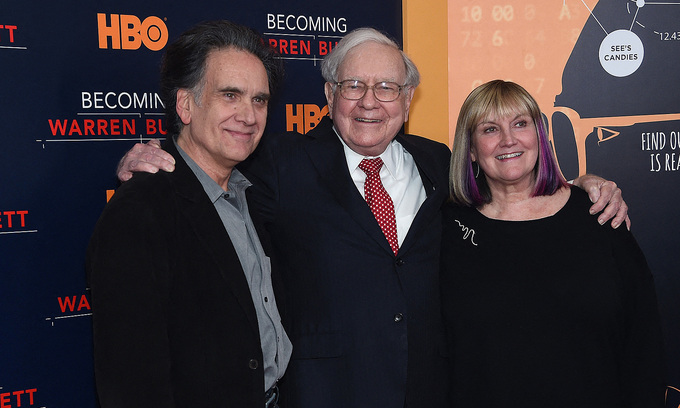
Peter Buffett, Warren Buffett, and Susie Buffett attend ‘Becoming Warren Buffett’ World Premiere at The Museum of Modern Art on January 19, 2017 in New York City. Photo by Getty Images via AFP |
Buffett himself once considered leaving college to go into business, according to an interview with Bloomberg in 2016. Even so, he does value an education; he is just not particular about the form it takes.
During a 2012 meeting with students of Ivey Business School at Western University, he said the best education is investing in yourself, but that does not necessarily mean going to college or university.
“I don’t think college is for everyone,” he said at the time, as quoted by CNBC.
In a letter accompanying his conglomerate Berkshire Hathaway’s 2024 annual report, he wrote that he “avidly” believes in “lifelong learning.”
The legendary investor, known as the “Oracle of Omaha,” took a similar view when selecting chief executives for Berkshire-owned companies, saying he never looked at which school applicants attended.
“There are great managers who attended the most famous schools. But there are plenty (…) who have benefitted by attending a less prestigious institution or even by not bothering to finish school,” he wrote.
Besides telling his kids to pursue their calling, Buffett is also known to be quite strict with them when it came to money. Susie has shared that her father believes children should not be given advantages they have not earned.
Peter told Forbes in 2013 that he and his siblings knew little about their father’s job, and that he himself did not know his dad was a billionaire until his 20s when he saw Buffett listed on one of the magazine’s lists.
Buffett has said that by the time his children fully understood the extent of the family’s wealth, they had already developed their own identities and paths.
After leaving college, Susie built a career centered on philanthropy, education, and supporting children and families.
Howard went on to become a farmer, conservationist and philanthropist, dedicating much of his work to agriculture, food security and humanitarian causes.
Peter became a musician, composer and author. He has won a regional Emmy Award and been named a New York Times best-selling author. He also focuses on philanthropy and social issues.
Buffett, one of the richest people in the world with a fortune of $145.4 billion, last month ended his annual donations to the Gates Foundation as his three children were now ready to oversee the distribution of his wealth, Reuters reported.
He instead donated $500 million worth of Berkshire Hathaway stock to each of the three foundations run by his children, Susie’s Sherwood Foundation, Howard’s Howard G. Buffett Foundation and Peter’s NoVo Foundation.
Buffett said in an interview with CNBC published shortly after the donations were announced that he did not have the same confidence in his children back in 2006 when he began donating to the Gates Foundation.
But he was impressed that his children wanted to distribute his money efficiently, without spending it on huge buildings or holding conferences “at esoteric places and all kinds of things,” he said.
Closing the interview, he said people would view a trust fund that supports them and the next five generations as winning a lottery.
“But I just wasn’t raised that way, and I think it’s a good thing I wasn’t, and I haven’t raised the kids that way—or more important, [his late first wife and their mother] didn’t raise them that way,” he concluded.