
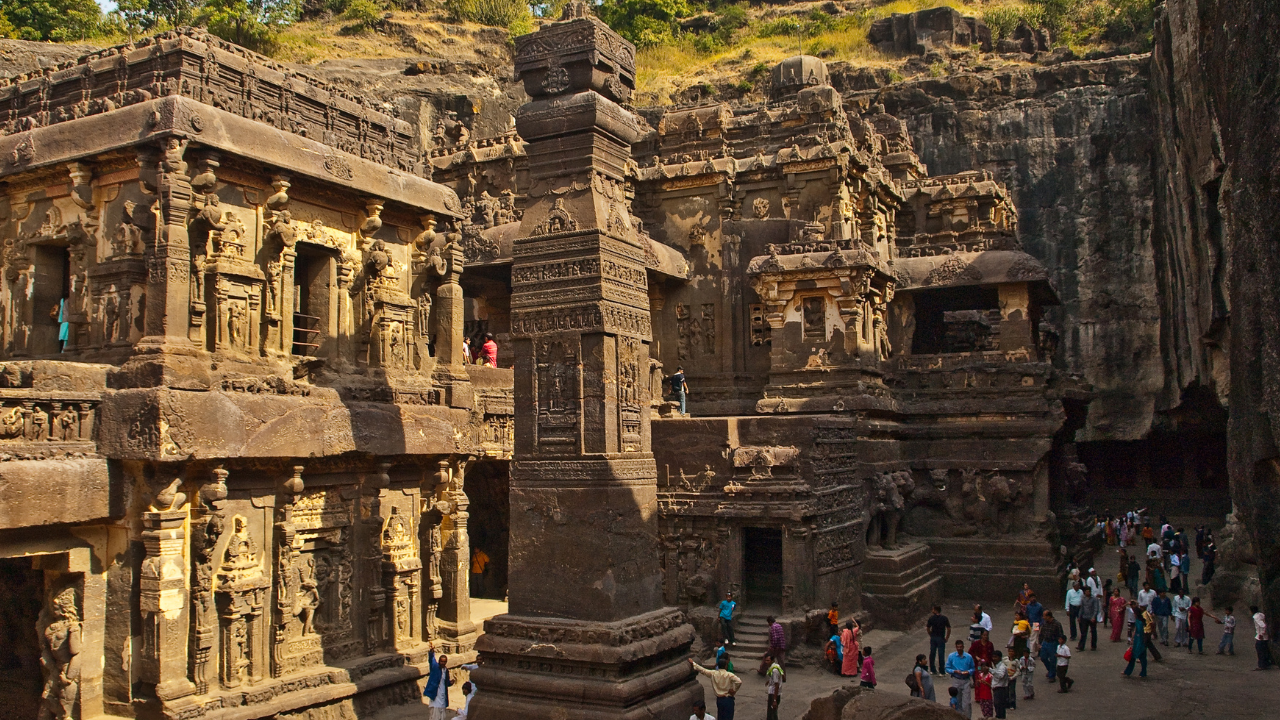
Was ‘Kailashnath Temple’ the royal ‘propaganda technique’ of the Rashtrakutas? Such was the ‘propaganda’ behind the construction of Kailashnath temple!

India has been rich in temples and architecture since time immemorial. Many kingdoms, empires, sultanates happened on the land of our India; Then there was monarchy-dictatorship, now it is democracy. But to a large extent some things do not change. The kings who became emperors in history. He should spread the fame of his kingdom far and wide. Adopted different ways to show their dominance, promote their kingdom and display their power. In fact it is still done today and is done in every field. This propaganda and show of power is what is called propaganda today, which is spread strategically through different media such as social, cultural and religious. Each policy has specific reasons behind it.
Demonstrations and propaganda
Different dynasties emerged during the ancient, medieval period of India; reached the pinnacle of prosperity and went to Lyas. Then many big dynasties like Gupta, Chola, Satavahana, Chalukya, Rashtrakuta can be mentioned in it. The ambitions of each caused much harm in the movement to preserve the survival of their respective dynasties by fighting with each other as mutual enemies. In all this, however, everyone tried hard to show their strength and wealth, in which many succeeded. In ancient and pre-medieval times in India, power was displayed by building large and powerful temples. A large crowd used to come to see the opulence, opulence, customs, architecture of those temples. There were also trips to the region. Through this, the fame of those temples and architecture would not only spread but also the talk of prosperity of that king and state would spread far and wide.
What is Ashwamedha Yagna in Vedas and Puranas? Learn the truth behind this legendary and historical ritual!
Kailashnath Temple of Verul
A good example of this is the Kailashnath temple of Verul in AD. Between 757 and 775 i.e. around eighth century, Rashtrakuta King Krishna I built this temple. King Dantidurga defeated the Chalukyas in the wars between the Chalukyas and the Rashtrakuta kingdom in the 18th century. This temple of Kailashnath in the caves of Verul was built by King Krishna I, the successor of King Dantidurga, to commemorate this victory and to extend his Rashtrakuta king’s dynasty keeping in mind his strategic interests. This temple is a wonder in itself. Ekashma, i.e. carved from top to bottom in a single stone, this temple stands as a unique example of sculpture and ancient architecture. Through this temple, Rashtrakuta king Krishna I demonstrated the strategic power of his power. Let us understand it in the next three points.
Religious propaganda
Kailasanath Temple which is dedicated to Hindu deity Lord Shankar. By connecting the umbilical cord of our dynasty with this divine power, this seems to be an attempt to impress that our power is blessed by the gods. The Kailasanath temple proved to be not only a religious symbol but also a symbol of the unity of the Rashtrakuta Empire. By building this temple, the religious and cultural customs and traditions of the large Hindu community were looked upon by King Krishna I as a guardian.
Cultural promotion
An attempt may also have been made to show cultural and artistic supremacy by building structures like the Kailasanath temples. The scope of this Kailashnath temple and Nakhshikanta give an impression of the wealth and resources of the Rashtrakutas. The temple pioneered the creation of great impactful images of the Rashtrakutas who prioritized fine art craftsmanship and religion.
Mysterious temples in India that were built overnight, one by gods and the other by demons…
Political campaigning
Kailashanat temple is built from top to bottom in a single rock with top quality sculpture. It was meant to amaze the locals as well as foreign travelers and outsiders. This demonstrated the strength of vast resources of the Rashtrakutas, the predominance of skilled workers, the king’s power to build large and mighty monumental projects in all directions. And even beyond that, the Rashtrakuta dynasty was glorified as far and wide as the monarchy of the Indian subcontinent. This is how political policies were propagated.
From time to time, such monuments were built as a show of power to spread their policies, for example, the Pyramids of Giza in Egypt, the Eiffel Tower in France, the Great Wall of China, the Taj Mahal. So much for the Burj Khalifa building which was built in the last decade. All these monuments are symbols of the culture, wealth, progress and power of the nations. The Kailashnath temple at Verul was a symbol of such a policy of the Rashtrakuta dynasty.

Comments are closed.