
Nvidia Invests in Data Center Developer Cloverleaf Infrastructure
Nvidia has invested in data center developer Cloverleaf Infrastructure as the AI chipmaker continues to expand its presence across the infrastructure ecosystem supporting the rapid growth of artificial intelligence.
The investment comes as demand for AI computing capacity accelerates worldwide. While Nvidia remains best known for its graphics processing units (GPUs), the company is increasingly focused on the broader infrastructure required to deploy those chips at scale.
Cloverleaf Infrastructure develops data center campuses designed to support high-performance computing and energy-intensive workloads. Its projects are aimed at meeting the growing requirements of modern AI systems, which demand significantly more computing power, electricity and cooling capacity than traditional data center workloads.
The investment highlights an important shift in the data center industry. Conventional facilities were largely built around cloud computing and enterprise applications, while the rise of generative AI is driving demand for much denser computing environments.
For Nvidia, investing in infrastructure developers can help strengthen the ecosystem around its technology. The company has increasingly built relationships across networking, software, energy and data center infrastructure as customers race to deploy large-scale AI systems.
The partnership also reflects the growing importance of power availability in the AI infrastructure race. Data center developers are increasingly seeking locations with reliable access to electricity, suitable land and the ability to support large computing facilities.
Cloverleaf operates in a market attracting significant investment from technology companies, infrastructure funds and institutional investors. As AI adoption expands, demand for specialized data centers is expected to remain strong, although developers face challenges including limited grid capacity, lengthy permitting processes, high construction costs and increasing energy requirements.
Nvidia’s investment signals that the company sees data center development as an important part of the AI supply chain. The move also illustrates how the AI boom is creating opportunities beyond semiconductors.
As competition in artificial intelligence intensifies, access to computing infrastructure could become as important as access to advanced chips. Nvidia’s investment in Cloverleaf shows that the company is positioning itself not only as a supplier of AI hardware, but also as a participant in the infrastructure ecosystem needed to power the next generation of AI.
TikTok Agrees to $400 Million US Children’s Privacy Settlement
TikTok has agreed to a $400 million settlement in the United States over allegations that the social media platform violated children’s privacy laws by collecting and processing personal information from young users without adequate parental consent.
The settlement marks a major development in the growing regulatory scrutiny surrounding social media platforms and their treatment of children’s data. Authorities have increasingly focused on whether technology companies do enough to prevent children from accessing services designed primarily for older users and whether appropriate safeguards are in place when minors use those platforms.
The case centers on allegations that TikTok did not take sufficient measures to identify and restrict users under the age of 13. Regulators also raised concerns about the collection and retention of children’s personal information and whether parents were given adequate control over that data.
As part of the settlement, TikTok is expected to strengthen its privacy protections and improve processes for identifying younger users. The company will also face additional requirements related to parental consent and the handling of information associated with children.

The agreement comes at a time when governments worldwide are increasing pressure on social media companies to create safer digital environments for minors. Regulators are examining issues ranging from data collection and targeted advertising to age verification and children’s exposure to potentially harmful content.
TikTok, which is owned by ByteDance, has faced regulatory scrutiny across several countries over privacy and data protection. The latest settlement adds another significant challenge as the company works to maintain user growth while complying with increasingly strict rules.
The case could also have broader implications for the technology industry. A large financial penalty and stronger compliance requirements may encourage other platforms to reassess how they collect, store and use information belonging to young users.
For TikTok, the settlement provides a path toward resolving the allegations while placing greater responsibility on the company to strengthen its children’s privacy practices.
The agreement ultimately underscores a growing regulatory message: protecting children’s personal information is becoming a central responsibility for social media platforms, rather than an optional safety measure.
US Corporate AI Debt Surge Tests Investor Limits as Fatigue Emerges
The rapid expansion of artificial intelligence is creating a new challenge for US companies: how much debt can investors absorb before enthusiasm for the AI boom begins to fade?
Technology companies, data center operators and businesses supporting AI infrastructure are increasingly turning to debt markets to finance the enormous cost of expanding computing capacity. The spending includes data centers, advanced servers, networking equipment and power infrastructure needed to support growing AI workloads.
For investors, the opportunity remains attractive. AI has become one of the fastest-growing areas of the technology economy, with companies racing to build infrastructure capable of handling increasingly demanding models and applications. However, the scale of investment is also raising concerns about whether future revenues will be sufficient to justify the borrowing.
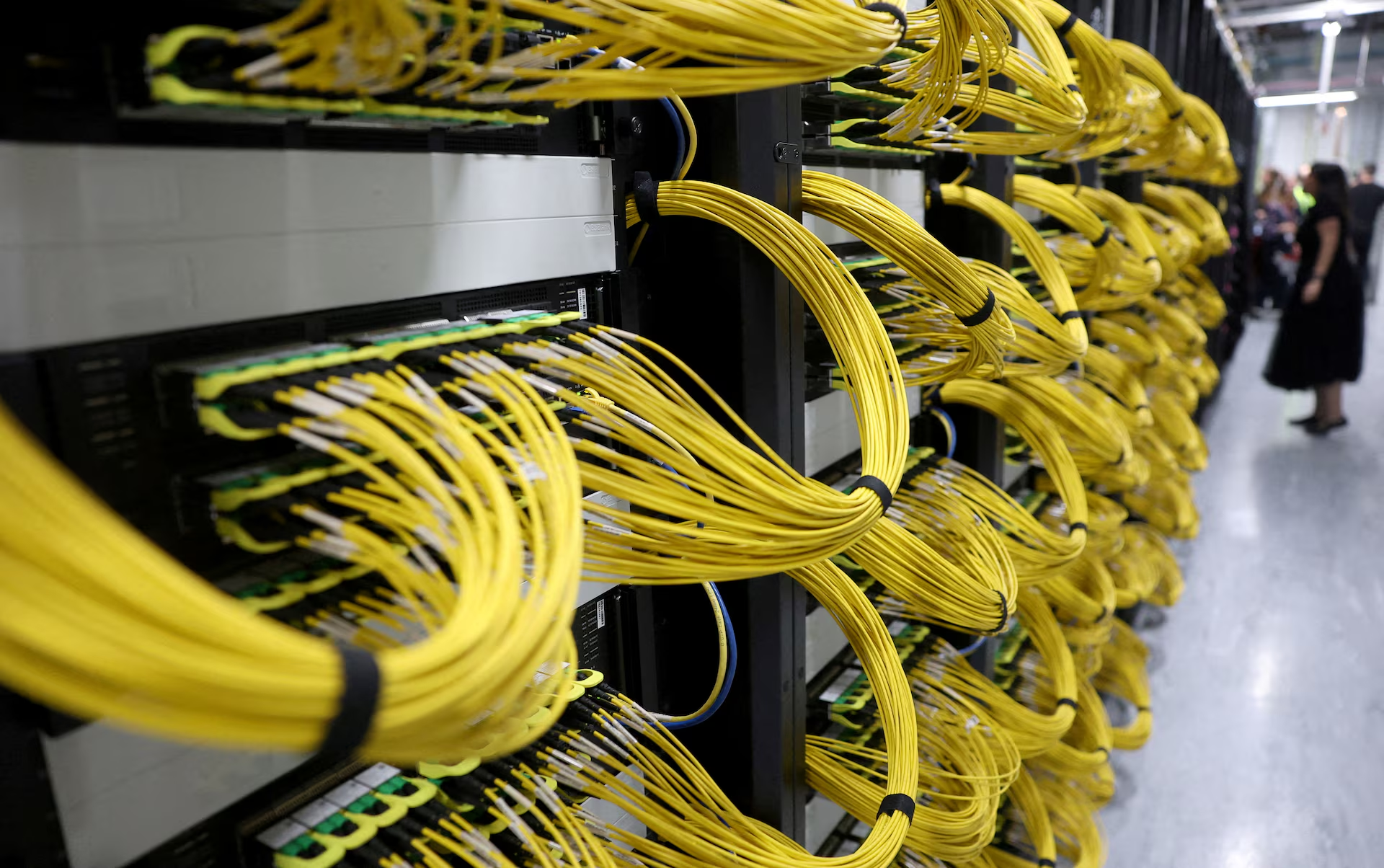
Data centers are at the center of this trend. AI facilities require enormous amounts of electricity, sophisticated cooling systems and expensive computing hardware. Building them can require billions of dollars, encouraging developers and technology companies to seek financing from banks and bond investors.
Signs of investor fatigue are beginning to emerge as lenders become more selective. Companies with strong customers, predictable cash flows and long-term contracts remain attractive, while businesses relying heavily on future AI demand could face greater scrutiny.
The changing environment could eventually make borrowing more expensive for companies with weaker balance sheets. Investors may also demand stronger financial protections before providing capital for large AI-related projects.
The shift comes as the AI industry moves beyond its initial investment frenzy. Investors are increasingly looking for evidence that massive spending on chips, data centers and software will eventually produce sustainable profits.
A significant slowdown in AI-related borrowing could affect the broader technology and infrastructure markets. Higher financing costs could delay data center projects, limit expansion plans and force companies to prioritize investments with clearer returns.
For now, money continues to pour into AI infrastructure. But the growing debt burden is changing the conversation. Investors are no longer asking only how large the AI opportunity could become. They are increasingly asking whether the companies building it can generate enough cash to pay for it.
OpenAI Cuts Developer Pricing for Frontier GPT-5.6 Sol by More Than 20%
OpenAI has cut developer pricing for its frontier GPT-5.6 Sol model by more than 20%, making its most advanced AI capabilities cheaper for businesses and developers building applications on the platform.
The pricing reduction comes as competition in the AI industry intensifies and companies increasingly compete on both model performance and cost. For developers, lower prices can significantly change the economics of running AI-powered products, particularly for applications that process millions of requests.
GPT-5.6 Sol is positioned as a high-end model for demanding workloads, including complex reasoning, coding, research and advanced automation. By reducing the cost of accessing the model, OpenAI is seeking to make frontier-level intelligence more accessible to a broader range of developers.
The move could be particularly important for startups and smaller companies that have traditionally faced high costs when using powerful AI models. Lower inference costs could allow developers to build more sophisticated features, increase usage or redirect savings toward other areas of product development.
OpenAI’s decision also reflects a broader shift in the AI market. As models become more capable, companies are under pressure to improve their price-to-performance ratios. Developers now have a growing number of models to choose from, making cost an increasingly important factor alongside accuracy, speed and reliability.
The reduction may also encourage existing OpenAI customers to shift more workloads toward GPT-5.6 Sol. For OpenAI, increased usage could help offset lower prices by generating greater overall demand for the model.
The AI industry has seen repeated price cuts as companies improve infrastructure and optimize the cost of serving increasingly powerful models. What was once considered premium AI capability is becoming progressively cheaper and more widely available.
For developers, the latest reduction could make high-end AI more practical for production applications rather than limited experiments.
OpenAI’s pricing move ultimately signals that the frontier AI race is no longer only about building the most capable model. As competition increases, companies must also make their models affordable enough for developers to use at massive scale.