
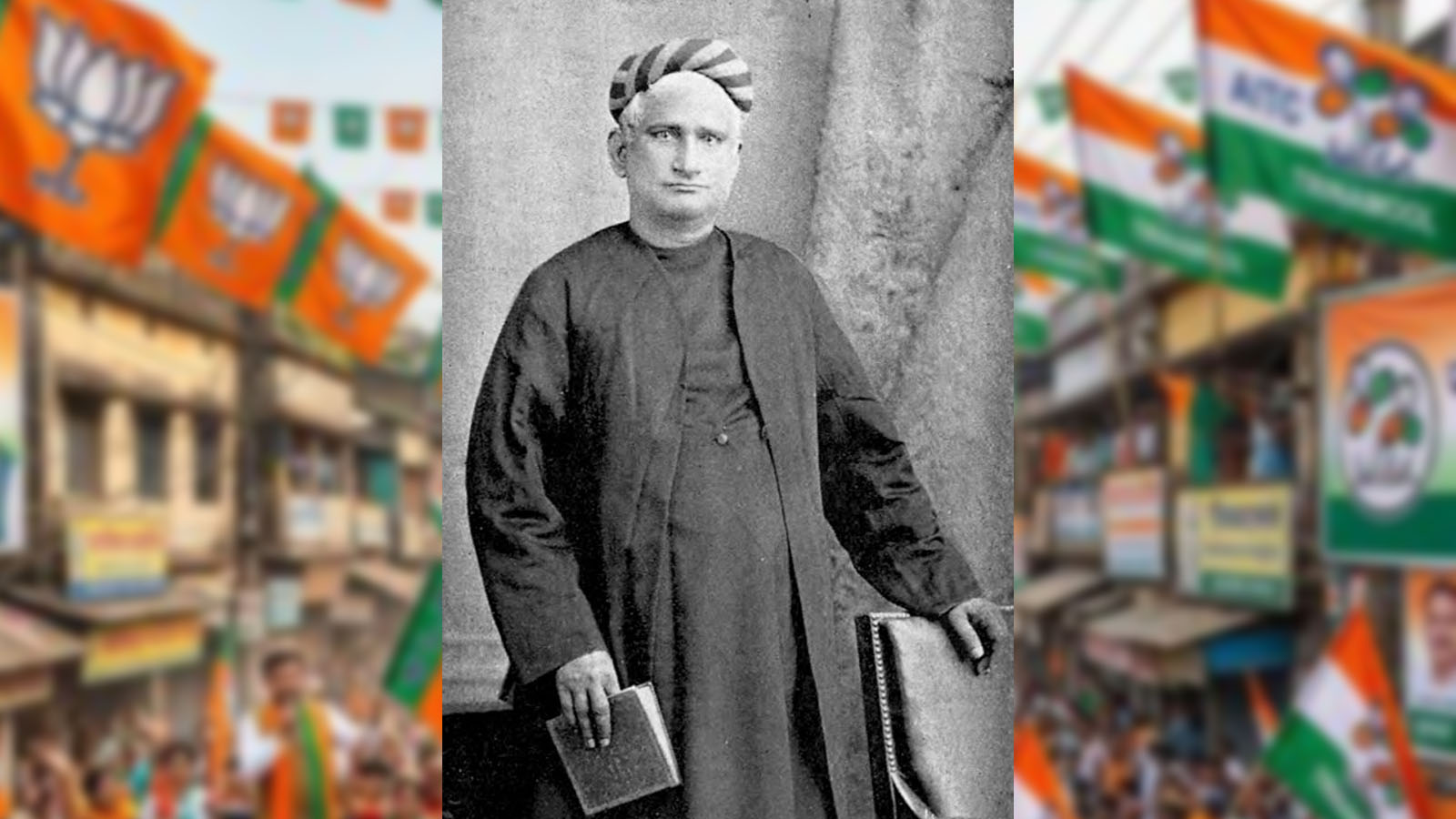

The riverfront town of Naihati in West Bengal’s North 24 Parganas district, where 19th-century Bengali litterateur Bankim Chandra Chattopadhyay (1838-1894) was born nearly two centuries ago, has become an unlikely focal point in one of India’s fiercest political contests of 2026, aiming to secure the power corridors in Kolkata on May 4.
Also read: Record turnout in TN, Bengal: What’s behind the surge? | Talking Sense With Srini
The narrow lanes of Naihati, dotted with institutions named after the creator of the National Song, “Vande Mataram”, are now at the centre of the Bharatiya Janata Party’s (BJP) effort to weaponise Bengal’s literary heritage as a nationalist electoral plank, turning the legacy of one of the state’s greatest cultural icons into a campaign symbol.
BJP fields Bankim Chandra’s kin
The party saffron has even fielded Soumitra Chattopadhyay, a fifth-generation descendant of Bankim Chandra, in the Naihati Assembly constituency, betting that his predecessor can help bridge its long-standing cultural gap in Bengal.
For months, Prime Minister Narendra Modi’s government has amplified celebrations around the 150th anniversary of “Vande Mataram”, which fell in 2025, portraying the song as an embodiment of national pride while accusing opponents of diminishing its place in public life.
The Naihati Assembly constituency of West Bengal, which will be among 142 seats that will vote on April 29, 2026.
BJP leaders in Bengal have repeatedly invoked the song on the campaign trail, seeking to fold the ‘Emperor of Literature’ Bankim Chandra’s legacy into the party’s larger nationalism narrative.
In Naihati, where Bankim Chandra is woven into the town’s identity, that strategy is playing out most vividly.
“This is not just about one seat,” said Gautam Basuli, president of the BJP’s Naihati Mandal-2 unit, pointing to party posters featuring the author, the prime minister and the local candidate. “This is about reclaiming Bengal’s nationalist heritage, which has been compromised under Mamata Banerjee’s Trinamool Congress government.”
About Naihati Assembly constituency
♦ Located in North 24 Parganas district of West Bengal (southern part)
♦ Naihati is one of the 33 seats located in the district
♦ Once a seat which periodically went to the Left and the Congress, Naihati has been under the TMC’s control since 2011, when it first came to power
♦ TMC’s Partha Bhowmick served as Naihati MLA for three consecutive terms before becoming an MP in 2024. Sanat Dey succeeded him by dominating a by-election held the same year.
The effort points to the BJP’s broader challenge in Bengal as it seeks to root its Hindi-belt brand of Hindu nationalism in the state’s fiercely guarded regional identity.
Also read: Bengal’s high turnout signals pro-incumbency, says Netaji kin Chandra Bose | Interview
For years, the saffron party’s rivals, primarily the TMC, have portrayed it as culturally alien to Bengal, accusing it of appropriating Bengali icons while ignoring the state’s pluralist political traditions.
Chief Minister Mamata Banerjee has often countered BJP invocations of “Vande Mataram” by accusing the party of selectively using Bengal’s intellectual icons for electoral gain.
TMC candidate snubs BJP
Sanat Dey, the TMC candidate from Naihati which he swept in the 2024 by-elections, has dismissed the BJP’s pitch, arguing that “people of Naihati do not give importance to someone who has no connection with Bankim Chandra,” while questioning the rival candidate’s claim of lineage.
He also alleged that “in his electoral affidavit, the candidate mentioned that the Central Bureau of Investigation has filed a chargesheet against him in a forgery scam,” adding that the BJP was offering him political cover, an allegation the BJP has not responded to.
But by elevating Bankim Chandra, whose “Vande Mataram” became a rallying cry in India’s anti-colonial movement, the BJP believes it has found a figure who can marry Bengali pride with pan-Indian nationalism.
We have never judged a writer based on personal religious beliefs, but on the message of his work.
In his campaign outreach, the BJP’s Naihati candidate has stressed that the song’s legacy extends beyond Bengal, portraying it as a unifying national symbol rather than a regional cultural artefact.
As the BJP seeks to consolidate Hindu voters across states, the party is increasingly recasting regional cultural figures into a broader nationalist canon, from Bankim Chandra in Bengal to Veer Savarkar in Maharashtra and Subramania Bharati in Tamil Nadu. The idea is to anchor national politics in local memory.
BJP fielded Netaji’s grandnephew in 2016, 2019
In 2016, the BJP fielded Chandra Kumar Bose, the grandnephew of iconic Indian freedom fighter Netaji Subhas Chandra Bose, against Mamata in Bhabanipur in Kolkata. He lost. He also contested the 2019 Lok Sabha election from the state and lost that too. Earlier this month, Bose joined the TMC and said his decision to join the saffron party was a “historic mistake”.
Political analysts say the choice of Naihati is strategic.
“Bankim Chandra gives the BJP an emotional and ideological bridge into Bengal’s cultural consciousness,” said Kolkata-based political analyst Amal Sarkar. “By making ‘Vande Mataram’ an election issue, the party is trying to frame Bengal not as an exception to its nationalism, but as one of its original sources.”
That framing also revives debates over the relevance of Bankim Chandra in contemporary politics and the contested use of “Vande Mataram”, including concerns over its religious imagery and whether such symbols should shape electoral discourse.
Questioning the contemporary political use of the 19th-century figure, Dey said that while Bankim Chandra was “undoubtedly a very great writer”, it was unclear what relevance he held in today’s politics and whether voters would accept his legacy being turned into an election issue.
Also read: Why 2026 Bengal election resembles a military operation, not a ‘dance of democracy’
Rejecting attempts to question his claim of descent from the literary figure, Soumitra has positioned himself as deeply connected to Naihati’s cultural and historical identity, saying his campaign is about preserving the town’s legacy rather than importing politics from outside.
Though “Vande Mataram” is celebrated as a patriotic anthem, its imagery of the nation as a Hindu goddess has long drawn criticism from some Muslim groups, and only the first two stanzas were adopted as India’s national song after Independence.
The BJP has revived those debates by accusing the Congress and other parties of diluting the song for “appeasement politics”.
On the other hand, opponents accuse the BJP of turning a shared anti-colonial symbol into a partisan slogan.
Some academics in Naihati have also raised concerns over the renewed focus on the song, cautioning against attempts to frame a literary figure through a narrow religious or political lens.
“Recently, a specific trend is being observed where Bankim Chandra is being politicised,” said Dr Ratan Nandi, director of the Bankim-Bhavan Research Centre in Naihati and secretary of the Bangiya Sahitya Parishad, which seeks to promote Bengali literature.
‘Never judged a writer over religious beliefs’
He added that while Bankim Chandra’s religious identity reflected his time, “we have never judged a writer based on personal religious beliefs, but on the message of his work.”
Nandi said the renewed focus risked deepening divisions, arguing that there was now “more interest in creating a situation around Bankim Chandra than in actual study,” with the issue at times framed in ways that could alienate sections of the Muslim community.
“Religion is a personal matter, and reducing a literary figure to a particular religious identity for political gain moves away from the broader humanist ideals his work represents,” he said.
Those tensions have spilt into Bengal’s campaign rhetoric.
At rallies, BJP leaders have accused the TMC of disrespecting “Vande Mataram”, while TMC leaders have countered that the BJP is exploiting Bankim Chandra’s memory to polarise voters. Last year, a major controversy erupted when Modi referred to Bankim Chandra as “Bankim da” (elder brother Bankim) in the Lok Sabha, earning the TMC’s wrath, as the Bengal outfit called it “disrespectful” towards the icon and “culturally insensitive”.
Also read: Second disenfranchisement? Travel hurdles rob Bengal’s migrant workers of their votes
Rejecting criticism that his party had neglected the author’s legacy, Dey said institutions such as Bankim Chandra’s museum and research centre in Naihati had been developed under the Mamata government since 2011.
The controversy has ensured that a literary work written in the 1870s now sits at the centre of a modern political battle over identity, nationalism and ownership of patriotic symbols.
Politics and arithmetic
The BJP’s gamble in Naihati is as much about political signalling as electoral arithmetic.
The constituency has been a TMC stronghold for over a decade (the North 24 Parganas is a TMC bastion in fact), and the BJP faces a formidable local organisation backed by welfare-driven voter loyalty.
With national politics increasingly shaped by battles over history, memory and symbolism, the contest in Naihati offers a glimpse into how the BJP is expanding its ideological vocabulary, less through economic promises than through cultural reclamation.
Also read: Bengal elections: Peace came to Jangalmahal, but prosperity didn’t follow | Ground Report
In that effort, Bankim Chandra, who imagined the nation as a sacred mother, has become a modern electoral asset.
In Naihati, where his name adorns educational institutions, community halls, roads and libraries, his legacy is now being projected as part of the BJP’s idea of India.
Naihati votes on April 29, when Bengal holds its second and final phase of polling.

Comments are closed.