
If you’re shopping for a high-quality small vehicle for the first time, you may be curious about what certain terms like “compact” actually mean. Many drivers likely believe that compact is the same as tiny, because of the car’s exterior dimensions. But according to the U.S. Environmental Protection Agency (EPA), passenger vehicle classification is determined by other criteria.
The EPA uses a vehicle’s interior volume index, which combines dimensions for both the passenger area and cargo space, to classify it. If that sum is at least 100 cubic feet but less than 110 cubic feet, the vehicle is considered a compact car. This places the compact car between the subcompact and midsize categories. So even if two cars have similar exterior measurements, they could end up in different size classes depending on how much usable space they have inside.
Compact cars offer some advantages over larger vehicles, including the fact that they tend to be less expensive, depending on the make and model. Additionally, their smaller size may make them easier for some drivers to maneuver and park. Some compact cars also rank as some of the most fuel-efficient cars you can buy, though that will vary by the make and model. It’s not all good, though; compact cars will come with tradeoffs, including less interior volume than larger vehicles and possibly reduced engine power than larger vehicles as well, due to smaller engines.
The evolution of compact cars in the US
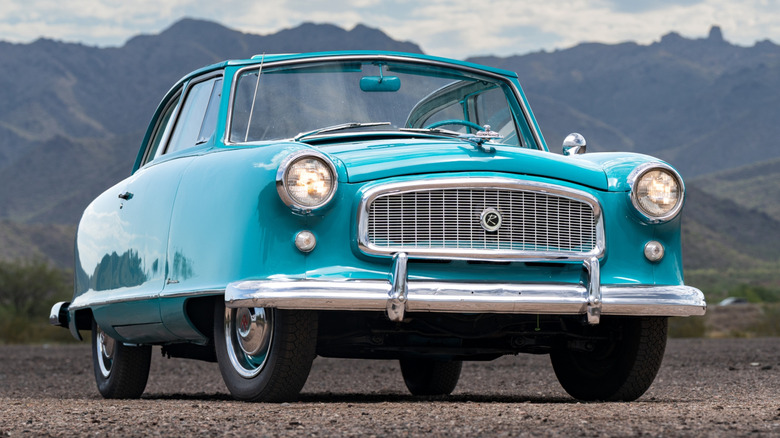
There was a time when larger cars dominated the U.S. market. But a few manufacturers began exploring compact cars after World War II because they saw the potential for smaller and more efficient vehicles. This led Nash to design the Rambler, a vehicle believed to be the first successful American compact car. This new vehicle type offered buyers a smaller and more practical option that was also more affordable to own.
Compact cars gained a foothold in the years that followed, though their popularity rose and fell depending on driver preferences and economic conditions as well. This was especially true in the 1970s, as fuel economy became a bigger concern for buyers, which helped shine a spotlight on cars like the very first Honda Civic. As time went on, compact cars evolved, becoming more reliable and more capable. Eventually, models like the Toyota Corolla proved that smaller cars were much more than just budget cars.
Larger SUVs and trucks have dominated American roads in recent years, but that does not mean that compact cars have lost their popularity. In fact, rising vehicle costs have sparked renewed interest in smaller and more affordable options. Modern compact vehicles offer more features, improved efficiency, and greater practicality than their predecessors. So, in spite of how many larger vehicles are on the highways, smaller cars are still an important part of today’s market.