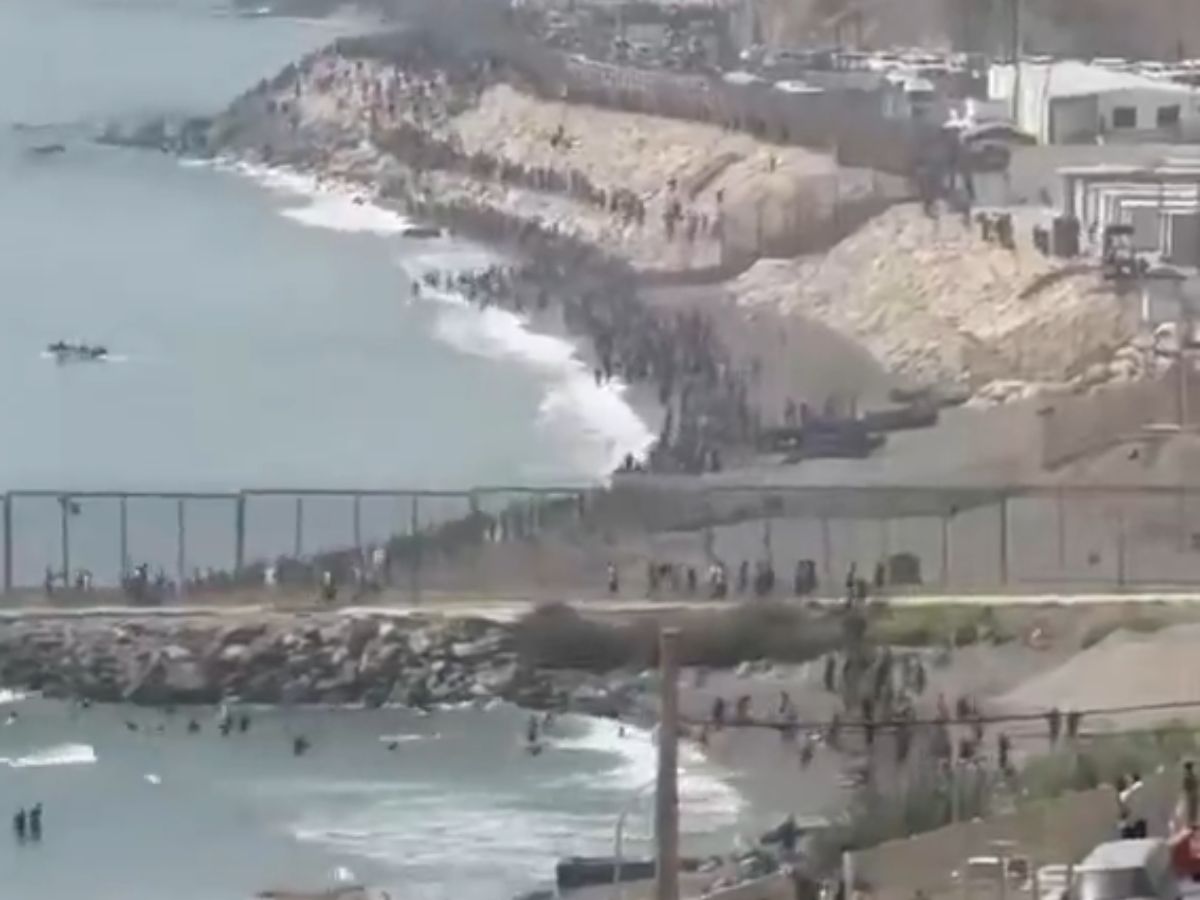
Spain has rushed troops and hundreds of additional police personnel to its North African enclave of Ceuta after one of the largest migrant crossings since 2021 saw between 2,000 and 3,000 people enter the territory from neighbouring Morocco on Thursday, July 30. Many migrants swam around the Tarajal breakwater using inflatable tubes and other makeshift flotation devices, while others forced their way through a border gate or climbed the border fence after security forces were overwhelmed. According to the BBC, at least 15 people drowned during the attempt, while Reuters reported that at least nine bodies were recovered. The sudden influx overwhelmed reception centres, forcing hundreds to sleep outdoors as authorities moved to declare a national emergency.
“The situation is absolute chaos,” said Rachid Sbihi, head of an association representing Spain’s Civil Guard officers in Ceuta, speaking to The Associated Press. He said thousands had crossed the frontier and that the border had “totally collapsed.”
What is Ceuta and why does it matter?
Ceuta is a small Spanish territory on the northern coast of Morocco. Although it sits on the African continent and shares a land border with Morocco, it is legally part of Spain and therefore the European Union. Alongside Melilla, another Spanish enclave on Morocco’s Mediterranean coast, Ceuta forms the EU’s only land border with Africa.
It is precisely because of this exceptional position that it is considered an important gateway into Europe. Migrants who get to Ceuta enter into the physical territory of Spain and the EU and can apply for asylum. Nevertheless, entry into Spain itself is not automatic and has to be processed legally. The enclaves serve as a gateway to Europe for many migrants.
Why are people trying to reach Ceuta now?
The latest crossings were not random. Many migrants set off from the Moroccan town of Fnideq, just five kilometres from Ceuta, while others came from the nearby village of Belyounech, where the border is even closer. From there, they attempt different routes: swimming around breakwaters, cutting through fences with bolt cutters, or rushing border gates in large coordinated groups.
Spanish authorities say smuggling networks played a role in encouraging the crossings, particularly after a Supreme Court ruling limited the immediate return of migrants arriving in Ceuta by sea without due process. Officials believe this legal change may have been exploited by traffickers to push people toward the enclave. Rights groups, however, argue that most migrants are unlikely to have been aware of such legal developments and are instead driven by desperation.
Moroccan security forces responded with water cannons and other crowd-control measures to prevent further departures, but the scale of movement still overwhelmed border defences.
Why Ceuta has become a repeated migration flashpoint
The current crisis is not an isolated event. Ceuta has long been one of Europe’s most sensitive migration pressure points because of its geography and legal status. It is one of only two Spanish enclaves in North Africa, and together with Melilla it represents the EU’s only land border with the continent.
For migrants from sub-Saharan Africa, Morocco, and parts of the Middle East, reaching Ceuta is often seen as a symbolic and practical breakthrough into Europe. The enclave is heavily fortified, but its proximity to Morocco, sometimes just a few metres of water or fence makes it a constant target for mass crossing attempts.
The most dramatic precedent came in May 2021, when more than 10,000 people entered Ceuta over two days after Morocco loosened border controls during a diplomatic dispute with Spain over Western Sahara. That episode exposed how quickly migration flows can surge when political tensions shift, and it remains a reference point for today’s crisis.
What is driving repeated attempts to cross?
Motives for crossing are varied, yet clear. Poverty, joblessness, and limited prospects are frequently stated reasons by migrants for leaving their country of origin. Some are escaping war and instability. For migrants waiting at Fnideq and Belyounech, Ceuta is the nearest legal access point to Europe.
Smuggling networks are also believed to play a role, coordinating movements and encouraging group crossings at moments when border security appears weakened. Spanish officials say these networks adapt quickly to legal and enforcement changes, including court rulings and shifts in patrol strategy.
On the other hand, the physical nature of the region presents an enforcement challenge. This is because the proximity of Morocco to Ceuta, in addition to the presence of coastlines and well-trodden pedestrian paths, means that many people can cross at once.
Political fallout in Spain and Europe
In response to the latest surge, Spain has deployed 60 troops and an additional 200 police officers to reinforce security in Ceuta. Prime Minister Pedro Sánchez and Interior Minister Fernando Grande-Marlaska are expected to visit the enclave to assess the situation and meet local authorities.
Madrid has said it is working with Morocco to manage returns of those who entered irregularly, while ensuring that individuals seeking international protection are processed under asylum law.
The crisis has also triggered political reactions across Europe. Italian Prime Minister Giorgia Meloni said she was prepared to consider “extraordinary measures” and even raised the possibility of suspending the Schengen Area with Spain. “The images coming from Ceuta are striking and demonstrate, once again, that uncontrolled illegal immigration poses a concrete threat to the security of Europe’s borders,” she wrote on X. She added that Italy would convene government bodies to consider responses, including suspension of Schengen arrangements, though she did not detail how such a move would be implemented.
A recurring pressure point on Europe’s edge
The latest crossings have once again placed Ceuta at the centre of Europe’s migration debate. Its combination of geography, legal status, and proximity to Morocco makes it uniquely vulnerable to sudden surges.
While Spain and Morocco have recently emphasised cooperation on border management, the events of July 30 show how quickly that balance can be disrupted. With thousands attempting to cross in a single day, overwhelmed infrastructure, and renewed political tension, Ceuta remains one of the most volatile frontiers between Africa and Europe.
Also Read: Will Trump’s New $100,000 OPT Fee End H-1B Visa Dream For Indian Students?
Khalid Lateef is a Sub-Editor at NewsX Digital, specializing in Indian politics and global affairs. He also covers viral trending stories and major crime developments.
The post What Is Happening In Spain’s African City Of Ceuta And Why Thousands Are Fleeing From Morocco appeared first on NewsX.