
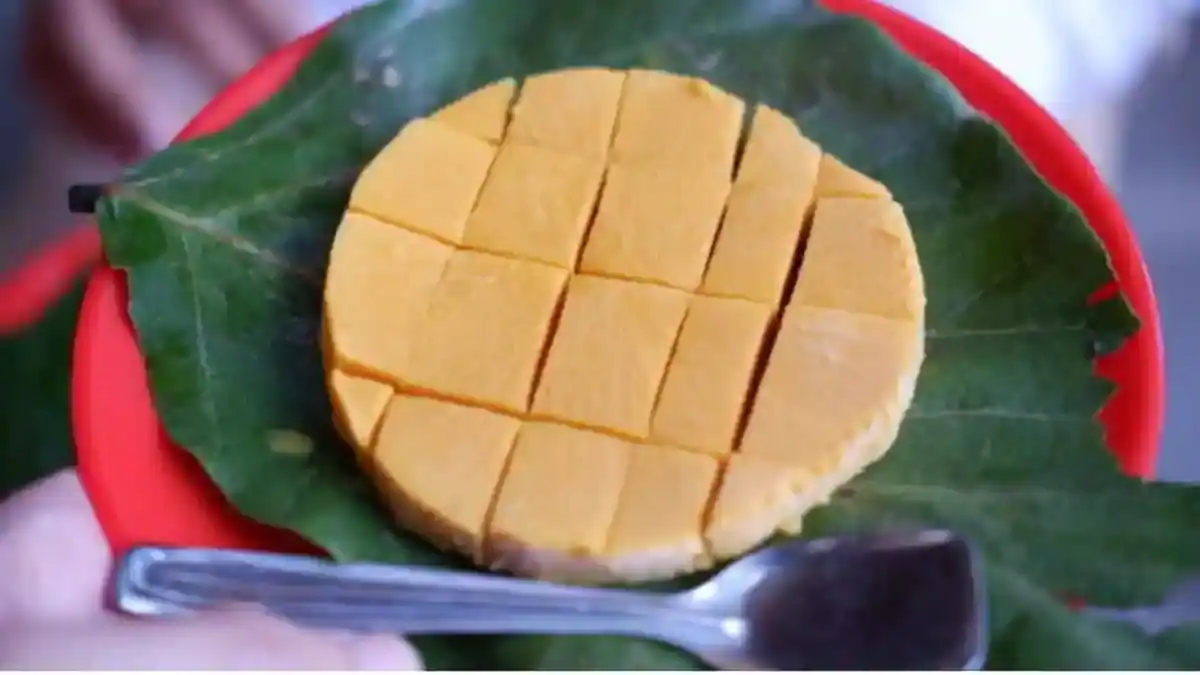

You have probably heard of kulfi. You have almost certainly had ice cream. But there is a good chance you have never encountered Malai Baraf, which is a shame because it is one of the most fascinating things Indian dairy tradition has ever produced. The name translates literally to “cream snow” or “cream ice,” which immediately sets up an expectation, and then proceeds to completely upend it. Because Malai Baraf, in its most traditional and authentic form, contains absolutely no ice. Not a single frozen water molecule. Instead, it is made entirely using heat, patience, and the extraordinary properties of full-fat buffalo milk. It is, in the most literal sense, ice cream made out of fire.
Where Does Malai Baraf Come From?
The rugged terrains of Jammu, Himachal Pradesh, and the northern reaches of Punjab are home to many culinary anomalies that challenge modern gastronomic logic. Among these, Malai Baraf stands out as a fascinating paradox. It is a mountain food, born in places where buffalo milk is abundant, wood fires burn steadily through the day, and the cool, dry air does half the work that a refrigerator might do elsewhere.
In the high altitudes and cool climates of the north, the concept of baraf or ice often refers more to the appearance and the cooling sensation of a dish rather than its physical state or the method of its creation. So when people in these hill communities called something “baraf,” they did not necessarily mean it was cold in the conventional sense. They meant it felt cool and refreshing when eaten. That distinction is the key to understanding Malai Baraf — and honestly, it is a rather elegant piece of culinary wordplay.
What Exactly Is Malai Baraf?
Malai Baraf is essentially a hyper-concentrated milk solid that achieves its structural integrity through hours of slow boiling. While modern ice cream relies on the rapid formation of tiny ice crystals through churning and sub-zero temperatures, Malai Baraf relies on the density of milk fats and the removal of water content to create a mouthfeel that is remarkably similar to a frozen custard.
Think of it this way. When you reduce full-fat milk down to a dense, almost solid state, the natural fats in the milk create a rich, coating quality on the palate that tricks your senses into perceiving coolness. Add to that the naturally chilly mountain air in which it is made and served, and you have something that genuinely feels like a frozen dessert without a freezer in sight.
The artisans begin with vast quantities of full-fat buffalo milk, prized for its high cream content. This milk is poured into large, wide-mouthed iron vessels known as kadhais. These vessels are placed over a steady wood fire, which is the heart of the entire operation. The choice of wood is not accidental: local varieties are used to provide a consistent, manageable heat that does not scorch the milk but allows it to simmer at a precise temperature for hours.
The Making: Heat as the Ingredient
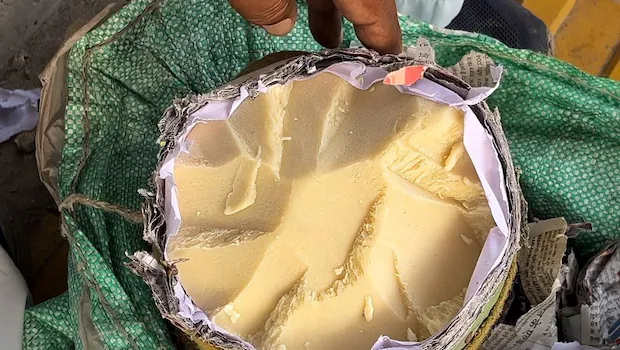
Photo Credit: Instagram/@shiva_soule_food_vlogs
The maker must constantly stir the milk, scraping the sides of the iron pot where the cream tends to stick and caramelise. This constant movement ensures that the proteins and fats do not separate in an unappealing way, but rather integrate into a thick, luscious texture.
Over several hours, the milk reduces to a fraction of its original volume. As the water evaporates, the natural sugars in the milk, known as lactose, undergo a subtle Maillard reaction. This is what gives Malai Baraf its characteristic off-white or pale golden hue and a deep, nutty flavor profile. That gentle browning and caramelisation is not a side effect — it is the whole point. This is what makes Malai Baraf taste different from plain rabri or regular khoya.
The absence of artificial flavorings is another hallmark of the traditional method. While some makers might add a sprinkle of sugar, crushed cardamom or a few strands of saffron, the primary hero is the milk itself. The richness is so profound that even a small portion is deeply satisfying.
The Texture: Danedar and Dense
One of the most distinctive qualities of Malai Baraf is what it feels like in your mouth. It does not melt into a puddle the moment it is served. Instead, it maintains its form, allowing the eater to savor the richness. It has a grainy, velvety quality that is often described as danedar, a term used in Indian confectionery to denote a desirable, tiny-grained texture. This graininess comes from the milk solids that have clumped together during the reduction process, providing a satisfying bite that is entirely different from the smooth, oily finish of many commercial ice creams.
The serving tradition is equally lovely. Following age-old customs, the thick cream is scooped out and placed onto a fresh leaf, usually from local trees like the Sal or Banyan. The tannins in the leaf are said to interact with the warm or room-temperature Malai Baraf, adding a subtle astringency that cleanses the palate. It is the kind of food that comes with its own biodegradable plate, which is both practical and quietly poetic.
Malai Baraf vs. Kulfi: What Is Actually the Difference?
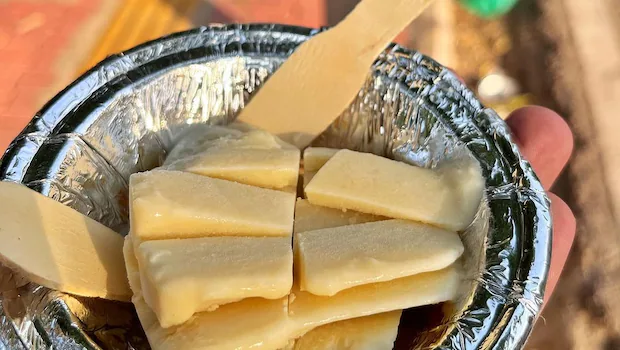
Photo Credit: Instagram/@shiva_soule_food_vlogs
The question often arises about the difference between Malai Baraf and Kulfi, both rooted in concentrated milk but distinct products. Kulfi, a traditional frozen dairy dessert from the Indian subcontinent, is often called Indian ice cream but differs significantly from its Western counterpart. It is denser and creamier due to the absence of air during freezing. Originating in 16th-century Delhi during the Mughal era, kulfi was crafted in royal kitchens using concentrated, evaporated milk, flavored with pistachios and saffron, packed into metal cones, and frozen with slurry ice.
The key difference lies in their preparation: kulfi is frozen using a concentrated milk base set with cold, traditionally a salt-and-ice brine in sealed metal molds. Malai Baraf, however, is not frozen; it sets through density and ambient temperature. Kulfi offers a firm, icy bite that softens as it warms, while Malai Baraf is soft, grainy, and akin to a thick rabri. Indian food regulations require kulfi to have at least 10% milk fat, 3.5% protein, and 36% total solids, whereas Malai Baraf lacks formal regulation, existing in culinary tradition. In flavour, kulfi is sweeter and aromatic, with pistachios and cardamom, while Malai Baraf focuses on the milk itself, offering a quiet, honest satisfaction.
How to Make Malai Baraf at Home
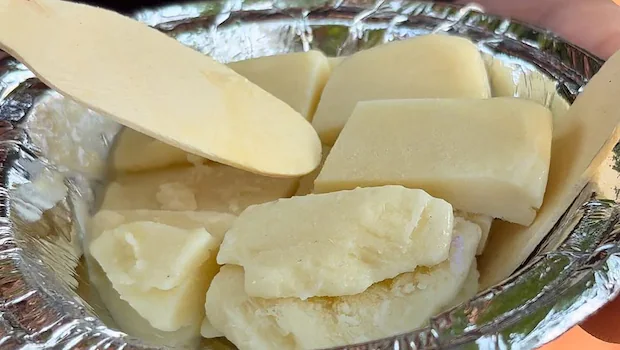
Photo Credit: Instagram/@shiva_soule_food_vlogs
You do not need a mountain, a wood fire, or a kadhai the size of a wheel to make a home version of Malai Baraf. What you do need is time, full-fat milk, and patience.
Ingredients (serves 4 to 6):
- 2 liters of full-fat buffalo milk or full-cream cow’s milk
- 3 to 4 tablespoons (adjust to taste) of sugar
- 3 to 4 (crushed) of green cardamom pods
- A few strands of saffron soaked in 2 tablespoons of warm milk, and optionally a handful of crushed pistachios or almonds for garnish.
Method
Pour milk into a wide, heavy-bottomed vessel for faster evaporation. Heat on medium flame until boiling, stirring to prevent skin. Reduce to low-medium and simmer, stirring frequently and scraping the sides with a spatula. This requires attention and effort, as the cream layer forms repeatedly, folding it back in for richness. After 45 minutes to an hour, the milk should reduce to one-third its volume. Add sugar, saffron milk, and crushed cardamom, stirring for 10 to 15 minutes until thick and pale gold. Remove from heat and cool to room temperature; do not refrigerate immediately. For a firmer texture, refrigerate for an hour, but the traditional experience is at room temperature. Serve on a fresh leaf, in a bowl, or with crushed pistachios. This process is akin to making intense khoya, not ice cream, and Malai Baraf is khoya cooked with intention, enjoyed ceremoniously.
Why Malai Baraf Deserves More Attention
In an era where Indian desserts gain global recognition, Malai Baraf remains largely unknown outside its region. It celebrates its ingredients honestly, free from modern stabilizers. This rarity is worth seeking. Malai Baraf highlights Indian culinary intelligence, showcasing how, before refrigeration and food science, someone in northern India used fire to create something ice-like. This isn’t just a recipe; it’s applied genius passed through generations of dairy artisans. Next time you grab commercial ice cream, remember that in Himachal Pradesh, someone is serving dense, golden Malai Baraf on a Sal leaf over a wood fire, a tradition with superior taste.

Comments are closed.