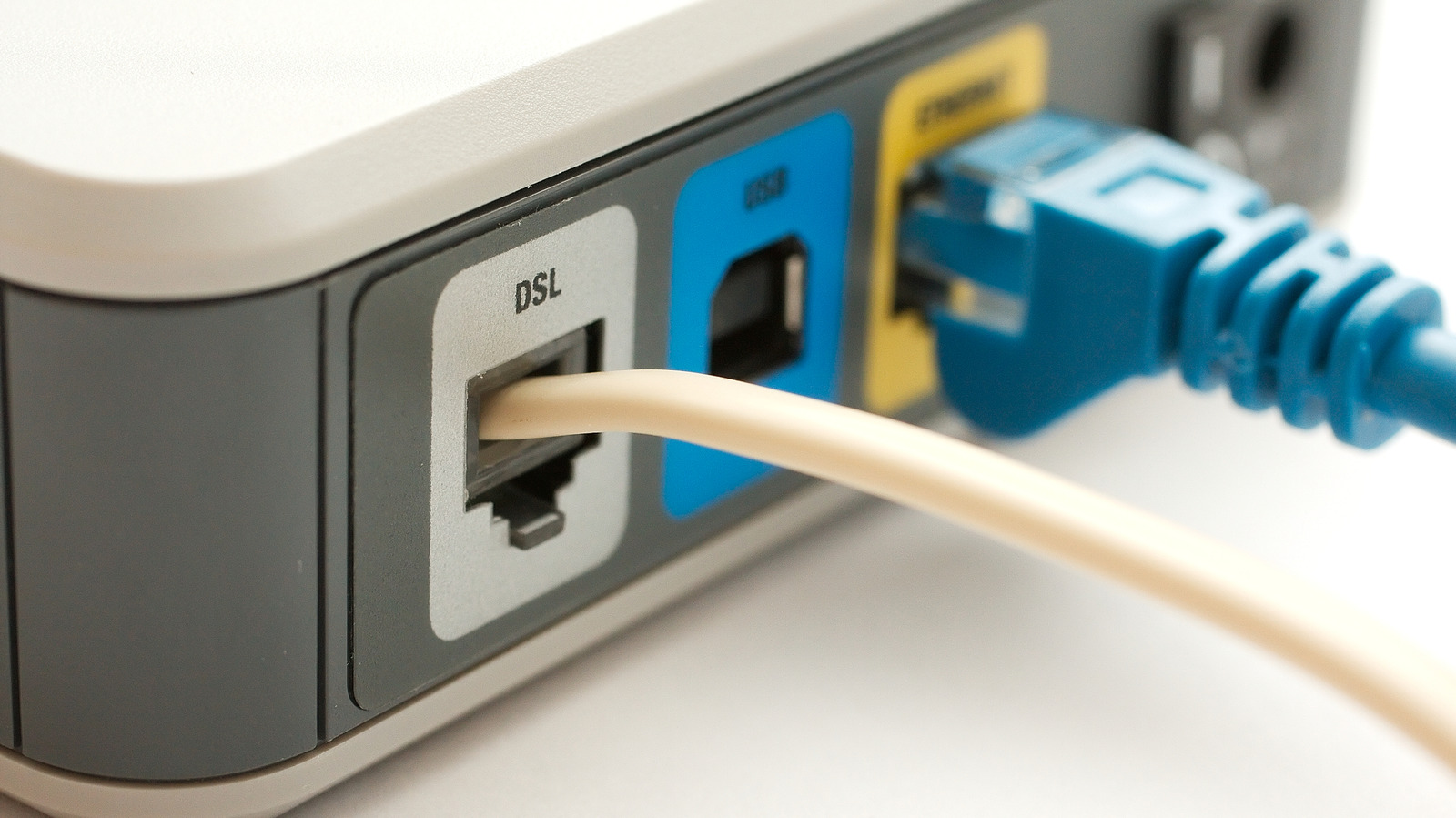
Not too long ago, most homes and businesses in the U.S. were wired for landline services. You had copper telephone lines running either underground or overhead that branched into various homes. So it made sense to run the internet through existing infrastructure. That’s exactly what DSL, short for digital subscriber line, did. A modem or router’s dedicated DSL port ran a wire that connected to the home’s phone jack. It all worked beautifully: since voice sat on a lower band than DSL data, both could share the same line.
Specifically, the DSL port sits on a device that merges a modem and a router, which is different from an access point, into a single box called a DSL modem router. The modem part of the device uses the port to communicate with the internet provider over the phone line via signals. These signals are translated into regular Ethernet data, which is then fed to the devices at home via Wi-Fi and LAN ports. That said, the DSL port itself doesn’t carry Ethernet data, so it’s incompatible with Ethernet cables. The DSL port takes an RJ11 phone plug, which measures 6 mm by 9.5 mm. It’s slightly smaller than the 6 mm by 11 mm RJ45 Ethernet plug.
Supporting DSL also requires a DSL modem, which the average router lacks, so if you do need DSL support, you’d have to hook it up to a separate one instead. Today, very few routers support DSL. Because of these hardware differences, DSL routers are usually labeled as such. A good example is the Asus DSL-AX82U, a Wi-Fi 6 modem router with a DSL port.
Where DSL stands today
Asymmetric digital subscriber line (ADSL) and very-high-bit-rate digital subscriber line (VDSL) are two flavors of DSL. ADSL is the version mainly used in homes and allows asymmetrically faster downloads than uploads. Meanwhile, VDSL is the more modern, faster version of DSL, with a common profile reaching download speeds up to 100 Mbps and upload speeds up to 50 Mbps. That said, you’ll have a hard time finding a DSL modem router like the Asus DSL-AX82U in the U.S. They’re more commonly sold in Europe and Australia, where DSL is still commonplace.
That’s not to say DSL is alien to the U.S. While the share of copper-line connections is tiny at 5.4% of the country’s 135 million fixed connections (as of 2025), according to an FCC reportit still represents a significant number at 7.3 million. However, these connections are declining rapidly. The 7.3 million figure is down from 18.6 million in June 2021, meaning it’s fallen a whopping 60% in roughly four years.
There’s a good reason for this. The same FCC report says that the median download speed on copper lines is just 24 Mbps, which may not match the internet speeds you need for quality HD streaming and gaming. Today, people are increasingly upgrading to fiber and enjoying vastly superior speeds as a result, with a median of 940 Mbps.
At the same time, internet providers are simply winding things down. AT&T stopped taking new DSL customers on October 1, 2020, though it continues to provide existing ones with service. That won’t be for long, though, since the carrier plans to retire most of its copper network by 2029 — one of several big changes by AT&T.