
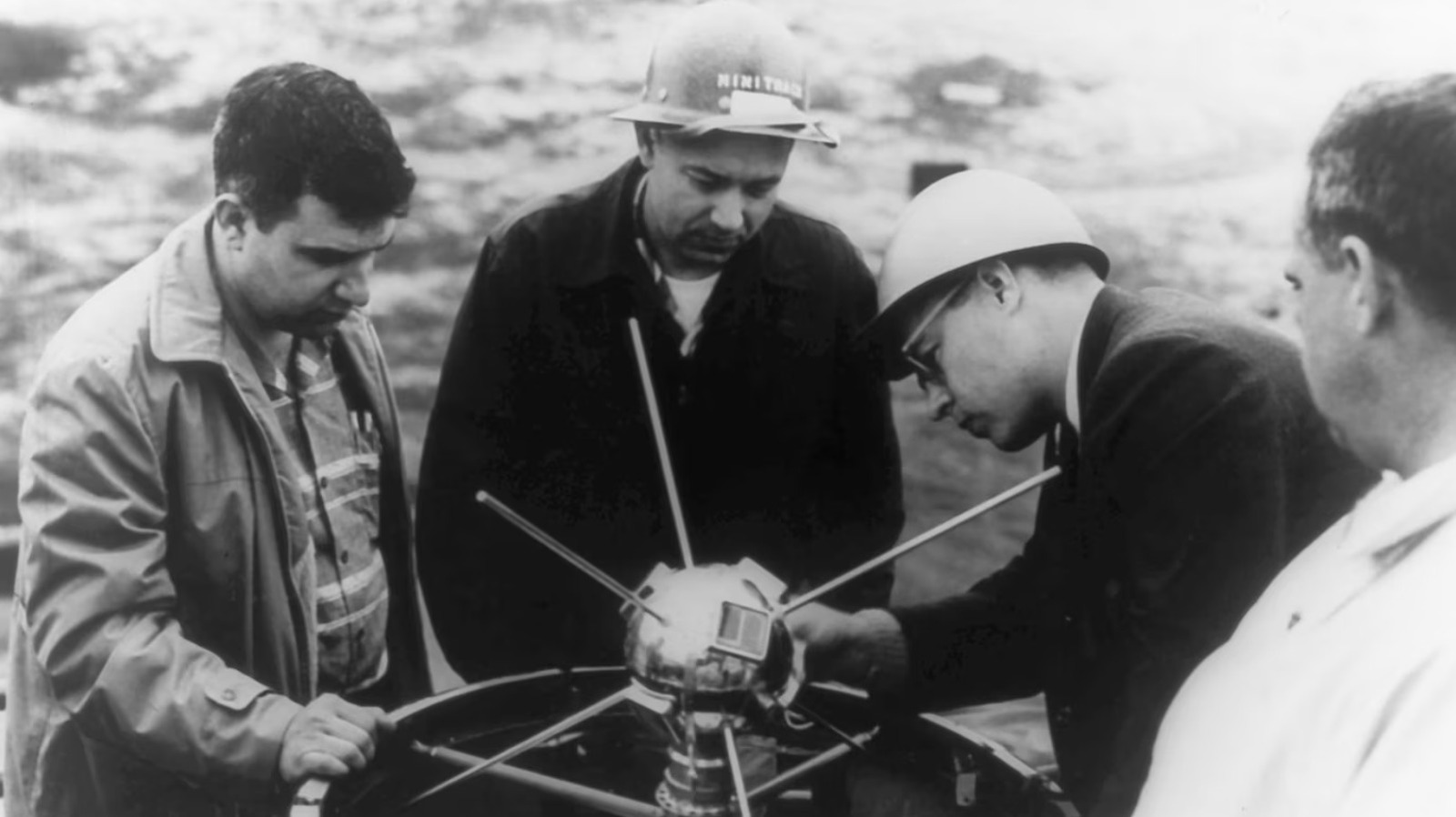

Satellites are essential to our daily lives, enabling everything from broadband internet to mobile phone service, GPS, and much more. While it’s easy to imagine that the three main satellite types are the products of modern technology, the truth is that they’ve been around for decades. The oldest one still orbiting Earth went up in 1958 and was actually the second successful satellite put into service by the United States.
The U.S. Naval Research Laboratory built Vanguard 1 for the International Geophysical Year, an 18-month multinational Earth study. Vanguard 1’s mission was to collect scientific data on Earth’s atmosphere and how space would affect satellites. It was also designed to demonstrate new technology, becoming the first orbital satellite powered by solar cells. The batteries on Vanguard 1 only lasted 20 days, but the solar cells continued to provide power until 1964. This marked a major milestone in the early days of U.S. space exploration and an important stage in the evolution of solar energy.
Scientists initially believed that Vanguard 1 could remain in space for thousands of years based on its orbital lifespan. But that number was later revised to about 240 years to account for new understandings of cosmic drag. While it no longer transmits data, Vanguard 1’s time in orbit has made it the focus of studies focusing on how manmade objects behave in Earth orbit over long periods.
The challenge of recovering Vanguard 1
As Vanguard 1’s journey around Earth continues, scientists and engineers have proposed different ideas for bringing the satellite back home. The first step would be determining its condition via imaging to ascertain whether recovery is even possible. Researchers involved in this effort believe that the satellite could be moved into a lower Earth orbit for retrieval, or even brought to the International Space Station for an eventual return. Once back on Earth, Vanguard 1 would be analyzed for long-term space exposure, including the effects of space radiation that all orbiting satellites endure.
Despite interest in recovering Vanguard 1, the idea has yet to move past the early discussion stage at the time of writing. Greenlighting a mission would require approval from NASA and the U.S. Naval Research Laboratory, both of which are connected to the satellite’s development and deployment. There are also some technical obstacles in play, including Vanguard 1’s current spin-stabilized motion, fragile antenna, and lack of a safe method of actually grabbing the satellite.
Additionally, such a recovery mission would not be cheap, with the total cost depending on the final design and specific technology used. Thus, any decision to move forward would likely require a high-level review, and the mission’s success would depend on whether a robotic or manned crew could safely capture Vanguard 1 to bring it home.

Comments are closed.